
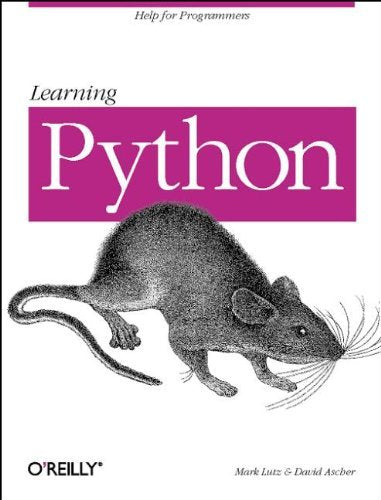
Title
Learning Python,Used
Sold by Ergodebooks, an authorized reseller.
Returns accepted within 30 days | support@ergodebooks.com
Shipping Information
- Free Standard Shipping — United States only
- Processing Time: 3–5 business days
- Estimated Delivery: 6–10 business days after dispatch
- Double-boxed, fully insured & discreetly packaged
- Tracking number sent via email once dispatched
Returns & Refund
Returns accepted within 30 days of delivery.
Damaged or Defective Item
Free return shipping + replacement or full refund
Wrong Item Received
Free return shipping + replacement or full refund
Change of Mind
Return shipping at customer's expense · 25% restocking fee applies
Payment Option

Learning Python is an introduction to the increasingly popular Python programming language. Python is an interpreted, interactive, objectoriented scripting language. Python is growing in popularity because: It is available on all important platforms: Windows NT, Windows 95, Windows 98, Linux, all major UNIX platforms, MacOS, and even the BeOS. It is opensource software, copyrighted but freely available for use, even in commercial applications. Its clean objectoriented interface makes it a valuable prototyping tool for C++ programmers. It works well with all popular windowing toolkits, including MFC, Tk, Mac, X11, and Motif.Learning Python is written by Mark Lutz, author ofProgramming Python and Python Pocket Reference; and David Ascher, a vision scientist and Python user.This book starts with a thorough introduction to the elements of Python: types, operators, statements, classes, functions, modules, and exceptions. By reading the first part of the book, the reader will be able to understand and construct programs in the Python language. In the second part of the book, the authors present more advanced information, demonstrating how Python performs common tasks and presenting real applications and the libraries available for those applications.All the examples use the Python interpreter, so the reader can type them in and get instant feedback. Each chapter ends with a series of exercises. Solutions to the exercises are in an appendix.
⚠️ WARNING (California Proposition 65):
This product may contain chemicals known to the State of California to cause cancer, birth defects, or other reproductive harm.
For more information, please visit www.P65Warnings.ca.gov.
- Q: What is the page count of 'Learning Python'? A: The book 'Learning Python' has three hundred eighty-four pages. This extensive length covers a wide range of topics in Python programming.
- Q: What type of binding does 'Learning Python' have? A: This book is a paperback edition. The paperback binding makes it lightweight and portable for readers.
- Q: Who are the authors of 'Learning Python'? A: The authors are Mark Lutz and David Ascher. Mark Lutz is known for his expertise in Python programming.
- Q: How do I start learning with 'Learning Python'? A: You can start by reading the first part of the book, which covers fundamental concepts. It introduces types, operators, and functions essential for programming in Python.
- Q: Is 'Learning Python' suitable for beginners? A: Yes, it is suitable for beginners. The book begins with an introduction to Python, making it accessible for those new to programming.
- Q: Are there exercises in 'Learning Python'? A: Yes, each chapter ends with exercises. The solutions to these exercises are provided in an appendix to help reinforce learning.
- Q: How should I care for my copy of 'Learning Python'? A: To keep it in good condition, store it in a dry place away from direct sunlight. Handle it gently to avoid creases and tears.
- Q: Is 'Learning Python' safe for all ages? A: Yes, the book is appropriate for all ages. It does not contain any adult content and is focused on educational material.
- Q: Can I use 'Learning Python' for self-study? A: Yes, it is ideal for self-study. The book is structured to guide readers through concepts with practical examples and exercises.
- Q: What if my copy of 'Learning Python' arrives damaged? A: If it arrives damaged, you can initiate a return process with the retailer. Most sellers have customer service options to assist with returns.
- Q: Does 'Learning Python' cover advanced topics? A: Yes, the second part of the book presents advanced information. It covers real applications and libraries available in Python.
- Q: Is there a focus on practical examples in 'Learning Python'? A: Yes, the book includes practical examples throughout. Readers can type these examples directly into the Python interpreter for instant feedback.
- Q: What platforms is Python available on as mentioned in 'Learning Python'? A: Python is available on Windows NT, Windows 95, Windows 98, Linux, all major UNIX platforms, MacOS, and even BeOS. This wide availability enhances its accessibility.
- Q: How does 'Learning Python' help with programming skills? A: The book teaches essential programming concepts and provides exercises to practice. This structured approach helps build foundational skills in Python.
- Q: Is 'Learning Python' open-source software? A: Yes, Python is open-source software. This means it is freely available for use, including in commercial applications.
- Q: Can I use 'Learning Python' for commercial projects? A: Yes, you can use the knowledge gained from this book for commercial projects. Python’s open-source nature allows for such applications.