
Title
LearningBased Robot Vision,Used
Sold by Ergodebooks, an authorized reseller.
Returns accepted within 30 days | support@ergodebooks.com
Shipping Information
- Free Standard Shipping — United States only
- Processing Time: 3–5 business days
- Estimated Delivery: 6–10 business days after dispatch
- Double-boxed, fully insured & discreetly packaged
- Tracking number sent via email once dispatched
Returns & Refund
Returns accepted within 30 days of delivery.
Damaged or Defective Item
Free return shipping + replacement or full refund
Wrong Item Received
Free return shipping + replacement or full refund
Change of Mind
Return shipping at customer's expense · 25% restocking fee applies
Payment Option

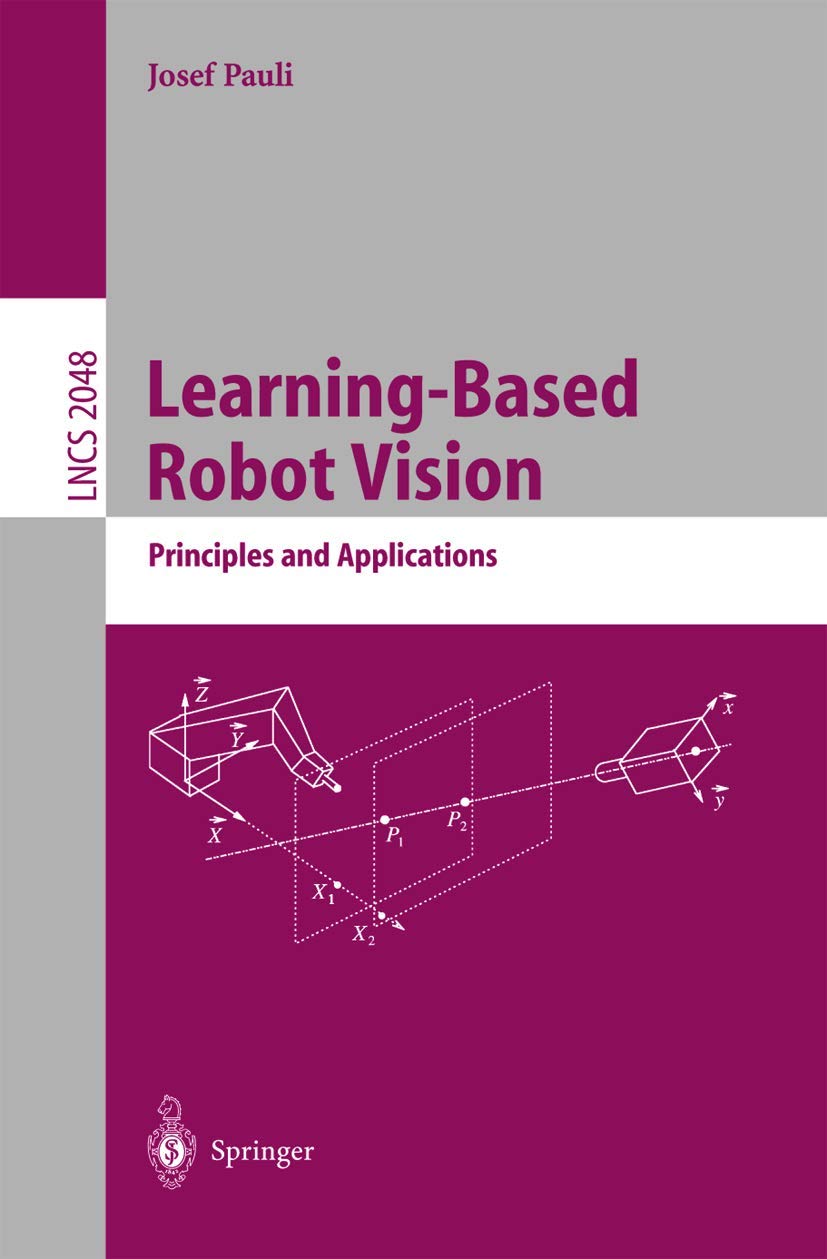
Industrial robots carry out simple tasks in customized environments for which it is typical that nearly all e?ector movements can be planned during an line phase. A continual control based on sensory feedback is at most necessary at e?ector positions near target locations utilizing torque or haptic sensors. It is desirable to develop newgeneration robots showing higher degrees of autonomy for solving highlevel deliberate tasks in natural and dynamic en ronments. Obviously, cameraequipped robot systems, which take and process images and make use of the visual data, can solve more sophisticated robotic tasks. The development of a (semi) autonomous cameraequipped robot must be grounded on an infrastructure, based on which the system can acquire and/or adapt taskrelevant competences autonomously. This infrastructure consists of technical equipment to support the presentation of real world training samples, various learning mechanisms for automatically acquiring function approximations, and testing methods for evaluating the quality of the learned functions. Accordingly, to develop autonomous cameraequipped robot systems one must ?rst demonstrate relevant objects, critical situations, and purposive situationaction pairs in an experimental phase prior to the application phase. Secondly, the learning mechanisms are responsible for quiring image operators and mechanisms of visual feedback control based on supervised experiences in the taskrelevant, real environment. This paradigm of learningbased development leads to the concepts of compatibilities and manifolds. Compatibilities are general constraints on the process of image formation which hold more or less under taskrelevant or accidental variations of the imaging conditions.
⚠️ WARNING (California Proposition 65):
This product may contain chemicals known to the State of California to cause cancer, birth defects, or other reproductive harm.
For more information, please visit www.P65Warnings.ca.gov.