If you have any questions, you are always welcome to contact us. We'll get back to you as soon as possible, withing 24 hours on weekdays.
Customer service
All questions about your order, return and delivery must be sent to our customer service team by e-mail at yourstore@yourdomain.com
Sale & Press
If you are interested in selling our products, need more information about our brand or wish to make a collaboration, please contact us at press@yourdomain.com
Help
If you have any questions, you are always welcome to contact us. We'll get back to you as soon as possible, withing 24 hours on weekdays.
Customer service
All questions about your order, return and delivery must be sent to our customer service team by e-mail at yourstore@yourdomain.com
Sale & Press
If you are interested in selling our products, need more information about our brand or wish to make a collaboration, please contact us at press@yourdomain.com
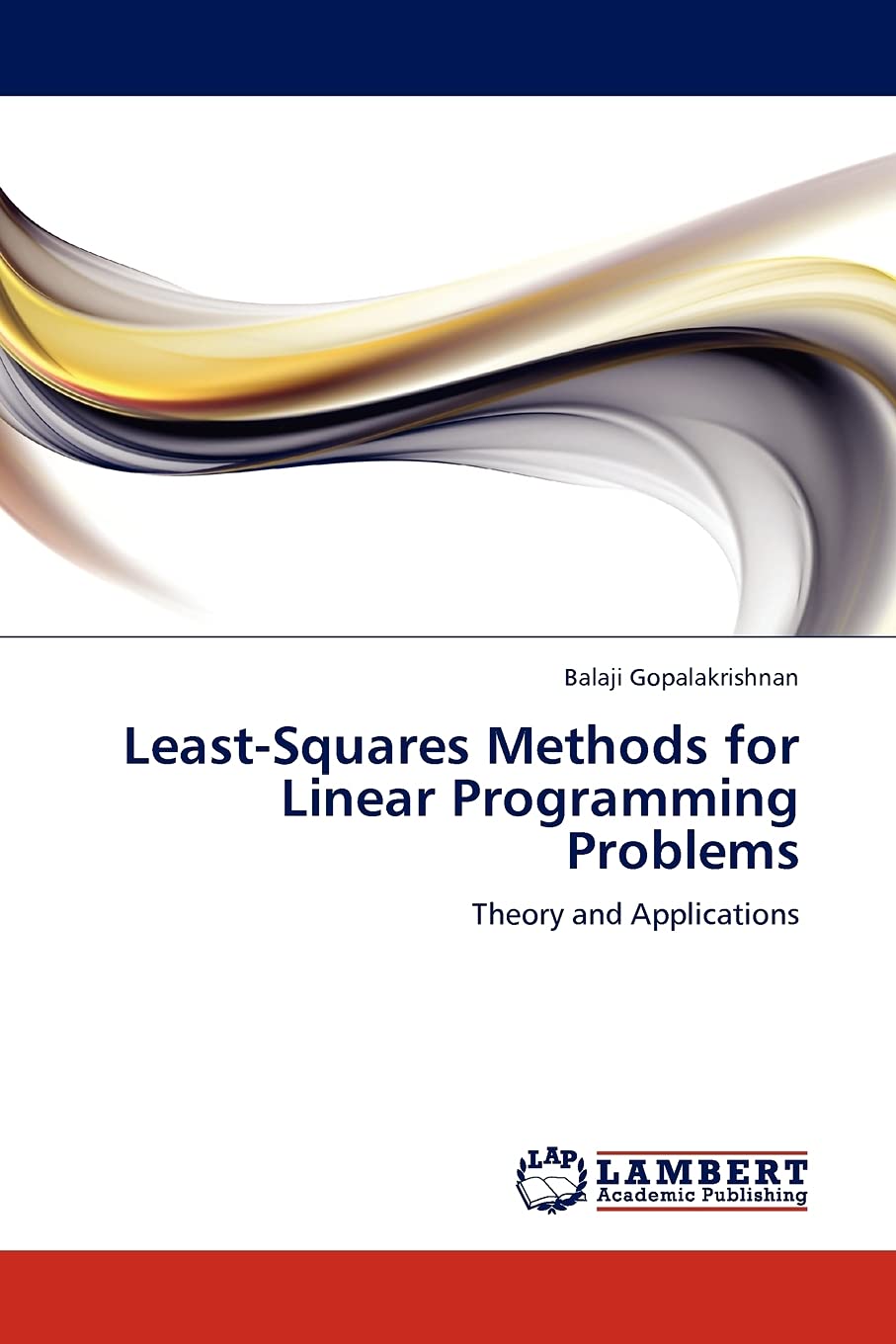
Linear programming has evolved over the years, due tosustained research and testing,as an excellent mathematical tool for solving manytheoretical and practical problems.Yet, escalating problem sizes in practical problemspose serious challenges for the verybest linear programming codes, running on the fastestcomputing hardware. New linearprogramming solution techniques have to developed tomeet these challenges. Theresearch performed in this book intends to addressthis issue through a comprehensivestudy of leastsquares methods for solving linearprogramming problems.We have developed two new linear programmingalgorithms based on leastsquarestheory. A Combined Objectives LeastSquares (COLS)algorithm uses a NonNegativeLeastSquares (NNLS) algorithm framework for solvingboth the Phase I and Phase IIlinear programming problems. A LeastSquaresPrimalDual (LSPD) algorithm usesNNLS solutions by solving small NNLS problems tosolve relatively larger linear programmingproblems. These algorithms are impervious todegeneracy. Computationalresults for the algorithms shows a superiorperformance over the simplex algorithmon a wide range of linear programming problems.
⚠️ WARNING (California Proposition 65):
This product may contain chemicals known to the State of California to cause cancer,
birth defects, or other reproductive harm.
For MAP (Minimum Advertised Price) violations and Intellectual Property (IP) or Trademark concerns, please contact:
support@ergodebooks.com
⚠️ California Proposition 65 Warning: Some products sold on this website may expose you to chemicals known to the State of California to cause cancer, birth defects, or other reproductive harm. For more information, visit www.P65Warnings.ca.gov.