If you have any questions, you are always welcome to contact us. We'll get back to you as soon as possible, withing 24 hours on weekdays.
Customer service
All questions about your order, return and delivery must be sent to our customer service team by e-mail at yourstore@yourdomain.com
Sale & Press
If you are interested in selling our products, need more information about our brand or wish to make a collaboration, please contact us at press@yourdomain.com
Help
If you have any questions, you are always welcome to contact us. We'll get back to you as soon as possible, withing 24 hours on weekdays.
Customer service
All questions about your order, return and delivery must be sent to our customer service team by e-mail at yourstore@yourdomain.com
Sale & Press
If you are interested in selling our products, need more information about our brand or wish to make a collaboration, please contact us at press@yourdomain.com
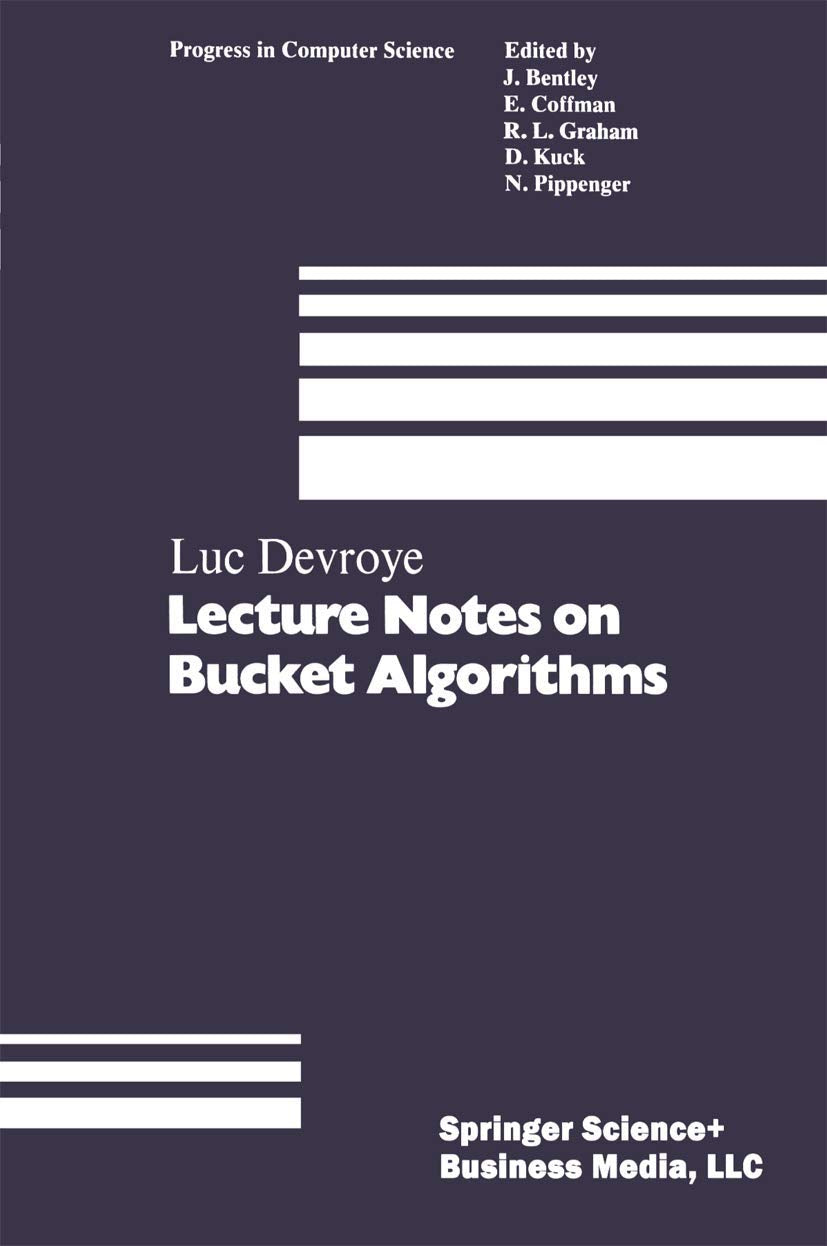
Hashing algorithms scramble data and create pseudouniform data distribu tions. Bucket algorithms operate on raw untransformed data which are parti tioned Into groups according to membership In equlslzed ddlmenslonal hyperrec tangles, called cells or buckets. The bucket data structure Is rather sensitive to the distribution of the data. In these lecture notes, we attempt to explain the connection between the expected time of various bucket algorithms and the dis tribution of the data. The results are Illustrated on standard searching, sorting and selection problems, as well as on a variety of problems In computational geometry and operations research. The notes grew partially from a graduate course on probability theory In computer science. I wish to thank Elizabeth Van Gulick for her help with the manuscript, and David Avis, Hanna AYukawa, Vasek Chvatal, Beatrice Devroye, Hossam EI Glndy, Duncan McCallum, Magda McCallum, Godfrled Toussaint and Sue Whltesldes'for making the School of Computer Science at McGill University such an enjoyable place. The work was supported by NSERC Grant A3456 and by FCAC Grant EQ1679. INTRODUCTION 1 INTRODUCTION It Is not a secret that methods based upon the truncation of data have good expected time performance. For example, for nice distributions of the data, searching Is often better done via a hashing data structure Instead of via a search tree. The speed one observes In practice Is due to the fact that the truncation operation Is a constant time operation.
⚠️ WARNING (California Proposition 65):
This product may contain chemicals known to the State of California to cause cancer,
birth defects, or other reproductive harm.
For MAP (Minimum Advertised Price) violations and Intellectual Property (IP) or Trademark concerns, please contact:
support@ergodebooks.com
⚠️ California Proposition 65 Warning: Some products sold on this website may expose you to chemicals known to the State of California to cause cancer, birth defects, or other reproductive harm. For more information, visit www.P65Warnings.ca.gov.