
Title

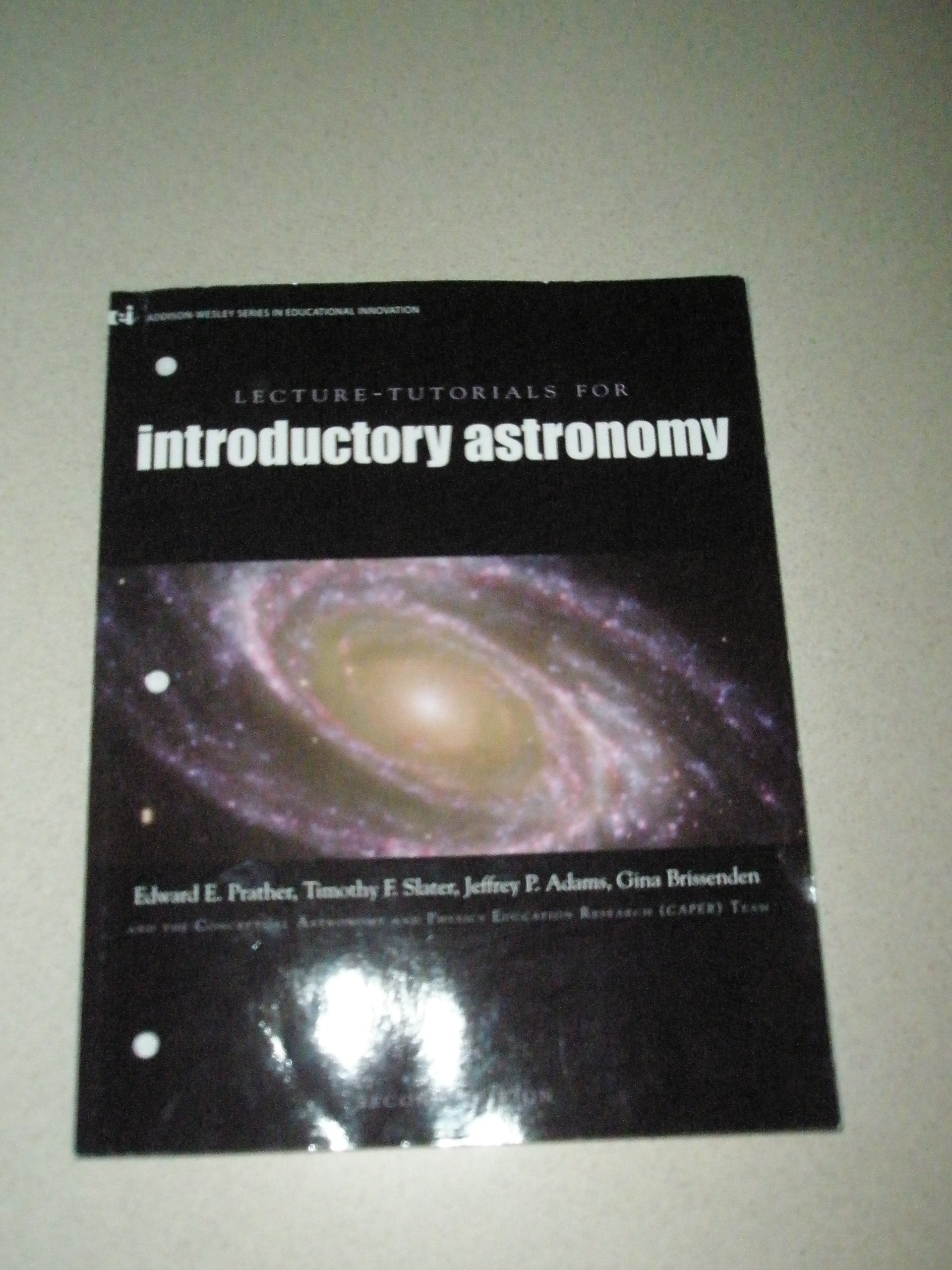
Lecture Tutorials For Introductory Astronomy (2Nd Edition)
Sold by Ergodebooks, an authorized reseller.
Returns accepted within 30 days | support@ergodebooks.com
Shipping Information
- Free Standard Shipping — United States only
- Processing Time: 3–5 business days
- Estimated Delivery: 6–10 business days after dispatch
- Double-boxed, fully insured & discreetly packaged
- Tracking number sent via email once dispatched
Returns & Refund
Returns accepted within 30 days of delivery.
Damaged or Defective Item
Free return shipping + replacement or full refund
Wrong Item Received
Free return shipping + replacement or full refund
Change of Mind
Return shipping at customer's expense · 25% restocking fee applies
Payment Option

Funded By The National Science Foundation, Lecturetutorials For Introductory Astronomy Is Designed To Help Make Large Lectureformat Courses More Interactive With Easytoimplement Student Activities That Can Be Integrated Into Existing Course Structures. The Second Edition Of The Lecturetutorials For Introductory Astronomy Contains Nine New Activities That Focus On Planetary Science, System Related Topics, And The Interactions Of Light And Matter. These New Activities Have Been Created Using The Same Rigorous Classtest Development Process That Was Used For The Highly Successful First Edition. Each Of The 38 Lecturetutorials, Presented In A Classroomready Format, Challenges Students With A Series Of Carefully Designed Questions That Spark Classroom Discussion, Engage Students In Critical Reasoning, And Require No Equipment.The Night Sky: Position, Motion, Seasonal Stars, Solar Vs. Sidereal Day, Ecliptic, Star Charts. Fundamentals Of Astronomy: Keplers 2Nd Law, Keplers 3Rd Law, Newtons Laws And Gravity, Apparent And Absolute Magnitudes Of Stars, The Parse, Parallax And Distance, Spectroscopic Parallax. Nature Of Light In Astronomy: The Electromagnetic (Em) Spectrum Of Light, Telescopes And Earths Atmosphere, Luminosity, Temperature And Size, Blackbody Radiation, Types Of Spectra, Light And Atoms, Analyzing Spectra, Doppler Shift. Our Solar System: The Cause Of Moon Phases, Predicting Moon Phases, Path Of Sun, Seasons, Observing Retrograde Motion, Earths Changing Surface, Temperature And Formation Of Our Solar System, Sun Size. Stars Galaxies And Beyond: Hr Diagram, Star Formation And Lifetimes, Binary Stars, The Motion Of Extrasolar Planets, Stellar Evolution, Milky Way Scales, Galaxy Classification, Looking At Distant Objects, Expansion Of The Universe. For All Readers Interested In Astronomy.
⚠️ WARNING (California Proposition 65):
This product may contain chemicals known to the State of California to cause cancer, birth defects, or other reproductive harm.
For more information, please visit www.P65Warnings.ca.gov.
- Q: How many pages does this book have? A: This book contains one hundred forty-four pages. It provides a comprehensive overview of introductory astronomy concepts.
- Q: What are the dimensions of the book? A: The book measures eight point four inches in length, zero point four inches in width, and ten point seven one inches in height.
- Q: What binding does this book have? A: This book is available in paperback binding. This makes it lightweight and easy to handle for students.
- Q: What topics are covered in this book? A: This book covers various astronomy topics, including planetary science, light-matter interactions, and the solar system. It includes nine new activities for enhanced learning.
- Q: Who is the author of this book? A: The author of this book is Edward E. Prather. He is noted for his contributions to educational materials in astronomy.
- Q: What is the target audience for this book? A: This book is suitable for all readers interested in astronomy. It is particularly designed for students in large lecture-format courses.
- Q: How can I use this book in a classroom setting? A: You can use this book to implement interactive activities during lectures. The activities require no equipment and are easy to integrate into existing course structures.
- Q: Is this book suitable for beginners in astronomy? A: Yes, this book is suitable for beginners in astronomy. It provides foundational knowledge and engaging activities to facilitate learning.
- Q: Can this book be used for self-study? A: Yes, this book is ideal for self-study. It includes clearly structured tutorials that guide readers through key concepts in astronomy.
- Q: How do I keep this book in good condition? A: To keep this book in good condition, store it in a cool, dry place and avoid direct sunlight. Handle it gently to prevent wear and tear.
- Q: Is this book safe for young readers? A: Yes, this book is safe for young readers. It is designed for educational purposes and contains age-appropriate content.
- Q: What if I receive a damaged book? A: If you receive a damaged book, contact the seller for a return or replacement. Most retailers have policies in place for such situations.
- Q: Are there any activities included in this book? A: Yes, the book includes thirty-eight lecture-tutorials with activities designed to promote classroom discussion and critical reasoning.
- Q: What editions of this book are available? A: This book is currently available in its second edition. It includes updates and new activities compared to the first edition.
- Q: Can this book be used for advanced astronomy courses? A: While primarily for beginners, this book can also serve as a supplementary resource for advanced courses due to its comprehensive material.