If you have any questions, you are always welcome to contact us. We'll get back to you as soon as possible, withing 24 hours on weekdays.
Customer service
All questions about your order, return and delivery must be sent to our customer service team by e-mail at yourstore@yourdomain.com
Sale & Press
If you are interested in selling our products, need more information about our brand or wish to make a collaboration, please contact us at press@yourdomain.com
Help
If you have any questions, you are always welcome to contact us. We'll get back to you as soon as possible, withing 24 hours on weekdays.
Customer service
All questions about your order, return and delivery must be sent to our customer service team by e-mail at yourstore@yourdomain.com
Sale & Press
If you are interested in selling our products, need more information about our brand or wish to make a collaboration, please contact us at press@yourdomain.com
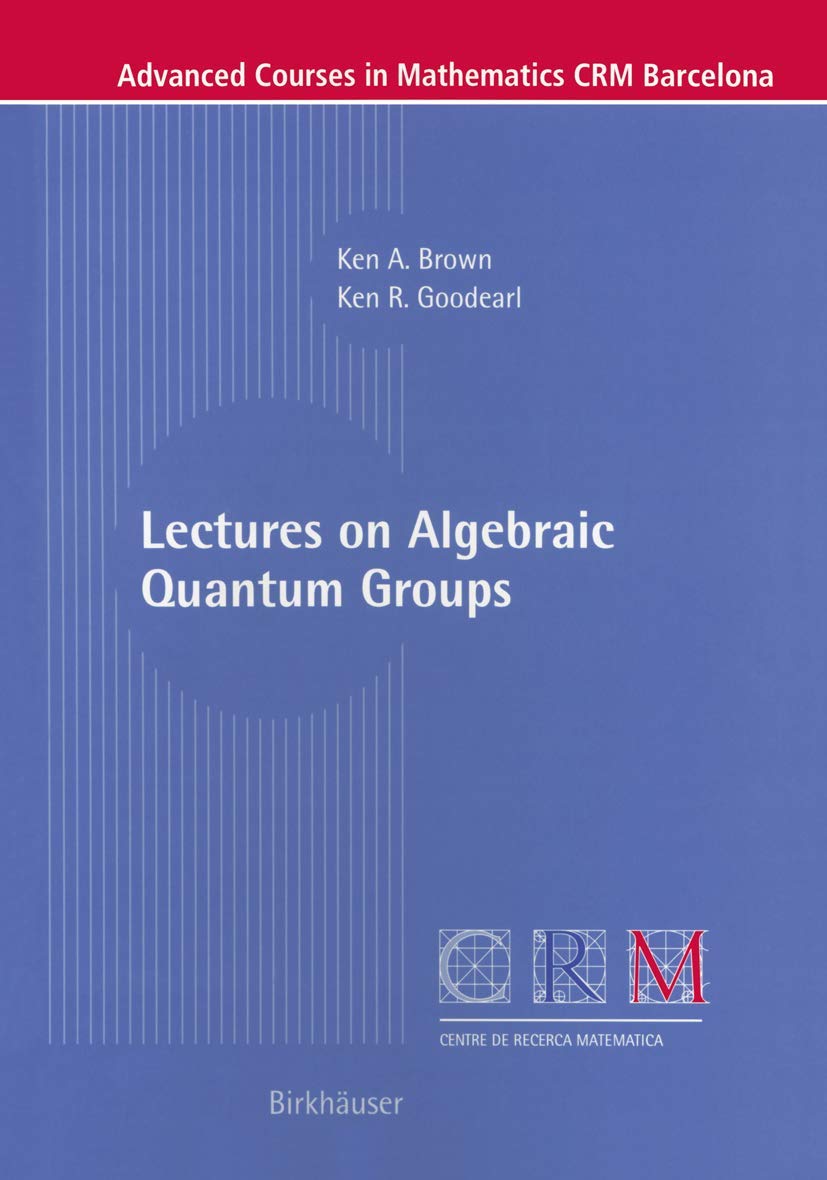
In September 2000, at the Centre de Recerca Matematica in Barcelona, we pre sented a 30hour Advanced Course on Algebraic Quantum Groups. After the course, we expanded and smoothed out the material presented in the lectures and inte grated it with the background material that we had prepared for the participants; this volume is the result. As our title implies, our aim in the course and in this text is to treat selected algebraic aspects of the subject of quantum groups. Sev eral of the words in the previous sentence call for some elaboration. First, we mean to convey several points by the term 'algebraic' that we are concerned with algebraic objects, the quantized analogues of 'classical' algebraic objects (in contrast, for example, to quantized versions of continuous function algebras on compact groups); that we are interested in algebraic aspects of the structure of these objects and their representations (in contrast, for example, to applications to other areas of mathematics); and that our tools will be drawn primarily from noncommutative algebra, representation theory, and algebraic geometry. Second, the term 'quantum groups' itself. This label is attached to a large and rapidly diversifying field of mathematics and mathematical physics, originally launched by developments around 1980 in theoretical physics and statistical me chanics. It is a field driven much more by examples than by axioms, and so resists attempts at concise description (but see Chapter 1. 1 and the references therein).
⚠️ WARNING (California Proposition 65):
This product may contain chemicals known to the State of California to cause cancer,
birth defects, or other reproductive harm.
For MAP (Minimum Advertised Price) violations and Intellectual Property (IP) or Trademark concerns, please contact:
support@ergodebooks.com
⚠️ California Proposition 65 Warning: Some products sold on this website may expose you to chemicals known to the State of California to cause cancer, birth defects, or other reproductive harm. For more information, visit www.P65Warnings.ca.gov.