
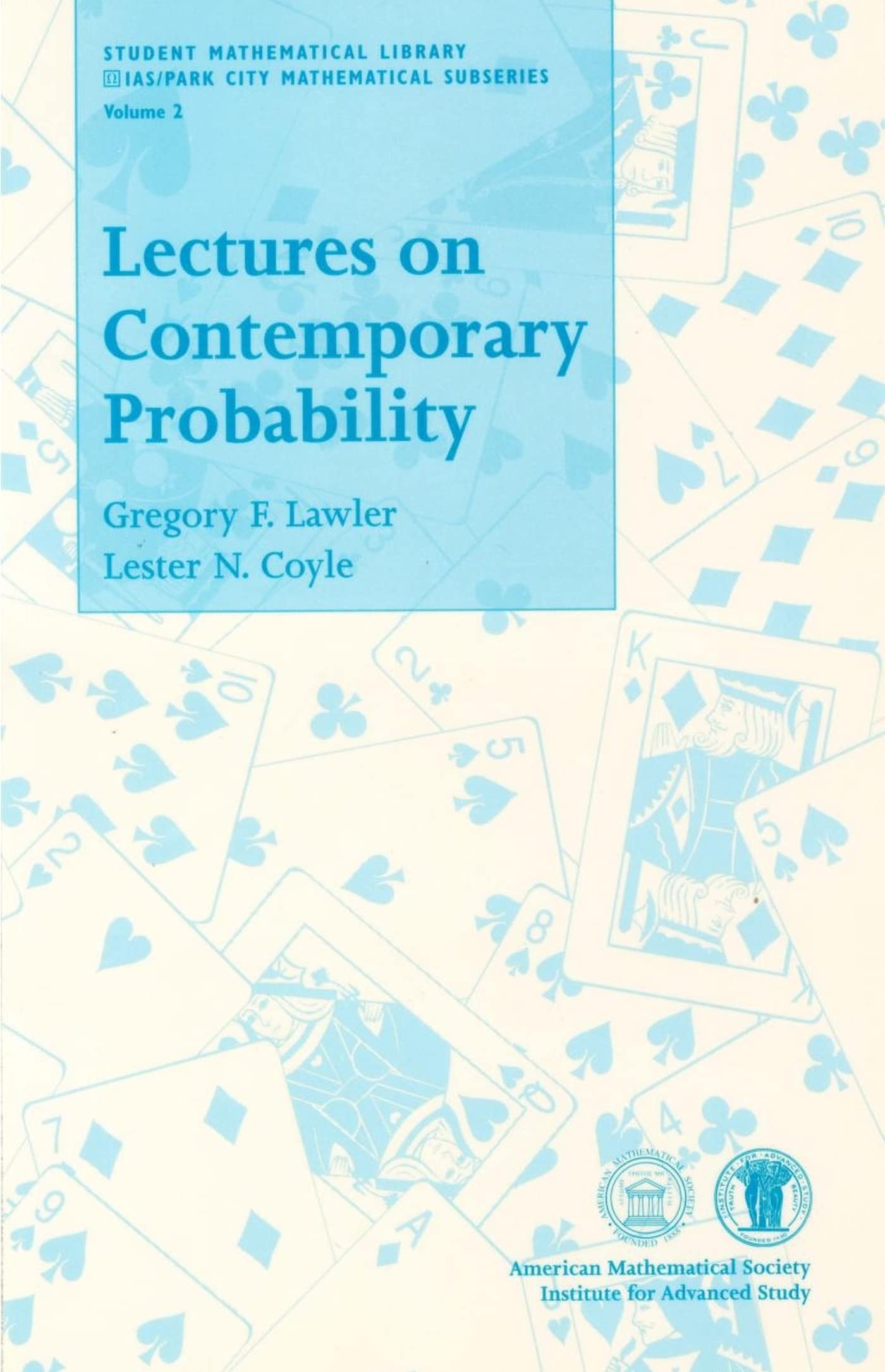
Title
Lectures on Contemporary Probability (Student Mathematical Library, V. 2),Used
Sold by Ergodebooks, an authorized reseller.
Returns accepted within 30 days | support@ergodebooks.com
Shipping Information
- Free Standard Shipping — United States only
- Processing Time: 3–5 business days
- Estimated Delivery: 6–10 business days after dispatch
- Double-boxed, fully insured & discreetly packaged
- Tracking number sent via email once dispatched
Returns & Refund
Returns accepted within 30 days of delivery.
Damaged or Defective Item
Free return shipping + replacement or full refund
Wrong Item Received
Free return shipping + replacement or full refund
Change of Mind
Return shipping at customer's expense · 25% restocking fee applies
Payment Option

This volume is based on classes in probability for advanced undergraduates held at the IAS/Park City Mathematics Institute (Utah). It is derived from both lectures (Chapters 110) and computer simulations (Chapters 1113) that were held during the program. The material is coordinated so that some of the major computer simulations relate to topics covered in the first ten chapters. The goal is to present topics that are accessible to advanced undergraduates, yet are areas of current research in probability. The combination of the lucid yet informal style of the lectures and the handson nature of the simulations allows readers to become familiar with some interesting and active areas of probability.The first four chapters discuss random walks and the continuous limit of random walks: Brownian motion. Chapters 5 and 6 consider the fascinating mathematics of card shuffles, including the notions of random walks on a symmetric group and the general idea of random permutations.Chapters 7 and 8 discuss Markov chains, beginning with a standard introduction to the theory. Chapter 8 addresses the recent important application of Markov chains to simulations of random systems on large finite sets: Markov Chain Monte Carlo.Random walks and electrical networks are covered in Chapter 9. Uniform spanning trees, as connected to probability and random walks, are treated in Chapter 10.The final three chapters of the book present simulations. Chapter 11 discusses simulations for random walks. Chapter 12 covers simulation topics such as sampling from continuous distributions, random permutations, and estimating the number of matrices with certain conditions using Markov Chain Monte Carlo. Chapter 13 presents simulations of stochastic differential equations for applications in finance. (The simulations do not require one particular piece of software. They can be done in symbolic computation packages or via programming languages such as C.)The volume concludes with a number of problems ranging from routine to very difficult. Of particular note are problems that are typical of simulation problems given to students by the authors when teaching undergraduate probability.
⚠️ WARNING (California Proposition 65):
This product may contain chemicals known to the State of California to cause cancer, birth defects, or other reproductive harm.
For more information, please visit www.P65Warnings.ca.gov.
- Q: How many pages are in the book? A: This book has ninety-seven pages. It covers foundational concepts in probability and includes both theoretical and practical applications.
- Q: What is the binding type of this book? A: The book is paperback bound. This makes it lightweight and easy to handle for students.
- Q: What are the dimensions of the book? A: The book measures five point seventy-five inches in length, zero point twenty-five inches in width, and eight point five inches in height. These dimensions make it portable for on-the-go learning.
- Q: Is this book suitable for beginners? A: No, this book is designed for advanced undergraduates. It discusses complex topics in probability, making it ideal for students who already have foundational knowledge.
- Q: What topics does this book cover? A: The book covers random walks, Markov chains, and simulations in probability. It combines theory with practical computer simulations for a comprehensive understanding.
- Q: How can I use this book effectively? A: You can use this book as a supplemental resource for advanced probability courses. It includes lectures and simulations that enhance theoretical understanding.
- Q: Does this book include exercises or problems? A: Yes, the book concludes with a variety of problems ranging from routine to very difficult. These exercises help reinforce the material covered.
- Q: What are the main applications discussed in the book? A: The book explores applications in finance, particularly simulations of stochastic differential equations. It focuses on real-world applications of probability theory.
- Q: Is there any software required for the simulations? A: No, the simulations can be performed using various programming languages or symbolic computation packages. This flexibility allows for a range of tools to be utilized.
- Q: How should I care for this book? A: To keep the book in good condition, store it in a cool, dry place and avoid exposure to direct sunlight. Handling it carefully will also help preserve its quality.
- Q: What if the book arrives damaged? A: If the book arrives damaged, you should contact the seller for a return or replacement. Most sellers have policies in place for damaged goods.
- Q: Are there any prerequisites for understanding this book? A: Yes, a solid understanding of undergraduate probability is recommended. The book builds on foundational concepts and introduces advanced topics.
- Q: Can this book be used for self-study? A: Yes, this book is suitable for self-study. The informal style and hands-on simulations facilitate independent learning.
- Q: Who is the author of this book? A: The author of this book is Gregory F. Lawler. His expertise in probability theory adds credibility to the content.
- Q: What is the main purpose of the simulations in the book? A: The simulations aim to illustrate and deepen the understanding of complex probability concepts. They provide practical experience in applying theoretical knowledge.
- Q: Does this book include discussions on recent research? A: Yes, the book addresses areas of current research in probability, making it relevant for advanced students interested in the latest developments.