
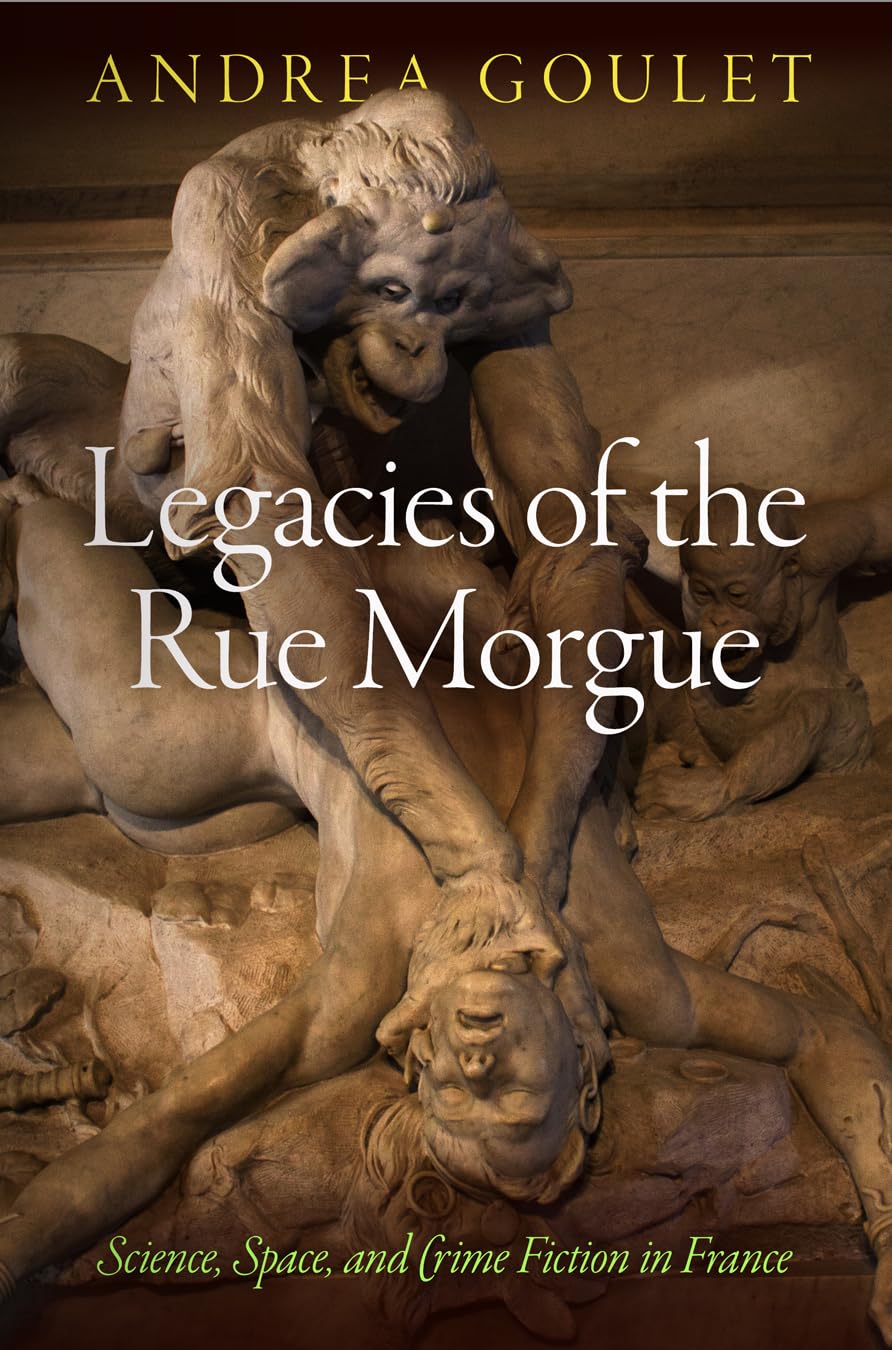
Title
Legacies of the Rue Morgue: Science, Space, and Crime Fiction in France (Critical Authors and Issues),Used
Sold by Ergodebooks, an authorized reseller.
Returns accepted within 30 days | support@ergodebooks.com
Shipping Information
- Free Standard Shipping — United States only
- Processing Time: 3–5 business days
- Estimated Delivery: 6–10 business days after dispatch
- Double-boxed, fully insured & discreetly packaged
- Tracking number sent via email once dispatched
Returns & Refund
Returns accepted within 30 days of delivery.
Damaged or Defective Item
Free return shipping + replacement or full refund
Wrong Item Received
Free return shipping + replacement or full refund
Change of Mind
Return shipping at customer's expense · 25% restocking fee applies
Payment Option

Taking Edgar Allan Poe's 1841 'The Murders in the Rue Morgue' as an inaugural frame, Andrea Goulet traces shifting representations of violence, space, and nation in French crime fiction from serial novels of the 1860s to cyberpunk fictions today. She argues that the history of spatial sciencesgeology, paleontology, cartographyhelps elucidate the genre's fundamental tensions: between brutal murder and pure reason; historical past and reconstructive present; national identity and global networks.As the sciences underlying her analysis make extensive use of strata and grids, Goulet employs vertical and horizontal axes to orient and inform her close readings of crime novels. Vertically, crimes that take place underground subvert aboveground modernization, and national traumas of the past haunt present criminal spaces. Horizontally, abstract crime scene maps grapple with the sociological realities of crime, while postmodern networks of international data trafficking extend colonial anxieties of the French nation.Crime gangs in the catacombs of 1860s Paris. Dirtdigging detectives in coastal caves at the findesicle. Schizoid cartographers in global cyberspace. Crime fiction's sites of investigation have always exposed central rifts in France's national identity while signaling broader, enduring unease with violent disruptions to social order. Reading murder novels of the last 150 years in the context of shifting sciences, Legacies of the Rue Morgue provides a new spatial history of modern crime fiction.
⚠️ WARNING (California Proposition 65):
This product may contain chemicals known to the State of California to cause cancer, birth defects, or other reproductive harm.
For more information, please visit www.P65Warnings.ca.gov.
- Q: What is the main theme of 'Legacies of the Rue Morgue'? A: 'Legacies of the Rue Morgue' explores the connections between violence, space, and national identity in French crime fiction, using Edgar Allan Poe's work as a foundational reference.
- Q: Who is the author of this book? A: The author of 'Legacies of the Rue Morgue' is Andrea Goulet.
- Q: How many pages does the book have? A: 'Legacies of the Rue Morgue' contains a total of 304 pages.
- Q: What type of binding does this book have? A: This book is available in hardcover binding.
- Q: When was 'Legacies of the Rue Morgue' published? A: 'Legacies of the Rue Morgue' was published on December 30, 2015.
- Q: What genre does this book belong to? A: 'Legacies of the Rue Morgue' falls under the Mystery & Detective genre.
- Q: Is this book suitable for academic study? A: Yes, 'Legacies of the Rue Morgue' offers scholarly insights into crime fiction and its historical contexts, making it suitable for academic study.
- Q: Does the book cover contemporary crime fiction? A: Yes, the book discusses contemporary crime fiction, including cyberpunk narratives, alongside historical works.
- Q: What unique perspectives does the author provide? A: Andrea Goulet provides a unique spatial history of crime fiction, analyzing how various scientific disciplines inform the narratives of violence and crime.
- Q: Are there any illustrations or maps included in the book? A: The book includes abstract crime scene maps and other visual elements to enhance the analysis of spatial representations in crime fiction.