If you have any questions, you are always welcome to contact us. We'll get back to you as soon as possible, withing 24 hours on weekdays.
Customer service
All questions about your order, return and delivery must be sent to our customer service team by e-mail at yourstore@yourdomain.com
Sale & Press
If you are interested in selling our products, need more information about our brand or wish to make a collaboration, please contact us at press@yourdomain.com
Help
If you have any questions, you are always welcome to contact us. We'll get back to you as soon as possible, withing 24 hours on weekdays.
Customer service
All questions about your order, return and delivery must be sent to our customer service team by e-mail at yourstore@yourdomain.com
Sale & Press
If you are interested in selling our products, need more information about our brand or wish to make a collaboration, please contact us at press@yourdomain.com
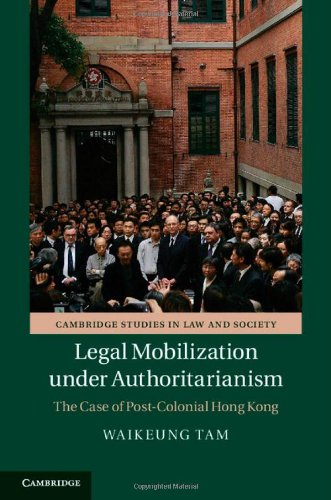
Legal mobilization is the process by which individuals invoke their legal rights and use litigation to defend or develop these rights against the government. In recent years, increasing attention has been paid to this phenomenon as it occurs under authoritarian regimes. It is often suggested that, in such situations, legal mobilization is caused by the strategic interests of the ruling elites. Using the case study of postcolonial Hong Kong, where legal mobilization has by no means unfolded as political authorities would wish, Waikeung Tam casts doubt on this contention. To do so, he examines in depth why and how legal mobilization arises under authoritarianism. Tam analyses quantitative data of changes in the Hong Kong judiciary agendas over the last three decades and uses detailed interviews with activists, politicians, cause lawyers, judges and government officials to reveal the complex underlying sociopolitical forces at play.
⚠️ WARNING (California Proposition 65):
This product may contain chemicals known to the State of California to cause cancer,
birth defects, or other reproductive harm.
For MAP (Minimum Advertised Price) violations and Intellectual Property (IP) or Trademark concerns, please contact:
support@ergodebooks.com
⚠️ California Proposition 65 Warning: Some products sold on this website may expose you to chemicals known to the State of California to cause cancer, birth defects, or other reproductive harm. For more information, visit www.P65Warnings.ca.gov.