
Title
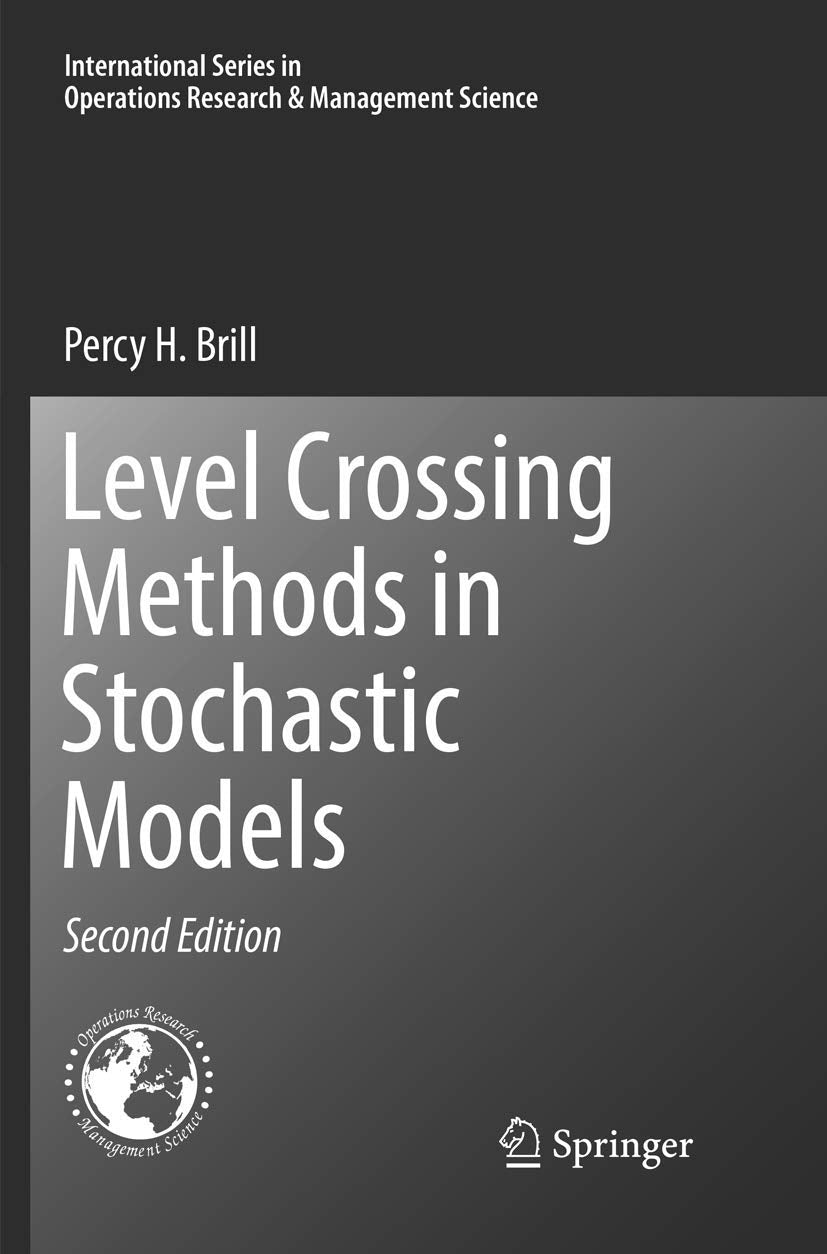
Level Crossing Methods in Stochastic Models (International Series in Operations Research & Management Science, 250),Used
Sold by Ergodebooks, an authorized reseller.
Returns accepted within 30 days | support@ergodebooks.com
Shipping Information
- Free Standard Shipping — United States only
- Processing Time: 3–5 business days
- Estimated Delivery: 6–10 business days after dispatch
- Double-boxed, fully insured & discreetly packaged
- Tracking number sent via email once dispatched
Returns & Refund
Returns accepted within 30 days of delivery.
Damaged or Defective Item
Free return shipping + replacement or full refund
Wrong Item Received
Free return shipping + replacement or full refund
Change of Mind
Return shipping at customer's expense · 25% restocking fee applies
Payment Option

This is a complete update of the first edition of Level Crossing Methods in Stochastic Models, which was published in 2008. Level crossing methods are a set of samplepath based mathematical tools used in applied probability to establish reliable probability distributions. Since the basis for solving any applied probability problem requires a reliable probability distribution, Level Crossing Methods in Stochastic Models, Second Edition is a useful tool for all researchers working on stochastic application problems, including inventory control, queueing theory, reliability theory, actuarial ruin theory, renewal theory, pharmacokinetics, and related Markov processes.The second edition includes a new section with a novel derivation of the Bene series for M/G/1 queues. It provides new results on the service time for three M/G/I queueing models with bounded workload. It analyzes new applications of queues where zerowait customers getexceptional service, including several examples on M/G/1 queues, and a new section on G/M/1 queues. Additionally, there are two other important new sections: on the levelcrossing derivation of the finite timet probability distributions of excess, age, and total life, in renewal theory; and on a levelcrossing analysis of a risk model in Insurance.The original Chapter 10 has been split into two chapters: the new chapter 10 is on renewal theory, and the first section of the new Chapter 11 is on a risk model. More explicit use is made of the renewal reward theorem throughout, and many technical and editorial changes have been made to facilitate readability.Percy H. Brill, Ph.D., is a Professor emeritus at the University of Windsor, Canada. Dr. Brill is the creator of the level crossing method for analyzing stochastic models. He has published extensively in stochastic processes, queueing theory and related models, especially using level crossing methods.
⚠️ WARNING (California Proposition 65):
This product may contain chemicals known to the State of California to cause cancer, birth defects, or other reproductive harm.
For more information, please visit www.P65Warnings.ca.gov.