
Title
Lexical Plurals: A Morphosemantic Approach (Oxford Studies in Theoretical Linguistics),New
Sold by Ergodebooks, an authorized reseller.
Returns accepted within 30 days | support@ergodebooks.com
Shipping Information
- Free Standard Shipping — United States only
- Processing Time: 3–5 business days
- Estimated Delivery: 6–10 business days after dispatch
- Double-boxed, fully insured & discreetly packaged
- Tracking number sent via email once dispatched
Returns & Refund
Returns accepted within 30 days of delivery.
Damaged or Defective Item
Free return shipping + replacement or full refund
Wrong Item Received
Free return shipping + replacement or full refund
Change of Mind
Return shipping at customer's expense · 25% restocking fee applies
Payment Option

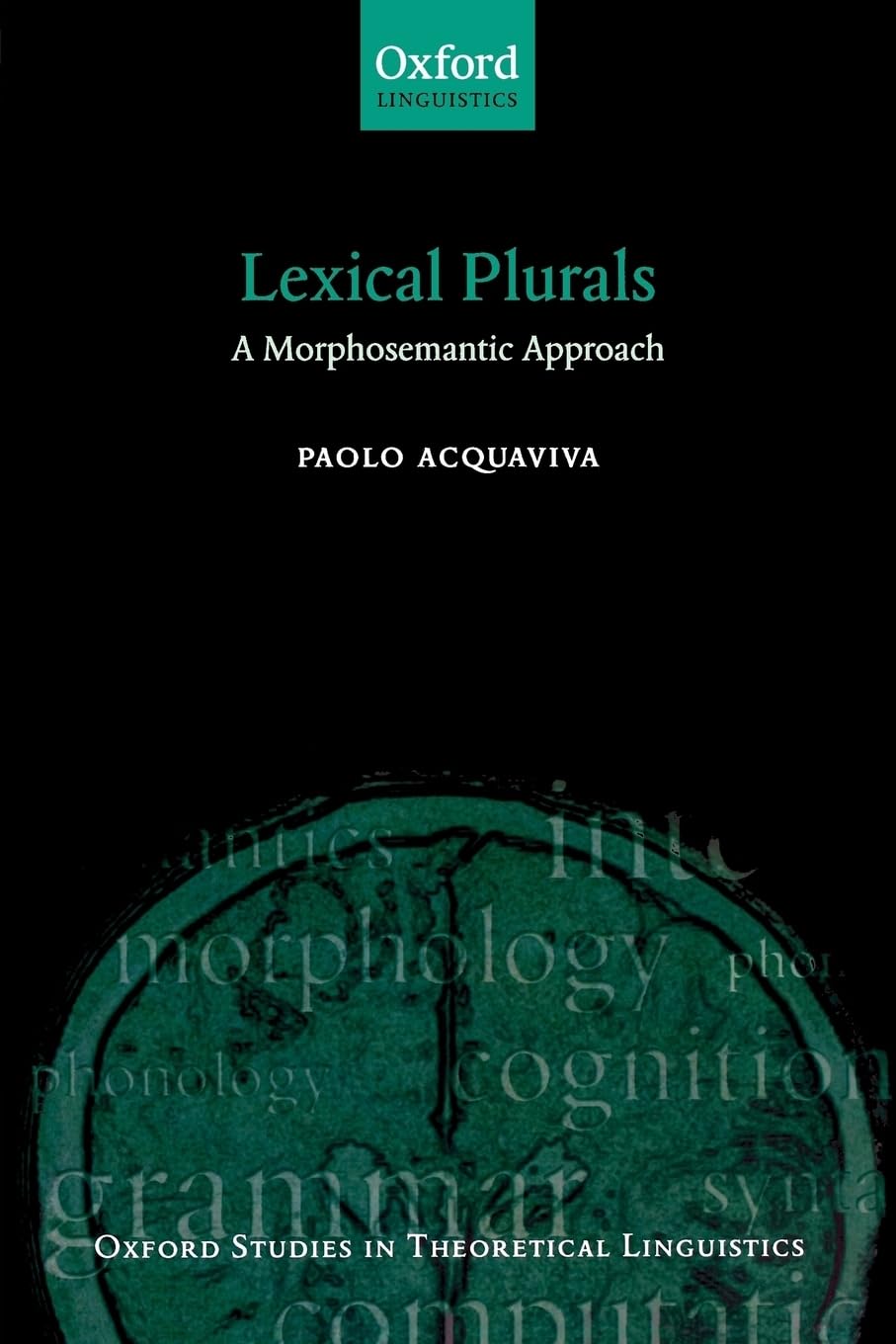
This book explores the wide variety of cases in which the plural of nouns is lexical. When a plural is lexicalized it becomes part of what it is to know a certain word: pence, for example, is lexical because it means a plurality of a certain kind a multiple value, not a set of physical objects like pennies and knowing this reading is knowing the word. Languages exhibit countless examples of similar worddependent irregularities in the form and meaning of plural, but these have never been analyzed in depth from a unified perspective. Dr. Acquaviva aims to do just that, using analytic tools from formal semantics and theoretical morphology to shed light on the relation between grammar and the lexicon. After an introduction setting out his approach he divides the book into two parts. The first gives a structured description of the ways plurality can be lexicalized with an emphasis on description and categorization. The second analyzes in depth different types of lexical plurals in Italian, Irish, Arabic and Breton. A final chapter spells out the theoretical consequences for the analysis of the lexicon. The book is unusual in combining a broad typological classification with a unified morphological and semantic analysis based on a formal framework.
⚠️ WARNING (California Proposition 65):
This product may contain chemicals known to the State of California to cause cancer, birth defects, or other reproductive harm.
For more information, please visit www.P65Warnings.ca.gov.