If you have any questions, you are always welcome to contact us. We'll get back to you as soon as possible, withing 24 hours on weekdays.
Customer service
All questions about your order, return and delivery must be sent to our customer service team by e-mail at yourstore@yourdomain.com
Sale & Press
If you are interested in selling our products, need more information about our brand or wish to make a collaboration, please contact us at press@yourdomain.com
Help
If you have any questions, you are always welcome to contact us. We'll get back to you as soon as possible, withing 24 hours on weekdays.
Customer service
All questions about your order, return and delivery must be sent to our customer service team by e-mail at yourstore@yourdomain.com
Sale & Press
If you are interested in selling our products, need more information about our brand or wish to make a collaboration, please contact us at press@yourdomain.com
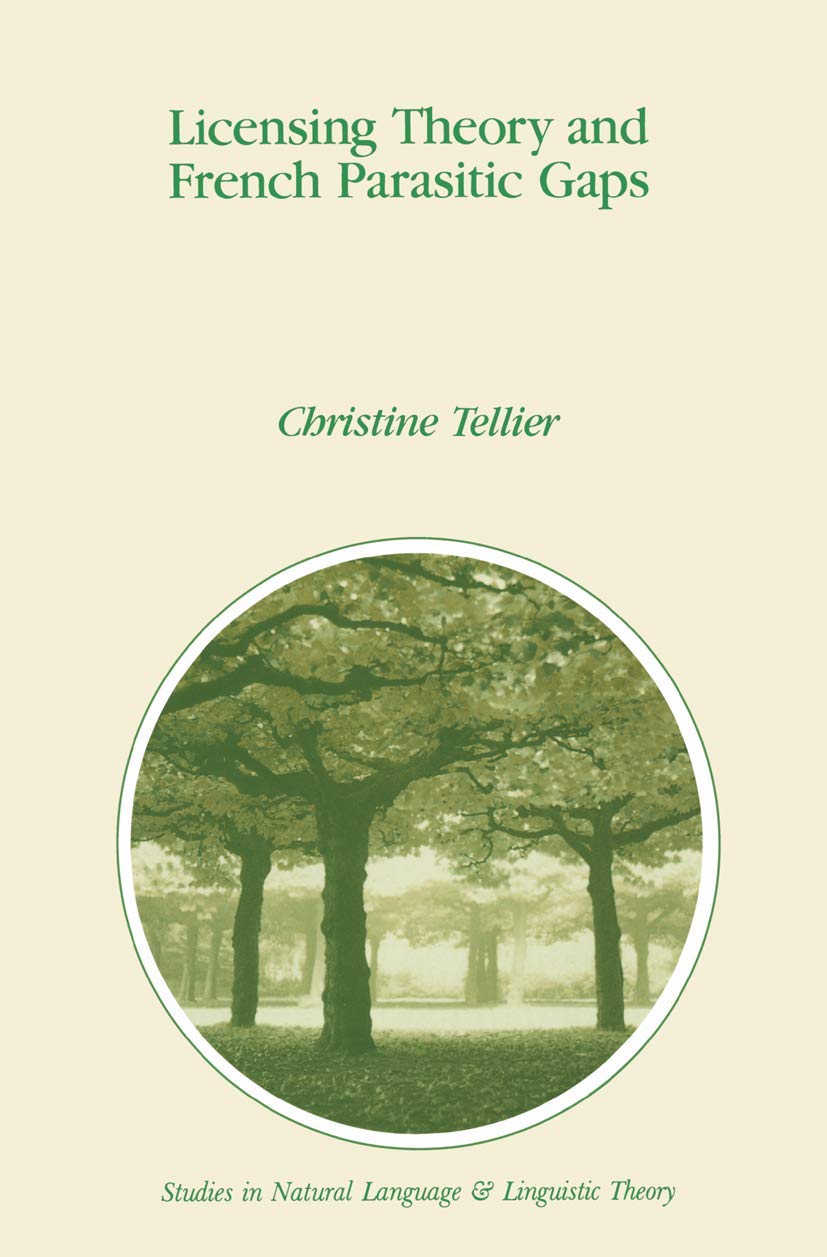
The study of parasitic gap constructions (e. g. these are the reports; which you corrected _; before filing _i) has been a very lively area of research over the last decade. The impetus behind this lies mostly in the margi nality of the construction. Clearly, the intuitions that native speakers have about parasitic gaps do not stem from direct instruction; hence, it is reasoned, such knowledge follows from the restrictions imposed by Universal Grammar. Furthermore, it is unlikely that any principle of Universal Grammar refers specifically to parasitic gap constructions; their syntactic and interpretive properties must instead follow entirely from independent principles. My own interest in the phenomenon was sparked a few years ago, when, in a novel, I came across a sentence like the following: Chait un armateur; dont Ie prestige _; reposait largement sur la fortune _;, 'he was a shipbuilder of whom the prestige was largely based on the wealth'. As the indices indicate, the interpretation of the French sentence is un ambiguous: both the prestige and the wealth necessarily pertain to the same individual. In this aspect, the sentence much resembles the English parasitic gap construction above: in the former case too, the comple ments of correct and file must corefer with the noun phrase heading the relative (the reports). Yet, there is an important difference between the two constructions. Verbs like correct and file subcategorize their com plements.
⚠️ WARNING (California Proposition 65):
This product may contain chemicals known to the State of California to cause cancer,
birth defects, or other reproductive harm.
For MAP (Minimum Advertised Price) violations and Intellectual Property (IP) or Trademark concerns, please contact:
support@ergodebooks.com
⚠️ California Proposition 65 Warning: Some products sold on this website may expose you to chemicals known to the State of California to cause cancer, birth defects, or other reproductive harm. For more information, visit www.P65Warnings.ca.gov.