
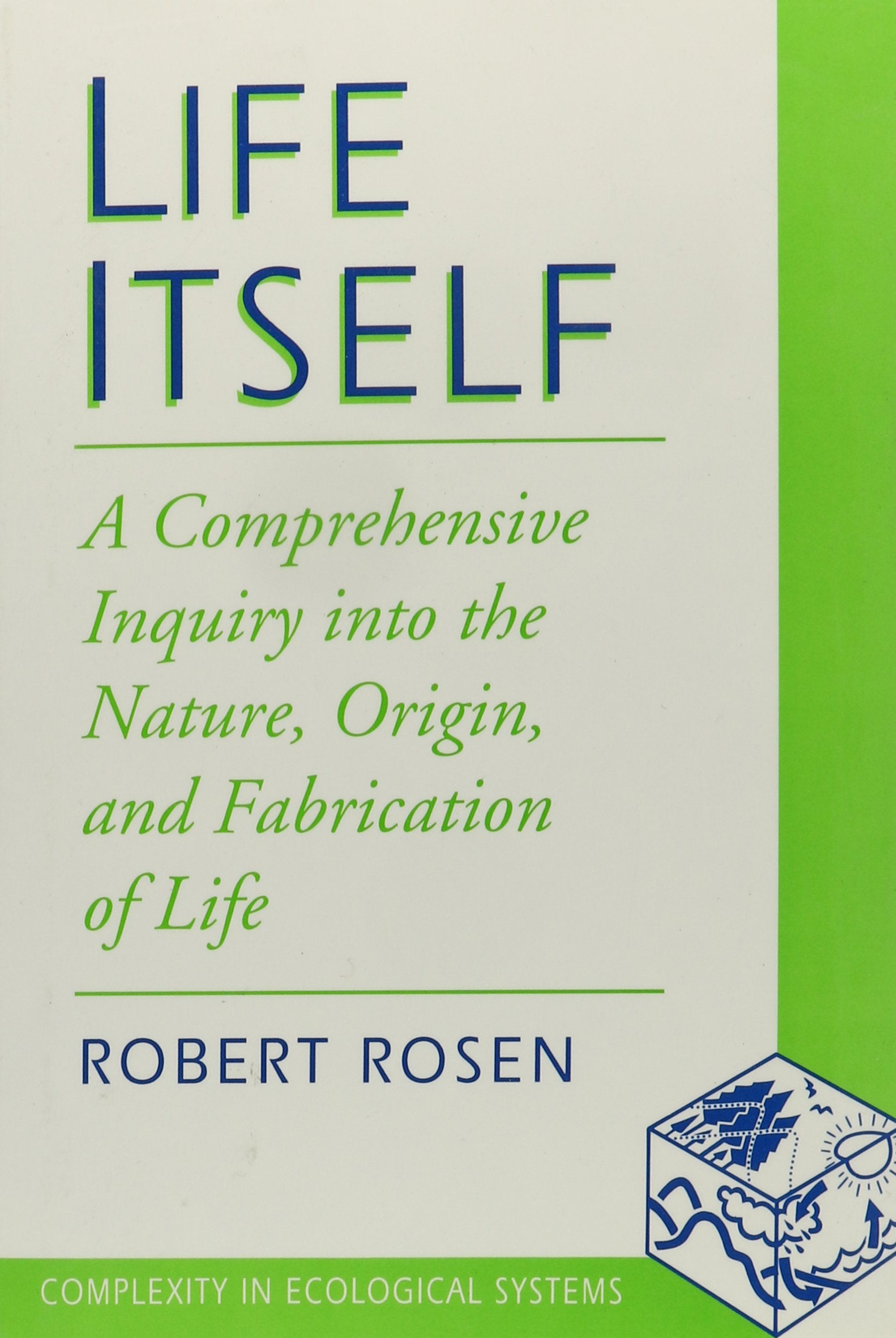
Title


Life Itself
Sold by Ergodebooks, an authorized reseller.
Returns accepted within 30 days | support@ergodebooks.com
Shipping Information
- Free Standard Shipping — United States only
- Processing Time: 3–5 business days
- Estimated Delivery: 6–10 business days after dispatch
- Double-boxed, fully insured & discreetly packaged
- Tracking number sent via email once dispatched
Returns & Refund
Returns accepted within 30 days of delivery.
Damaged or Defective Item
Free return shipping + replacement or full refund
Wrong Item Received
Free return shipping + replacement or full refund
Change of Mind
Return shipping at customer's expense · 25% restocking fee applies
Payment Option

Why Are Living Things Alive? As A Theoretical Biologist, Robert Rosen Saw This As The Most Fundamental Of All Questionsand Yet It Had Never Been Answered Satisfactorily By Science. The Answers To This Question Would Allow Humanity To Make An Enormous Leap Forward In Our Understanding Of The Principles At Work In Our World.For Centuries, It Was Believed That The Only Scientific Approach To The Question What Is Life? Must Proceed From The Cartesian Metaphor (Organism As Machine). Classical Approaches In Science, Which Also Borrow Heavily From Newtonian Mechanics, Are Based On A Process Called Reductionism. The Thinking Was That We Can Better Learn About An Intricate, Complicated System (Like An Organism) If We Take It Apart, Study The Components, And Then Reconstruct The Systemthereby Gaining An Understanding Of The Whole.However, Rosen Argues That Reductionism Does Not Work In Biology And Ignores The Complexity Of Organisms. Life Itself, A Landmark Work, Represents The Scientific And Intellectual Journey That Led Rosen To Question Reductionism And Develop New Scientific Approaches To Understanding The Nature Of Life. Ultimately, Rosen Proposes An Answer To The Original Question About The Causal Basis Of Life In Organisms. He Asserts That Renouncing The Mechanistic And Reductionistic Paradigm Does Not Mean Abandoning Science. Instead, Rosen Offers An Alternate Paradigm For Science That Takes Into Account The Relational Impacts Of Organization In Natural Systems And Is Based On Organized Matter Rather Than On Particulate Matter Alone.Central To Rosen'S Work Is The Idea Of A Complex System, Defined As Any System That Cannot Be Fully Understood By Reducing It To Its Parts. In This Sense, Complexity Refers To The Causal Impact Of Organization On The System As A Whole. Since Both The Atom And The Organism Can Be Seen To Fit That Description, Rosen Asserts That Complex Organization Is A General Feature Not Just Of The Biosphere On Earthbut Of The Universe Itself.
⚠️ WARNING (California Proposition 65):
This product may contain chemicals known to the State of California to cause cancer, birth defects, or other reproductive harm.
For more information, please visit www.P65Warnings.ca.gov.
- Q: What is the page count of 'Life Itself'? A: The book contains two hundred eighty-five pages. This makes it a substantial read for those interested in theoretical biology.
- Q: What are the dimensions of 'Life Itself'? A: The book measures six point thirty-eight inches in length, one point oh two inches in width, and nine point thirty-one inches in height. These dimensions make it a standard hardcover size.
- Q: Who is the author of 'Life Itself'? A: The author is Robert Rosen. He is recognized for his contributions to theoretical biology and the philosophy of science.
- Q: How do I read 'Life Itself' effectively? A: To read this book effectively, consider taking notes on key concepts. It's recommended for readers interested in complex systems and biology.
- Q: Is 'Life Itself' suitable for beginners in biology? A: Yes, 'Life Itself' is suitable for beginners. However, some background in biological concepts may enhance understanding.
- Q: What is the binding type of 'Life Itself'? A: The book features a hardcover binding. This ensures durability and a professional presentation.
- Q: How should I store 'Life Itself'? A: Store 'Life Itself' in a cool, dry place. Avoid exposing it to direct sunlight to preserve its condition.
- Q: Can I clean the cover of 'Life Itself'? A: Yes, you can clean the cover gently with a soft, damp cloth. This will help maintain its appearance without damaging the material.
- Q: How do I keep 'Life Itself' in good condition? A: Keep the book on a bookshelf or flat surface to avoid bending. Regularly check for any signs of wear.
- Q: Is 'Life Itself' appropriate for young readers? A: No, 'Life Itself' is not recommended for young readers. It discusses complex biological theories that may be difficult for them to grasp.
- Q: How does 'Life Itself' compare to other biology texts? A: Compared to other biology texts, 'Life Itself' focuses on theoretical approaches rather than practical applications. This makes it unique in its perspective.
- Q: What if 'Life Itself' arrives damaged? A: If 'Life Itself' arrives damaged, you should contact the seller for a return or exchange. Most retailers have policies to address such issues.
- Q: What is the main theme of 'Life Itself'? A: The main theme is the exploration of what constitutes life and the limitations of reductionism in biology. It presents alternative scientific paradigms.
- Q: Can I find additional resources on the topics in 'Life Itself'? A: Yes, you can find additional resources through academic journals and books on theoretical biology. These will complement the concepts discussed.
- Q: Is 'Life Itself' a popular book in biology? A: Yes, 'Life Itself' is considered a landmark work in theoretical biology. It has influenced many discussions in the field.