If you have any questions, you are always welcome to contact us. We'll get back to you as soon as possible, withing 24 hours on weekdays.
Customer service
All questions about your order, return and delivery must be sent to our customer service team by e-mail at yourstore@yourdomain.com
Sale & Press
If you are interested in selling our products, need more information about our brand or wish to make a collaboration, please contact us at press@yourdomain.com
Help
If you have any questions, you are always welcome to contact us. We'll get back to you as soon as possible, withing 24 hours on weekdays.
Customer service
All questions about your order, return and delivery must be sent to our customer service team by e-mail at yourstore@yourdomain.com
Sale & Press
If you are interested in selling our products, need more information about our brand or wish to make a collaboration, please contact us at press@yourdomain.com
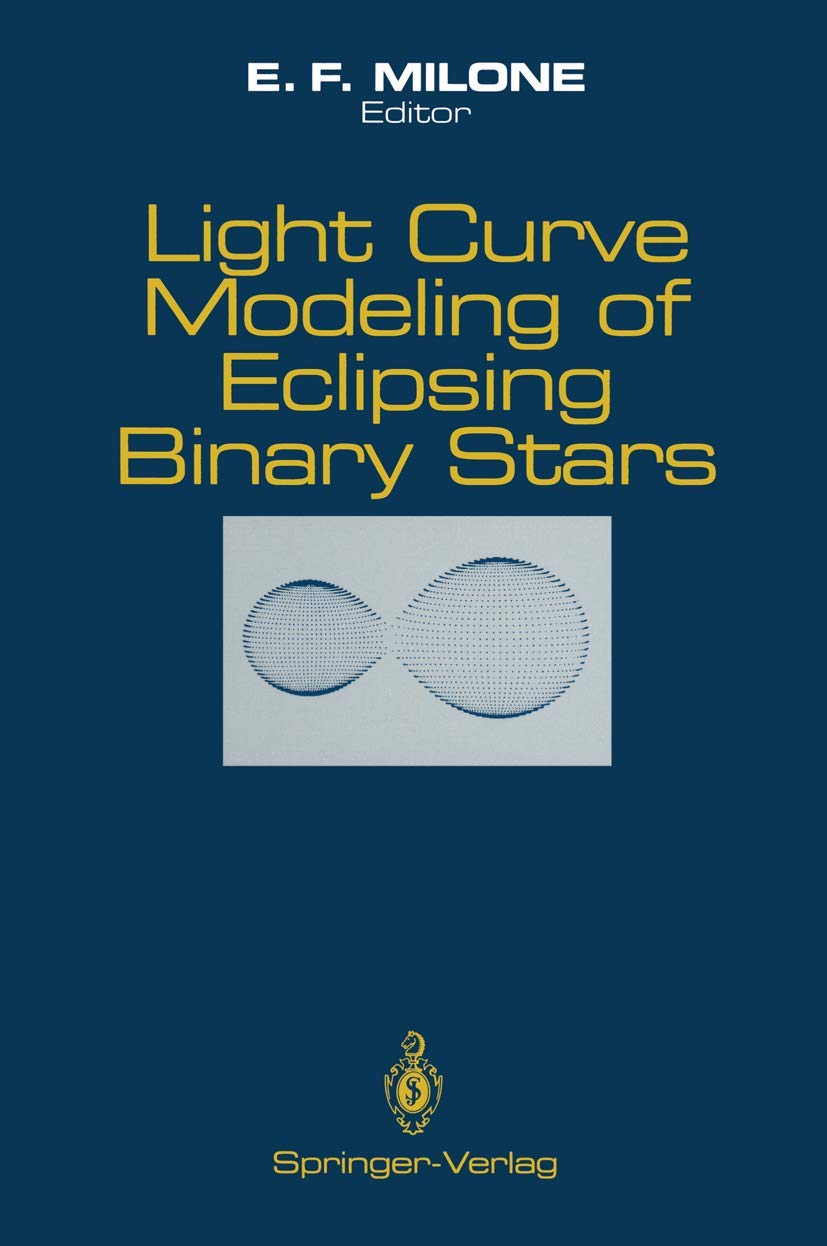
In the two decades since the development of the first eclipsingbinary modeling code, new analytic techniques and the availability of powerful, sometimes dedicated computing facilities have made possible vastly improved determinations of fundamental and even transient stellar parameters. The scale of these developments, of course, raises questions about modeling tools, techniques, and philosophies, such as: Who will maintain and upgrade the codes? Will the codes be open to improvement by outsiders, and if so, how? And, indeed, what should be the goals of a modeling program? Such questions had not been aired for a long time and, for this reason alone, deserved to be discussed in as general a forum as the community provides. This volume contains material presented by Commission 42 (Close Binary Stars) during the International Astronomical Union's XXI General Assembly in Argentina, July 1991, and during IAU Colloquium 151, Cordoba, Argentina, August 1991. The techniques discussed include simulations of stellar bright and dark spots, streams, partial and complete stellar disks, prominences, and other features characterizing active stars; modeling of polarization parameters; models that use radial velocities as well as line profile simulations to model velocity field variation across stellar disks; the weighted effects of brightness asymmetries; and models for translucent eclipsing agents such as stellar winds.
⚠️ WARNING (California Proposition 65):
This product may contain chemicals known to the State of California to cause cancer,
birth defects, or other reproductive harm.
For MAP (Minimum Advertised Price) violations and Intellectual Property (IP) or Trademark concerns, please contact:
support@ergodebooks.com
⚠️ California Proposition 65 Warning: Some products sold on this website may expose you to chemicals known to the State of California to cause cancer, birth defects, or other reproductive harm. For more information, visit www.P65Warnings.ca.gov.