If you have any questions, you are always welcome to contact us. We'll get back to you as soon as possible, withing 24 hours on weekdays.
Customer service
All questions about your order, return and delivery must be sent to our customer service team by e-mail at yourstore@yourdomain.com
Sale & Press
If you are interested in selling our products, need more information about our brand or wish to make a collaboration, please contact us at press@yourdomain.com
Help
If you have any questions, you are always welcome to contact us. We'll get back to you as soon as possible, withing 24 hours on weekdays.
Customer service
All questions about your order, return and delivery must be sent to our customer service team by e-mail at yourstore@yourdomain.com
Sale & Press
If you are interested in selling our products, need more information about our brand or wish to make a collaboration, please contact us at press@yourdomain.com
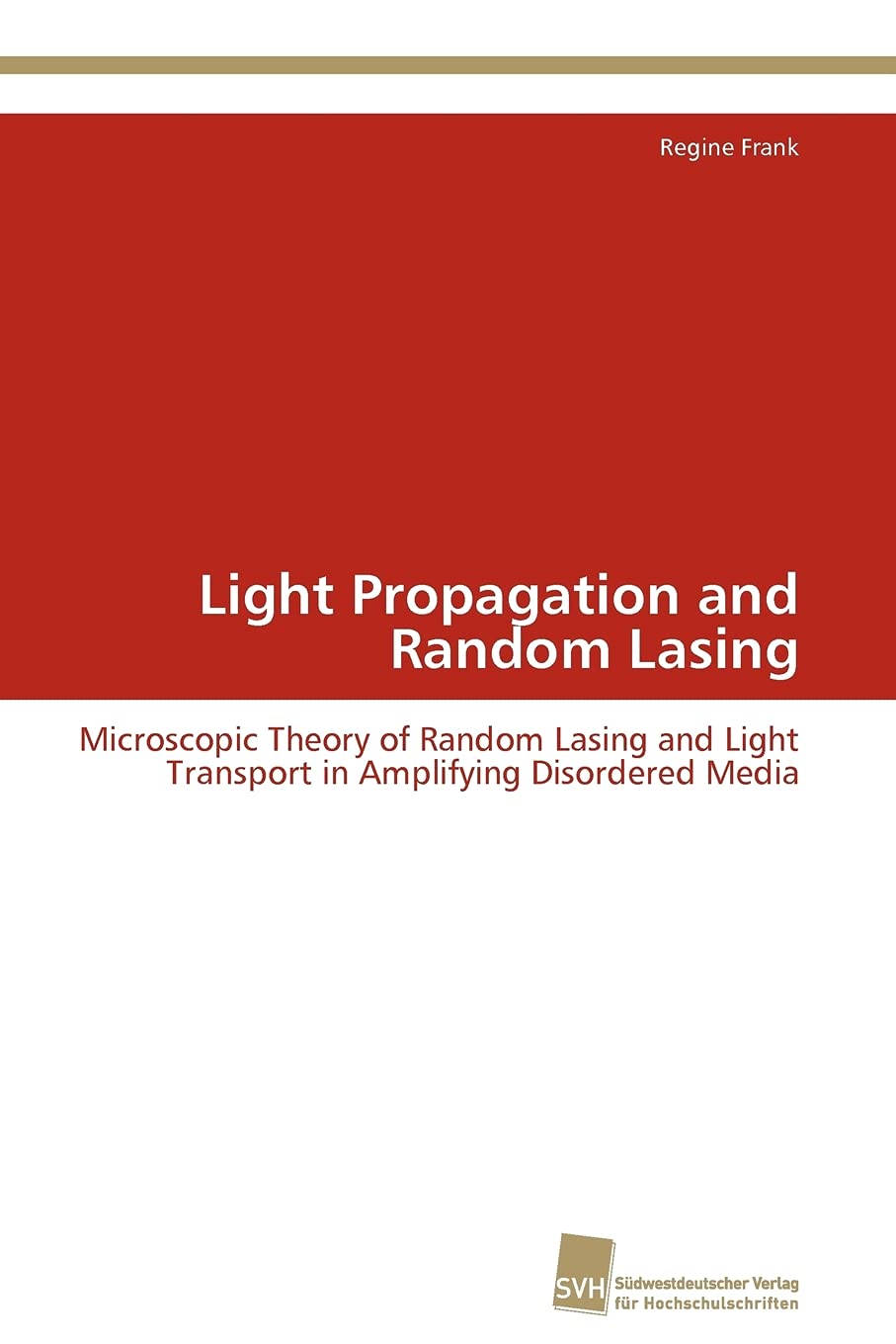
In the last decade Anderson Localization of Light and Random Lasing has attracted a variety of interest in the community of condensed matter theory. The fact that a system so inartificial as a thin layer consisting of dust particles, which have amplifying properties, can produce coherent laser emission, is of a simple elegance, which promises new insights in fundamental physics. There is no need of an external feedback mechanism, like in the system of a conventional laser. Whereas several attempts try to enter the subject numerically by considering cavity approximations, this thesis is concerned with building a microscopically selfconsistent theory of random lasing. Designing this method, we had to study light localization effects in random media including absorption and gain. Incorporating interference effects by means of Cooperon contributions we derived Anderson localized states for passive media. Mapping this on a system which consists of laser active Miescatterers in a passive medium, we found that by incorporation of the Cooperon, we loose the Anderson localization, but the system is weakly localized, which is sufficient for population inversion and stimulated emission.
⚠️ WARNING (California Proposition 65):
This product may contain chemicals known to the State of California to cause cancer,
birth defects, or other reproductive harm.
For MAP (Minimum Advertised Price) violations and Intellectual Property (IP) or Trademark concerns, please contact:
support@ergodebooks.com
⚠️ California Proposition 65 Warning: Some products sold on this website may expose you to chemicals known to the State of California to cause cancer, birth defects, or other reproductive harm. For more information, visit www.P65Warnings.ca.gov.