
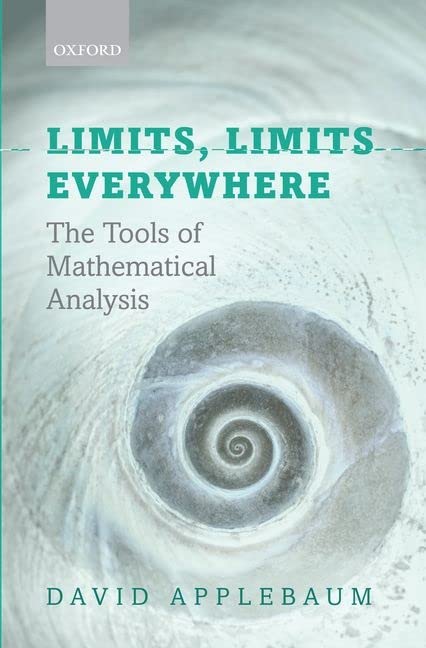
Title
Limits, Limits Everywhere: The Tools Of Mathematical Analysis
Sold by Ergodebooks, an authorized reseller.
Returns accepted within 30 days | support@ergodebooks.com
Shipping Information
- Free Standard Shipping — United States only
- Processing Time: 3–5 business days
- Estimated Delivery: 6–10 business days after dispatch
- Double-boxed, fully insured & discreetly packaged
- Tracking number sent via email once dispatched
Returns & Refund
Returns accepted within 30 days of delivery.
Damaged or Defective Item
Free return shipping + replacement or full refund
Wrong Item Received
Free return shipping + replacement or full refund
Change of Mind
Return shipping at customer's expense · 25% restocking fee applies
Payment Option

A quantity can be made smaller and smaller without it ever vanishing. This fact has profound consequences for science, technology, and even the way we think about numbers. In this book, we will explore this idea by moving at an easy pace through an account of elementary real analysis and, in particular, will focus on numbers, sequences, and series.Almost all textbooks on introductory analysis assume some background in calculus. This book doesn't and, instead, the emphasis is on the application of analysis to number theory. The book is split into two parts. Part 1 follows a standard university course on analysis and each chapter closes with a set of exercises. Here, numbers, inequalities, convergence of sequences, and infinite series are all covered. Part 2 contains a selection of more unusual topics that aren't usually found in books of this type. It includes proofs of the irrationality of e and ?, continued fractions, an introduction to the Riemann zeta function, Cantor's theory of the infinite, and Dedekind cuts. There is also a survey of what analysis can do for the calculus and a brief history of the subject.A lot of material found in a standard university course on 'real analysis' is covered and most of the mathematics is written in standard theoremproof style. However, more details are given than is usually the case to help readers who find this style daunting. Both set theory and proof by induction are avoided in the interests of making the book accessible to a wider readership, but both of these topics are the subjects of appendices for those who are interested in them. And unlike most university texts at this level, topics that have featured in popular science books, such as the Riemann hypothesis, are introduced here. As a result, this book occupies a unique position between a popular mathematics book and a first year college or university text, and offers a relaxed introduction to a fascinating and important branch of mathematics.
⚠️ WARNING (California Proposition 65):
This product may contain chemicals known to the State of California to cause cancer, birth defects, or other reproductive harm.
For more information, please visit www.P65Warnings.ca.gov.