
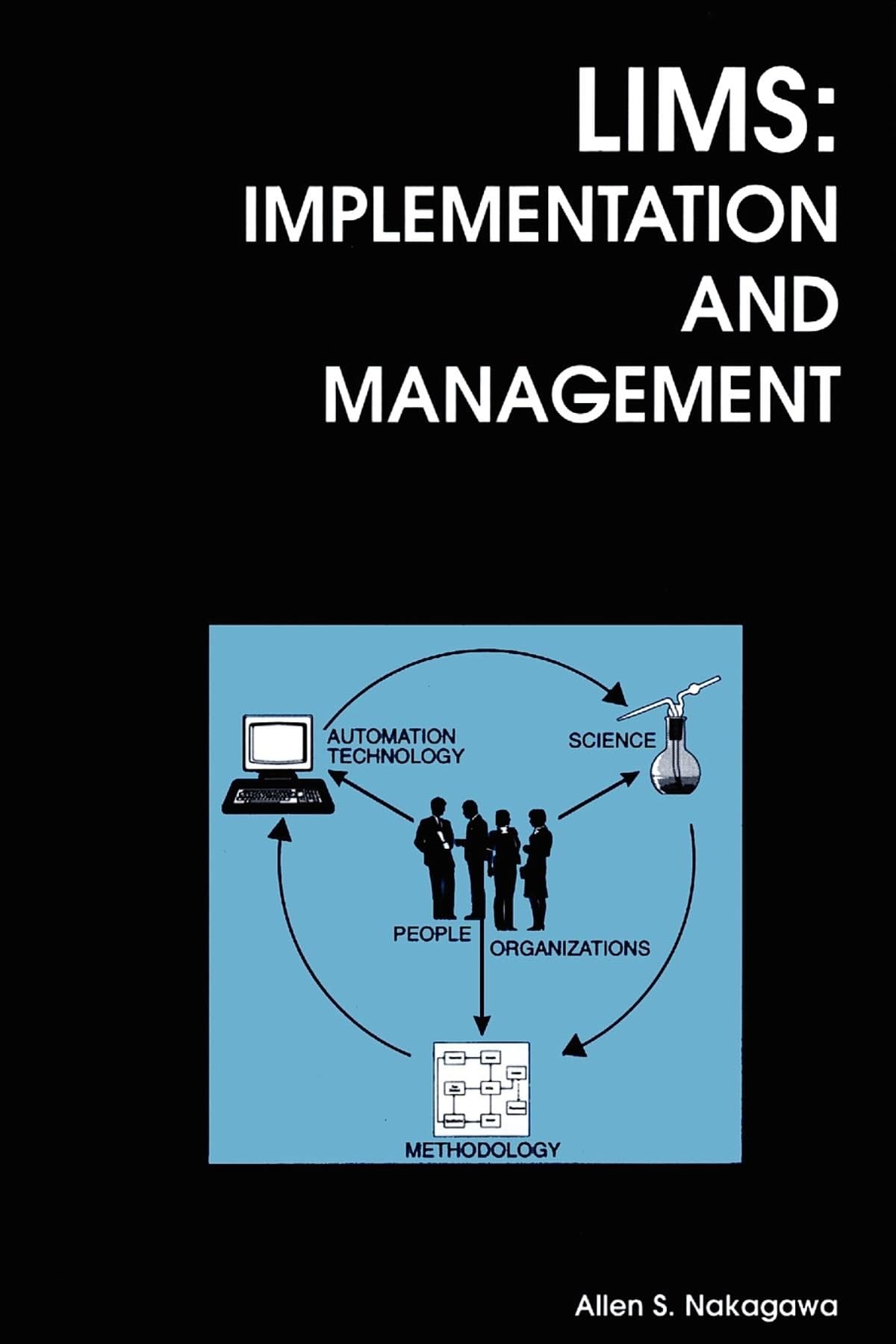
Title
Lims: Implementation And Management,Used
Sold by Ergodebooks, an authorized reseller.
Returns accepted within 30 days | support@ergodebooks.com
Shipping Information
- Free Standard Shipping — United States only
- Processing Time: 3–5 business days
- Estimated Delivery: 6–10 business days after dispatch
- Double-boxed, fully insured & discreetly packaged
- Tracking number sent via email once dispatched
Returns & Refund
Returns accepted within 30 days of delivery.
Damaged or Defective Item
Free return shipping + replacement or full refund
Wrong Item Received
Free return shipping + replacement or full refund
Change of Mind
Return shipping at customer's expense · 25% restocking fee applies
Payment Option

Excerpt. Reprinted by permission. All rights reserved.LIMS: Implementation and ManagementBy Allen S. Nakagawa The Royal Society of ChemistryCopyright 1994 The Royal Society of ChemistryAll rights reserved.ISBN: 9780851868240ContentsChapter 1 Historical Perspective, 1,Chapter 2 What is a LIMS?, 9,Chapter 3 Techniques for Understanding Laboratory Operations, 30,Chapter 4 Laboratory Roles and Internal Interactions, 48,Chapter 5 Laboratory Interactions with Other Groups, 63,Chapter 6 Impact of a LIMS on the Laboratory, 75,Chapter 7 Determining Technologies that are Relevant or Irrelevant to a LIMS, 81,Chapter 8 Establishing Realistic Goals for the LIMS, 88,Chapter 9 Needs Assessment and System Selection, 95,Chapter 10 Resources for LIMS Implementation, 112,Chapter 11 Essential Elements of a LIMS Implementation Plan, 119,Chapter 12 Justification and Approvals, 138,Chapter 13 The LIMS Implementation Infrastructure, 148,Chapter 14 Managing Change, 159,Chapter 15 Postimplementation Considerations, 166,Subject Index, 177,CHAPTER 1Historical PerspectiveAbove all, the principal product of any laboratory is information. This information advances the state of our commerce, welfare, and the technologies upon which our businesses and societies rely. The analytical measurement (or information generating) capabilities of laboratories are based upon increasingly complex testing systems. They consist of a coherent blend of components representing innovations from several disciplines. In fact, the specialized field of analytical chemistry consists of an everexpanding collage of scientific areas, including organic chemistry, biochemistry, mathematics, inorganic chemistry, optics, biotechnology, microbiology, physics, electronics, statistics, and immunology.During the past three decades, automation has exponentially increased the laboratory's data generation and information management capabilities. This chapter presents a historical perspective on computermediated improvements in laboratory capabilities, efficiency, and overall operations. The first section presents a chronological overview of innovations affecting the usage and application of computers within the laboratory. The second section discusses the historical development and selected case histories of LIMS.1 History of Laboratory Computer UtilizationProgress in automation of the laboratory parallels technical and commercial developments in computers. The earliest mainframe computer systems of the 1960s were extremely expensive and required highly skilled professionals to keep them running. Initially, only the wealthiest organizations could afford them. Their use was highly restricted, tightly controlled, and had to be scheduled far in advance. By today's standards, the earlier machines were extremely primitive. Over the years, technological developments have significantly improved the capabilities of, performance of, and access to automation. At the same time, the cost of computers has dramatically decreased. The capability of the earlier million dollar systems is now readily available in pocket sized calculators costing less than 10 dollars. The extent and use of automation by laboratories has increased as the emerging technology has developed, stabilized, and become more affordable through largescale production and marketing.The use of computers in laboratories proceeded through the following stages. Initially, scientists created programs for their own use. Usage was limited to individuals who were highly computer literate and to organizations willing to invest the substantial time needed to create software. Commercial software packages emerged which provided increased access to automation. This extended the utilization of software to organizations who were unwilling to invest in substantial software development efforts. The costs of computer hardware decreased substantially due to advances in solid state electronics and the introducti
⚠️ WARNING (California Proposition 65):
This product may contain chemicals known to the State of California to cause cancer, birth defects, or other reproductive harm.
For more information, please visit www.P65Warnings.ca.gov.