
Title
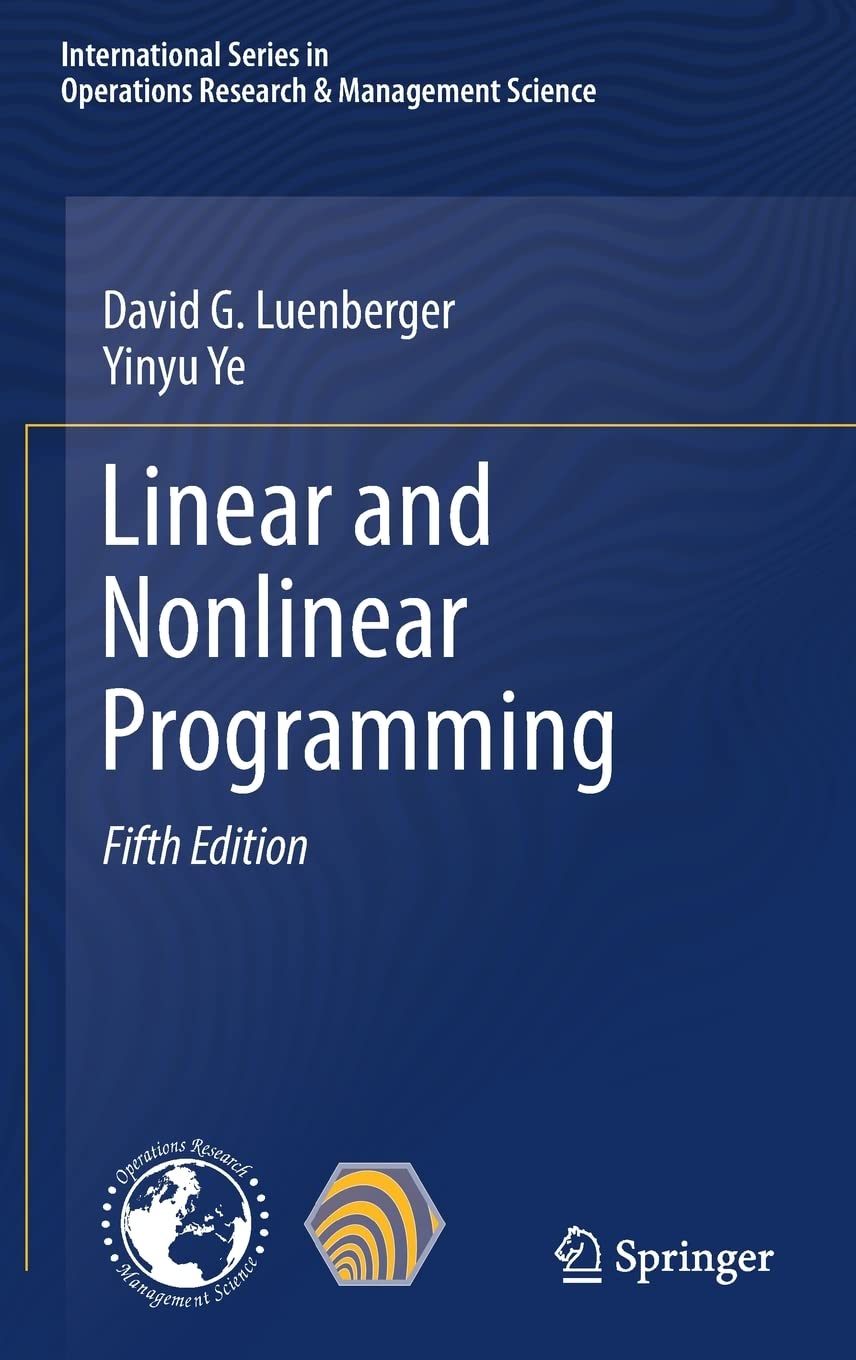
Linear and Nonlinear Programming (International Series in Operations Research & Management Science, 228),Used
Sold by Ergodebooks, an authorized reseller.
Returns accepted within 30 days | support@ergodebooks.com
Shipping Information
- Free Standard Shipping — United States only
- Processing Time: 3–5 business days
- Estimated Delivery: 6–10 business days after dispatch
- Double-boxed, fully insured & discreetly packaged
- Tracking number sent via email once dispatched
Returns & Refund
Returns accepted within 30 days of delivery.
Damaged or Defective Item
Free return shipping + replacement or full refund
Wrong Item Received
Free return shipping + replacement or full refund
Change of Mind
Return shipping at customer's expense · 25% restocking fee applies
Payment Option

The 5th edition of this classic textbook covers the central concepts of practical optimization techniques, with an emphasis on methods that are both stateoftheart and popular. One major insight is the connection between the purely analytical character of an optimization problem and the behavior of algorithms used to solve that problem. Endofchapter exercises are provided for all chapters.The material is organized into three separate parts. Part I offers a selfcontained introduction to linear programming. The presentation in this part is fairly conventional, covering the main elements of the underlying theory of linear programming, many of the most effective numerical algorithms, and many of its important special applications. Part II, which is independent of Part I, covers the theory of unconstrained optimization, including both derivations of the appropriate optimality conditions and an introduction to basic algorithms. This part of the book explores the general properties of algorithms and defines various notions of convergence. In turn, Part III extends the concepts developed in the second part to constrained optimization problems. Except for a few isolated sections, this part is also independent of Part I. As such, Parts II and III can easily be used without reading Part I and, in fact, the book has been used in this way at many universities.New to this edition are popular topics in data science and machine learning, such as the Markov Decision Process, Farkas lemma, convergence speed analysis, duality theories and applications, various firstorder methods, stochastic gradient method, mirrordescent method, FrankWolf method, ALM/ADMM method, interior trustregion method for nonconvex optimization, distributionally robust optimization, online linear programming, semidefinite programming for sensornetwork localization, and infeasibility detection for nonlinear optimization.
⚠️ WARNING (California Proposition 65):
This product may contain chemicals known to the State of California to cause cancer, birth defects, or other reproductive harm.
For more information, please visit www.P65Warnings.ca.gov.