If you have any questions, you are always welcome to contact us. We'll get back to you as soon as possible, withing 24 hours on weekdays.
Customer service
All questions about your order, return and delivery must be sent to our customer service team by e-mail at yourstore@yourdomain.com
Sale & Press
If you are interested in selling our products, need more information about our brand or wish to make a collaboration, please contact us at press@yourdomain.com
Help
If you have any questions, you are always welcome to contact us. We'll get back to you as soon as possible, withing 24 hours on weekdays.
Customer service
All questions about your order, return and delivery must be sent to our customer service team by e-mail at yourstore@yourdomain.com
Sale & Press
If you are interested in selling our products, need more information about our brand or wish to make a collaboration, please contact us at press@yourdomain.com
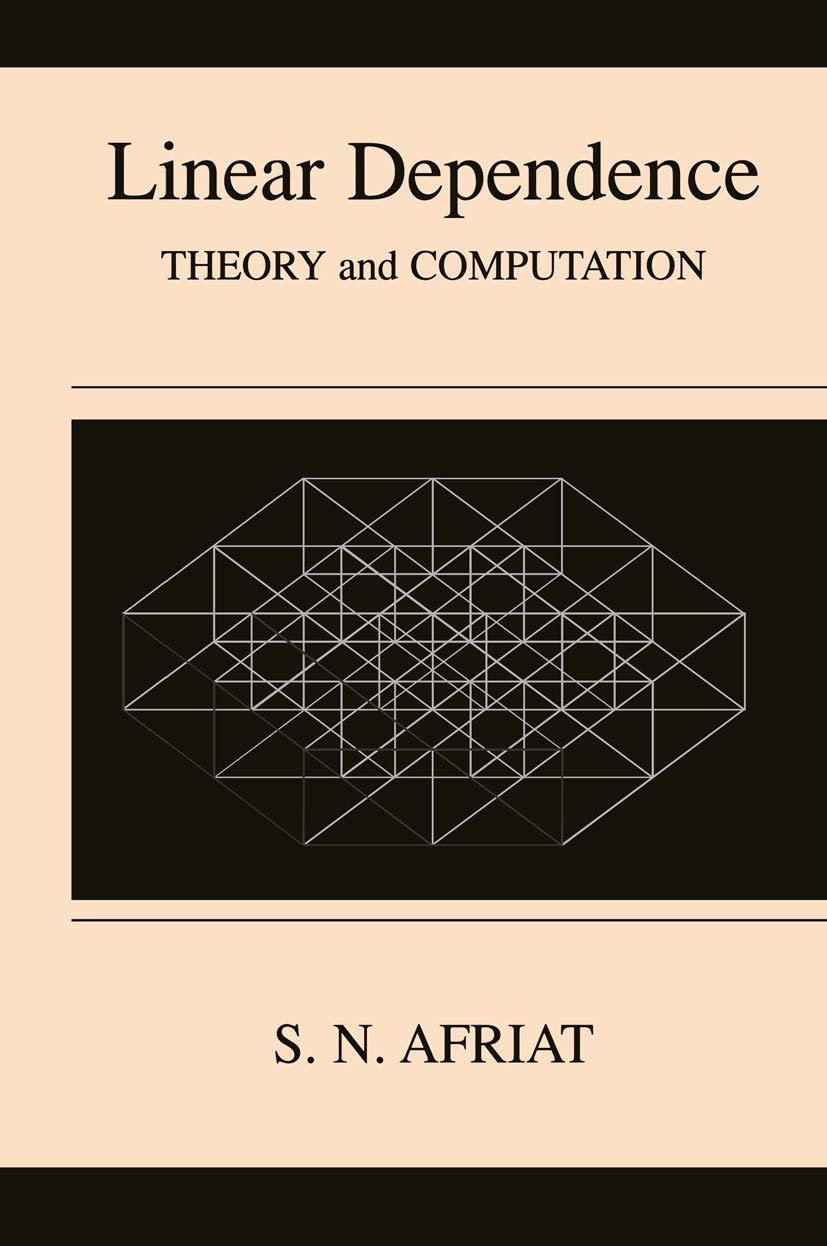
Deals with the most basic notion of linear algebra, to bring emphasis on approaches to the topic serving at the elementary level and more broadly.A typical feature is where computational algorithms and theoretical proofs are brought together. Another is respect for symmetry, so that when this has some part in the form of a matter it should also be reflected in the treatment. Issues relating to computational method are covered. These interests may have suggested a limited account, to be roundedout suitably. However this limitation where basic material is separated from further reaches of the subject has an appeal of its own.To the elementary operations' method of the textbooks for doing linear algebra, Albert Tucker added a method with his pivot operation'. Here there is a more primitive method based on the linear dependence table', and yet another based on rank reduction'. The determinant is introduced in a completely unusual upsidedown fashion where Cramer's rule comes first. Also dealt with is what is believed to be a completely new idea, of the alternant', a function associated with the affine space the way the determinant is with the linear space, with n+1 vector arguments, as the determinant has n. Then for affine (or barycentric) coordinates we find a rule which is an unprecedented exact counterpart of Cramer's rule for linear coordinates, where the alternant takes on the role of the determinant. These are among the more distinct or spectacular items for possible novelty, or unfamiliarity. Others, with or without some remark, may be found scattered in different places.
⚠️ WARNING (California Proposition 65):
This product may contain chemicals known to the State of California to cause cancer,
birth defects, or other reproductive harm.
For MAP (Minimum Advertised Price) violations and Intellectual Property (IP) or Trademark concerns, please contact:
support@ergodebooks.com
⚠️ California Proposition 65 Warning: Some products sold on this website may expose you to chemicals known to the State of California to cause cancer, birth defects, or other reproductive harm. For more information, visit www.P65Warnings.ca.gov.