
Title
Linear Dichroism and Circular Dichroism: A Textbook on PolarizedLight Spectroscopy (Special Publication),Used
Sold by Ergodebooks, an authorized reseller.
Returns accepted within 30 days | support@ergodebooks.com
Shipping Information
- Free Standard Shipping — United States only
- Processing Time: 3–5 business days
- Estimated Delivery: 6–10 business days after dispatch
- Double-boxed, fully insured & discreetly packaged
- Tracking number sent via email once dispatched
Returns & Refund
Returns accepted within 30 days of delivery.
Damaged or Defective Item
Free return shipping + replacement or full refund
Wrong Item Received
Free return shipping + replacement or full refund
Change of Mind
Return shipping at customer's expense · 25% restocking fee applies
Payment Option

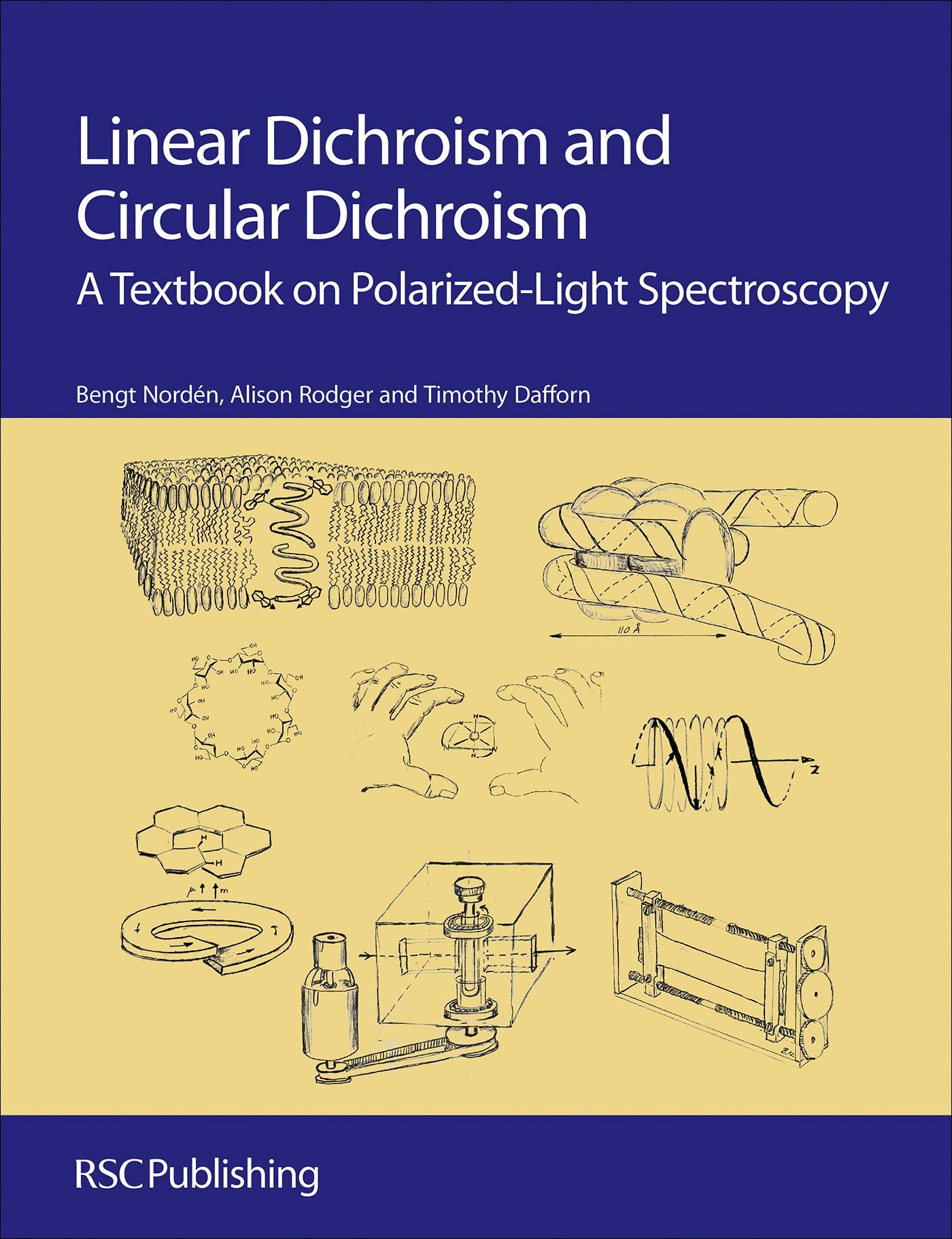
This book provides an introduction to optical anisotropy (linear dichroism, LD) and optical activity (circular dichroism, CD) as techniques for the study of structures and interactions of molecules in solution. The book covers the use of these techniques for both small and large molecular systems with particular emphasis being placed on proteins and nucleic acids. CD is a wellestablished technique and this book aims to explain how it can be used simply and effectively for new entrants to the field as well as covering more advanced techniques for experts. LD is often seen as a rather exotic method intended only for experienced spectroscopists. This book demonstrates that it is an approach with real utility that may be used by both students and scientists from graduate level onwards to give simple answers, which are not available from any other technique, to structural and kinetic questions. Much of the emphasis is on flow orientation of samples in solution phase. The book first describes the techniques and the information they can provide; it then goes on to give specific details on how to actually implement them, including a wide range of examples showing how LD and CD can help with * protein and nucleic acid secondary structure elucidation; * analysis of the formation and rearrangements of fibrous proteins and membrane proteins; * identification of the absolute configuration of small molecules; * determination of the orientation of small molecules in anisotropic media; * assignment of transition moment polarizations; * investigation of binding strengths and geometries of ligandmacromolecule complexes; * 3D structure determination from LD, molecular replacement and MD modeling. The advantages of combined LD/CD studies are also outlined with examples of DNA/drug complexes and protein insertion into membranes. Taken together the book represents a comprehensive text on the theory and application of LD and CD in the chemical and biological sciences.
⚠️ WARNING (California Proposition 65):
This product may contain chemicals known to the State of California to cause cancer, birth defects, or other reproductive harm.
For more information, please visit www.P65Warnings.ca.gov.