
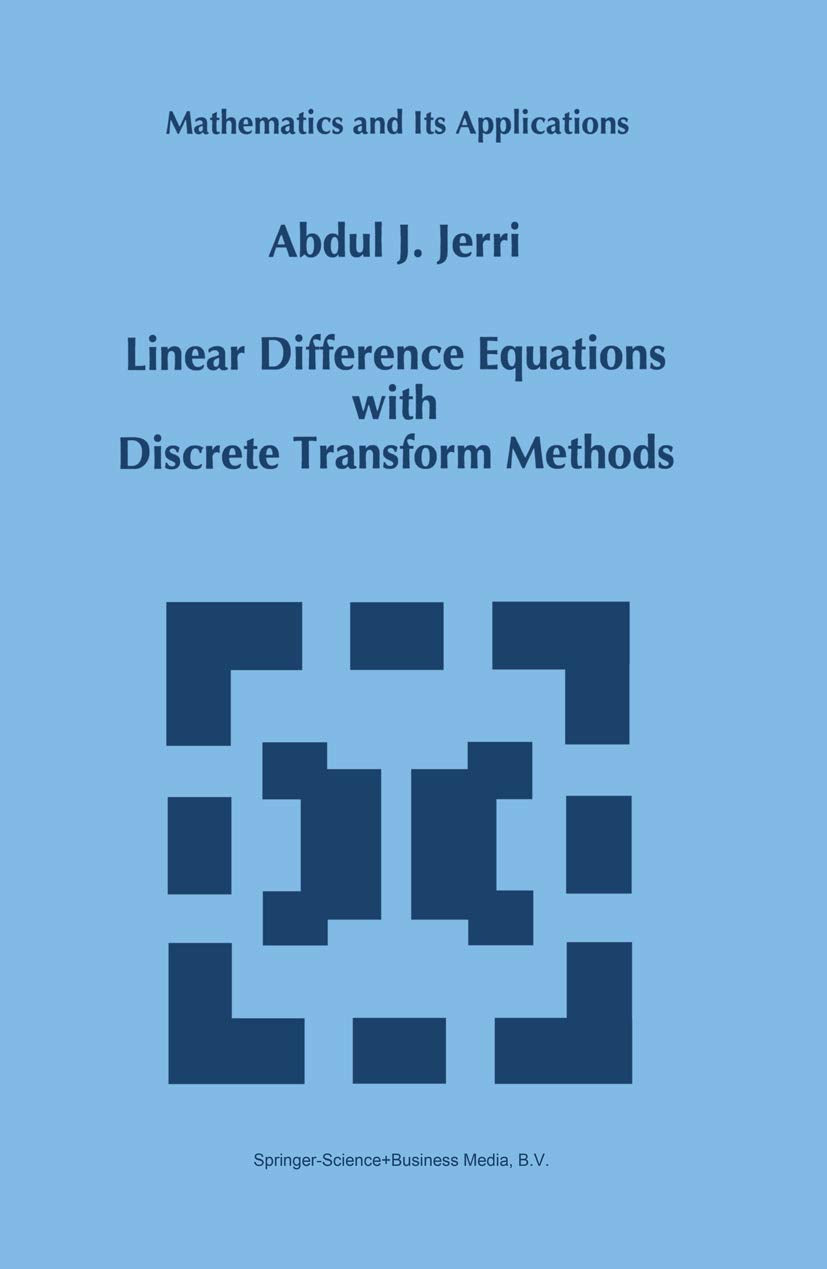
Title
Linear Difference Equations with Discrete Transform Methods (Mathematics and Its Applications, 363),Used
Sold by Ergodebooks, an authorized reseller.
Returns accepted within 30 days | support@ergodebooks.com
Shipping Information
- Free Standard Shipping — United States only
- Processing Time: 3–5 business days
- Estimated Delivery: 6–10 business days after dispatch
- Double-boxed, fully insured & discreetly packaged
- Tracking number sent via email once dispatched
Returns & Refund
Returns accepted within 30 days of delivery.
Damaged or Defective Item
Free return shipping + replacement or full refund
Wrong Item Received
Free return shipping + replacement or full refund
Change of Mind
Return shipping at customer's expense · 25% restocking fee applies
Payment Option

This book covers the basic elements of difference equations and the tools of difference and sum calculus necessary for studying and solv ing, primarily, ordinary linear difference equations. Examples from various fields are presented clearly in the first chapter, then discussed along with their detailed solutions in Chapters 27. The book is in tended mainly as a text for the beginning undergraduate course in difference equations, where the "operational sum calculus" of the di rect use of the discrete Fourier transforms for solving boundary value problems associated with difference equations represents an added new feature compared to other existing books on the subject at this introductory level. This means that in addition to the familiar meth ods of solving difference equations that are covered in Chapter 3, this book emphasizes the use of discrete transforms. It is an attempt to introduce the methods and mechanics of discrete transforms for solv ing ordinary difference equations. The treatment closely parallels what many students have already learned about using the opera tional (integral) calculus of Laplace and Fourier transforms to solve differential equations. As in the continuous case, discrete operational methods may not solve problems that are intractable by other meth ods, but they can facilitate the solution of a large class of discrete initial and boundary value problems. Such operational methods, or what we shall term "operational sum calculus," may be extended eas ily to solve partial difference equations associated with initial and/or boundary value problems.
⚠️ WARNING (California Proposition 65):
This product may contain chemicals known to the State of California to cause cancer, birth defects, or other reproductive harm.
For more information, please visit www.P65Warnings.ca.gov.