If you have any questions, you are always welcome to contact us. We'll get back to you as soon as possible, withing 24 hours on weekdays.
Customer service
All questions about your order, return and delivery must be sent to our customer service team by e-mail at yourstore@yourdomain.com
Sale & Press
If you are interested in selling our products, need more information about our brand or wish to make a collaboration, please contact us at press@yourdomain.com
Help
If you have any questions, you are always welcome to contact us. We'll get back to you as soon as possible, withing 24 hours on weekdays.
Customer service
All questions about your order, return and delivery must be sent to our customer service team by e-mail at yourstore@yourdomain.com
Sale & Press
If you are interested in selling our products, need more information about our brand or wish to make a collaboration, please contact us at press@yourdomain.com
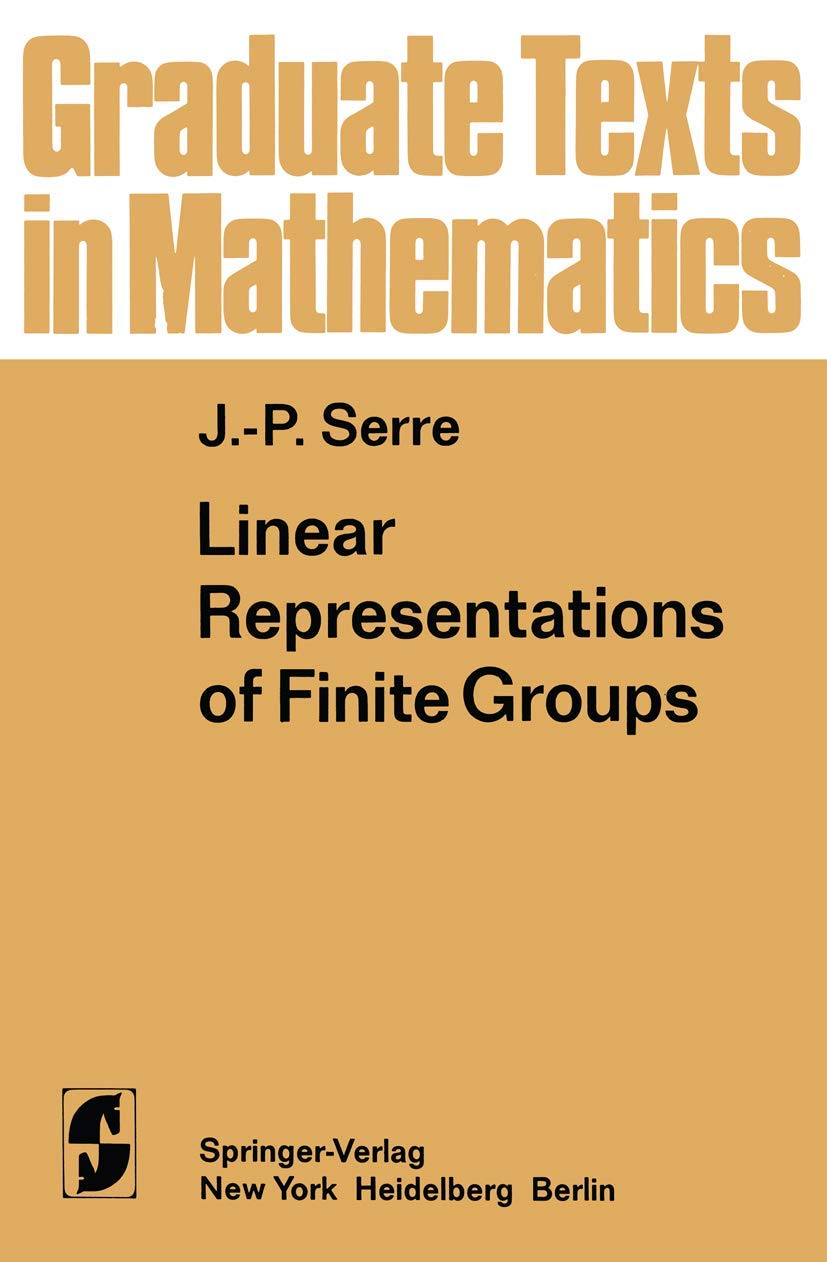
This book consists of three parts, rather different in level and purpose: The first part was originally written for quantum chemists. It describes the correspondence, due to Frobenius, between linear representations and charac ters. This is a fundamental result, of constant use in mathematics as well as in quantum chemistry or physics. I have tried to give proofs as elementary as possible, using only the definition of a group and the rudiments of linear algebra. The examples (Chapter 5) have been chosen from those useful to chemists. The second part is a course given in 1966 to secondyear students of I'Ecoie Normale. It completes the first on the following points: (a) degrees of representations and integrality properties of characters (Chapter 6); (b) induced representations, theorems of Artin and Brauer, and applications (Chapters 711); (c) rationality questions (Chapters 12 and 13). The methods used are those of linear algebra (in a wider sense than in the first part): group algebras, modules, noncommutative tensor products, semisimple algebras. The third part is an introduction to Brauer theory: passage from characteristic 0 to characteristic p (and conversely). I have freely used the language of abelian categories (projective modules, Grothendieck groups), which is well suited to this sort of question. The principal results are: (a) The fact that the decomposition homomorphism is surjective: all irreducible representations in characteristic p can be lifted 'virtually' (i.e., in a suitable Grothendieck group) to characteristic O.
⚠️ WARNING (California Proposition 65):
This product may contain chemicals known to the State of California to cause cancer,
birth defects, or other reproductive harm.
For MAP (Minimum Advertised Price) violations and Intellectual Property (IP) or Trademark concerns, please contact:
support@ergodebooks.com
⚠️ California Proposition 65 Warning: Some products sold on this website may expose you to chemicals known to the State of California to cause cancer, birth defects, or other reproductive harm. For more information, visit www.P65Warnings.ca.gov.