
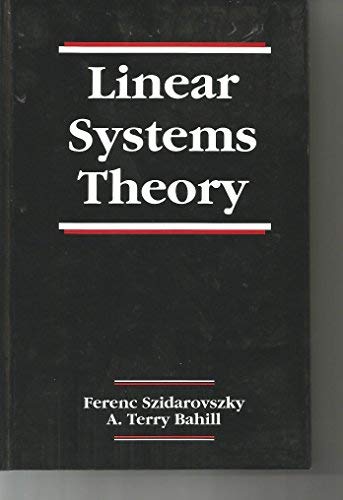
Title
Linear Systems Theory (Systems Engineering),Used
Sold by Ergodebooks, an authorized reseller.
Returns accepted within 30 days | support@ergodebooks.com
Shipping Information
- Free Standard Shipping — United States only
- Processing Time: 3–5 business days
- Estimated Delivery: 6–10 business days after dispatch
- Double-boxed, fully insured & discreetly packaged
- Tracking number sent via email once dispatched
Returns & Refund
Returns accepted within 30 days of delivery.
Damaged or Defective Item
Free return shipping + replacement or full refund
Wrong Item Received
Free return shipping + replacement or full refund
Change of Mind
Return shipping at customer's expense · 25% restocking fee applies
Payment Option

Linear Systems Theory is a comprehensive text that presents a mathematically rigorous development of important tools of linear systems theory. These tools include differential and difference equations, Laplace and Z transforms, state space and transfer function representations, stability, controllability and observability, duality, canonical forms, realizability, minimal realizations, observers, feedback compensators, nonnegative systems, Kalman filters, and adaptive control and neural networks.
⚠️ WARNING (California Proposition 65):
This product may contain chemicals known to the State of California to cause cancer, birth defects, or other reproductive harm.
For more information, please visit www.P65Warnings.ca.gov.
- Q: What are the dimensions of this book? A: The book measures six point seventy-five inches in length, one inch in width, and nine point seventy-six inches in height.
- Q: How many pages does 'Linear Systems Theory' have? A: This book contains four hundred forty-eight pages, providing an in-depth exploration of linear systems.
- Q: What type of binding is used for this book? A: The book is bound in hardcover, ensuring durability and longevity for frequent use.
- Q: How do I effectively study from this book? A: To study effectively, read chapter summaries first, then dive into the detailed explanations and practice problems.
- Q: Is this book suitable for beginners in systems engineering? A: Yes, this book is suitable for beginners, as it introduces foundational concepts in linear systems theory.
- Q: Can I use this book for reference in advanced courses? A: Yes, this book serves as a valuable reference for advanced courses and topics in systems engineering.
- Q: How should I store this book to keep it in good condition? A: Store the book upright on a shelf in a dry place to prevent moisture damage and ensure its longevity.
- Q: What are the best practices for cleaning this hardcover book? A: To clean the book, gently wipe the cover with a dry cloth. Avoid using liquids or excessive pressure.
- Q: Is this book safe to use in a classroom setting? A: Yes, this book is safe for use in classroom settings and is appropriate for educational purposes.
- Q: What should I do if my book arrives damaged? A: If your book arrives damaged, please contact the seller for a return or exchange within the specified return period.
- Q: What is the return policy for this book? A: The return policy allows for returns within thirty days of purchase, provided the book is in good condition.
- Q: How can I contact support if I have questions about this book? A: You can contact the seller's customer support via email or phone for any questions regarding your purchase.
- Q: Is this book suitable for graduate-level study? A: Yes, this book is suitable for graduate-level study, covering advanced topics in linear systems theory.
- Q: What topics are covered in 'Linear Systems Theory'? A: The book covers topics such as stability, controllability, observability, and Kalman filters in linear systems.
- Q: Who is the author of this book? A: The author of 'Linear Systems Theory' is Ferenc Szidarovszky, a knowledgeable figure in systems engineering.
- Q: Does this book include practical examples? A: Yes, the book includes practical examples and exercises to reinforce the theoretical concepts discussed.