If you have any questions, you are always welcome to contact us. We'll get back to you as soon as possible, withing 24 hours on weekdays.
Customer service
All questions about your order, return and delivery must be sent to our customer service team by e-mail at yourstore@yourdomain.com
Sale & Press
If you are interested in selling our products, need more information about our brand or wish to make a collaboration, please contact us at press@yourdomain.com
Help
If you have any questions, you are always welcome to contact us. We'll get back to you as soon as possible, withing 24 hours on weekdays.
Customer service
All questions about your order, return and delivery must be sent to our customer service team by e-mail at yourstore@yourdomain.com
Sale & Press
If you are interested in selling our products, need more information about our brand or wish to make a collaboration, please contact us at press@yourdomain.com
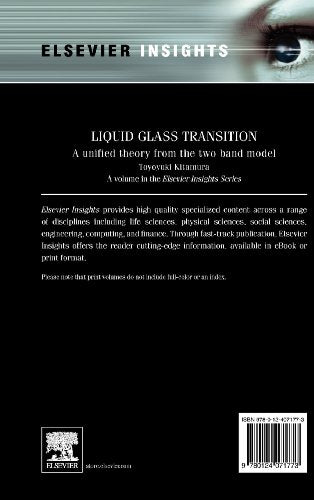
A glass is disordered material like a viscous liquid and behaves mechanically like a solid. A glass is normally formed by supercooling the viscous liquid fast enough to avoid crystallization, and the liquidglass transition occurs in diverse manners depending on the materials, their history, and the supercooling processes, among other factors. The glass transition in colloids, molecular systems, and polymers is studied worldwide. This book presents a unified theory of the liquidglass transition on the basis of the two band model from statistical quantum field theory associated with the temperature Greens function method. It is firmly original in its approach and will be of interest to researchers and students specializing in the glass transition across the physical sciences. Examines key theoretical problems of the liquidglass transition and related phenomena Clarifies the mechanism and the framework of the liquidglass transition
⚠️ WARNING (California Proposition 65):
This product may contain chemicals known to the State of California to cause cancer,
birth defects, or other reproductive harm.
For MAP (Minimum Advertised Price) violations and Intellectual Property (IP) or Trademark concerns, please contact:
support@ergodebooks.com
⚠️ California Proposition 65 Warning: Some products sold on this website may expose you to chemicals known to the State of California to cause cancer, birth defects, or other reproductive harm. For more information, visit www.P65Warnings.ca.gov.