If you have any questions, you are always welcome to contact us. We'll get back to you as soon as possible, withing 24 hours on weekdays.
Customer service
All questions about your order, return and delivery must be sent to our customer service team by e-mail at yourstore@yourdomain.com
Sale & Press
If you are interested in selling our products, need more information about our brand or wish to make a collaboration, please contact us at press@yourdomain.com
Help
If you have any questions, you are always welcome to contact us. We'll get back to you as soon as possible, withing 24 hours on weekdays.
Customer service
All questions about your order, return and delivery must be sent to our customer service team by e-mail at yourstore@yourdomain.com
Sale & Press
If you are interested in selling our products, need more information about our brand or wish to make a collaboration, please contact us at press@yourdomain.com
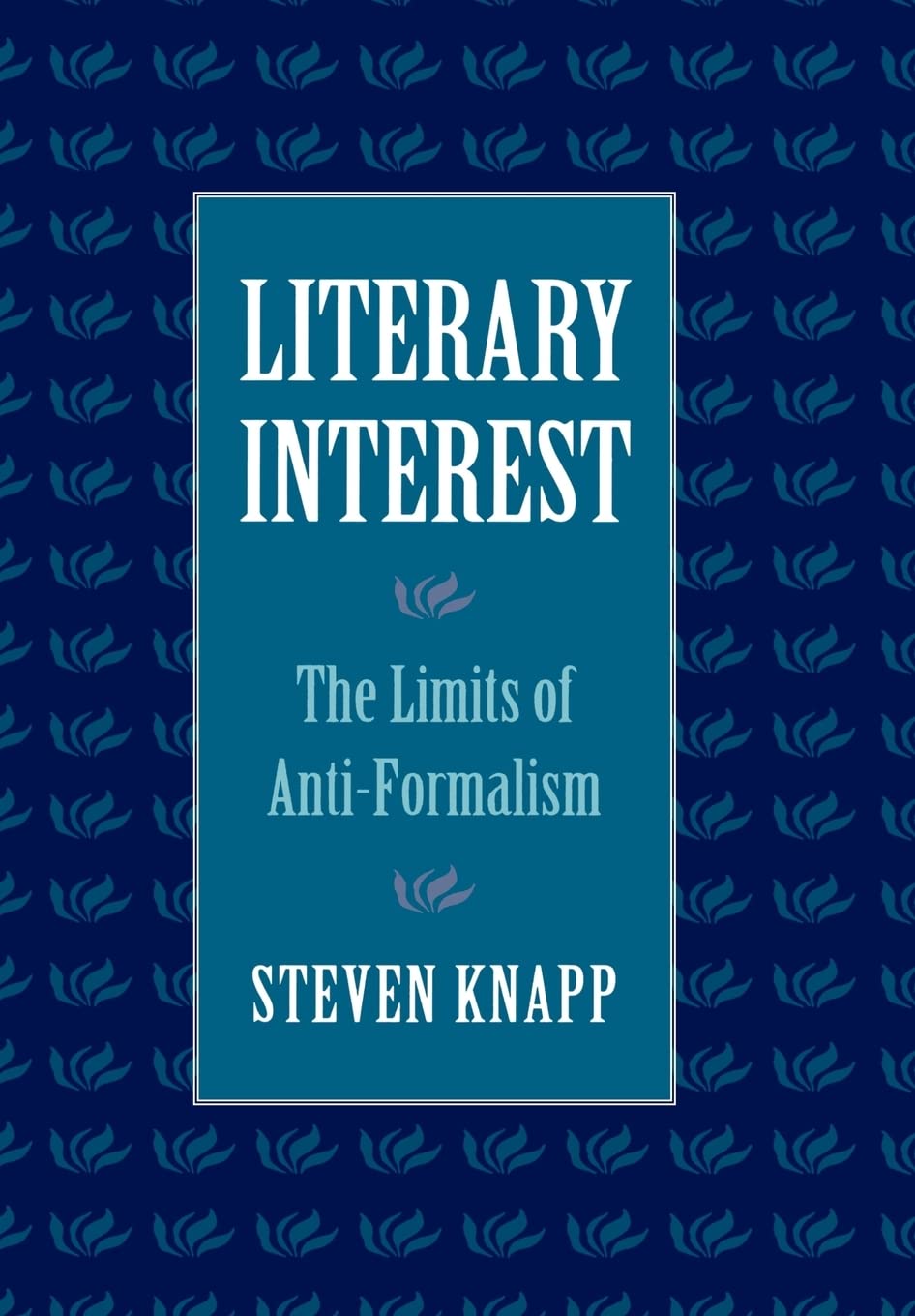
Is there such a thing as a specifically literary discourse, distinguishable from other modes of thought and writing? Is there any way to defend the intuition that a work of literature says something that can't be said in any other way? Drawing on recent work in the philosophies of language and action, Steven Knapp presents a challenging new definition of the literary in a forceful analysis that will radically change the sometimes heated debate about formalism.Formalist theorists have maintained that the uniqueness of the literary lies in the special nature of literary language. Their critics argue that to draw sharp distinctions between literary and nonliterary language is to privilege one kind of text and to insulate cultural activity from social conflict and political change. In the course of a rigorous engagement with such literary theorists, old and new, Knapp develops a provocative defense of the notion of a uniquely literary mode of discoursea defense that challenges proponents as well as critics of formalism. He extends and deepens current debates about the literary canon, the purpose of literary study, and the aims and implications of the recent critical return to history. His bold and surprising argument has significance for the ethical and political role of literary studies that no one interested in literary theory or the philosophy of art will be able to ignore. Literary Interest will engage theorists, literary critics in all fields, and philosophers addressing issues of aesthetics and language.
⚠️ WARNING (California Proposition 65):
This product may contain chemicals known to the State of California to cause cancer,
birth defects, or other reproductive harm.
For MAP (Minimum Advertised Price) violations and Intellectual Property (IP) or Trademark concerns, please contact:
support@ergodebooks.com
⚠️ California Proposition 65 Warning: Some products sold on this website may expose you to chemicals known to the State of California to cause cancer, birth defects, or other reproductive harm. For more information, visit www.P65Warnings.ca.gov.