
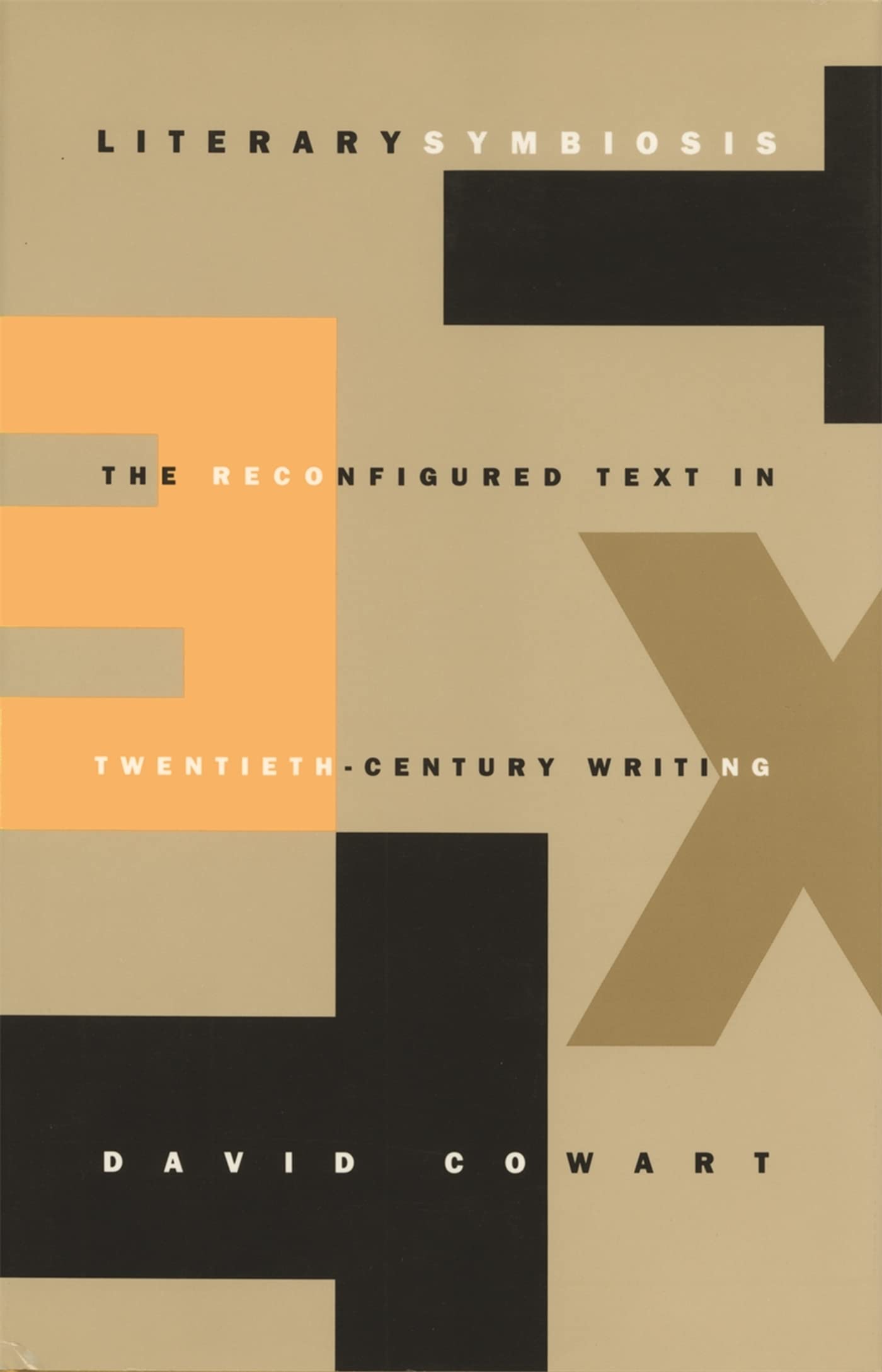
Title
Literary Symbiosis: The Reconfigured Text In Twentiethcentury Writing,New
Sold by Ergodebooks, an authorized reseller.
Returns accepted within 30 days | support@ergodebooks.com
Shipping Information
- Free Standard Shipping — United States only
- Processing Time: 3–5 business days
- Estimated Delivery: 6–10 business days after dispatch
- Double-boxed, fully insured & discreetly packaged
- Tracking number sent via email once dispatched
Returns & Refund
Returns accepted within 30 days of delivery.
Damaged or Defective Item
Free return shipping + replacement or full refund
Wrong Item Received
Free return shipping + replacement or full refund
Change of Mind
Return shipping at customer's expense · 25% restocking fee applies
Payment Option

Review Cowart attempts with admirable success to give shape and definition to particular kinds of intertextuality and then proceeds to examine some instances with insight and originality in several works. Modern Fiction StudiesAn excellent look at a central feature of literature. . . . Although Cowart's study focuses on the explicitly symbiotic text, he does so with the intent of showing 'a number of features common to all literature, and thereby to suggest that what at first seems an anomaly is ultimately something at the heart of the matter.' ChoiceLiterary Symbiosis offers brilliant individual readings in the context of a theoretically expansive structure that has wideranging implications. It is an engaging and important book. American Studies International Product Description 'It is only the unimaginative who ever invents,' Oscar Wilde once remarked. 'The true artist is known by the use he makes of what he annexes, and he annexes everything.' Converying a similar awareness, James Joyce observes in Finnegan's Wake that storytelling is in reality 'stolentelling,' that art always involves some sort of 'theft' or borrowing.Usually literary borrowings are so integrated into the new work as to be disguised; however, according to David Cowart, recent decades have seen an increasing number of texts that attach themselves to their sources in seemingly parasiticbut, more accurately, symbioticdependence. It is this kind of mutuality that Cowart examines in his wideranging and richly provocative study Literary Symbiosis. Cowart considers, for instance, what happens when Tom Stoppard, in Rosencrantz and Guildenstern Are Dead, rewrites Hamlet from the point of view of its two most insignificant characters, or when Jean Rhys, in Wide Sargasso Sea, imagines the early life of Bertha Rochester, the madwoman in the attic in Jane Eyre.In such works of literary symbiosis, Cowart notes, intertextuality surrenders its usual veil of near invisibility to become concrete and explicita phenomenon that Cowart sees as part of the postmodern tendency toward selfconsciousness and selfreflexivity. He recognizes that literary symbiosis has some close cousins and so limits his compass to works that are genuine reinterpretations, writings that cast a new light on earlier works through 'some tangible measure of formal or thematic evolution, whether on the part of the guest alone or the host and guest together.' Proceeding from this intriguing premise, he offers detailed readings of texts that range from Auden's 'The Sea and the Mirror,' based on The Tempest, to Valerie Martin's reworking of The Strange Case of Dr. Jekyll and Mr. Hyde as Mary Reilly, to various fictions based on Robinson Crusoe. He also considers, in Nabokov's Pale Fire, a compelling example of text and parasitetext within a single work.Drawing on and responding to the ideas of disparate thinkers and criticsamong them Freud, Harold Bloom, Jacques Lacan, Jacques Derrida, Hillis Miller, and Henry Louis Gates Jr.Cowart discusses literary symbiosis as Oedipal drama, as reading and misreading, as deconstruction, as Signifying, and as epistemic dialogue. Although his main examples come from the contemporary period, he refers to works dating as far back as the classical era, works representing a range of genres (drama, fiction, poetry, opera, and film). The study of literary symbiosis, Cowart contends, can reveal much about the dynamics of literary renewal in every age. If all literature redeems the familiar, he suggests, literary symbiosis redeems the familiar in literature itself. About the Author DAVID COWART is Louise Fry Scudder Professor of Humanities at the University of South Carolina. He has published several books of twentiethcentury literary criticism, including Literary Symbiosis: The Reconfigured Text in TwentiethCentury Writing (Georgia) and Thomas Pynchon: The Art of Allusion.
⚠️ WARNING (California Proposition 65):
This product may contain chemicals known to the State of California to cause cancer, birth defects, or other reproductive harm.
For more information, please visit www.P65Warnings.ca.gov.