
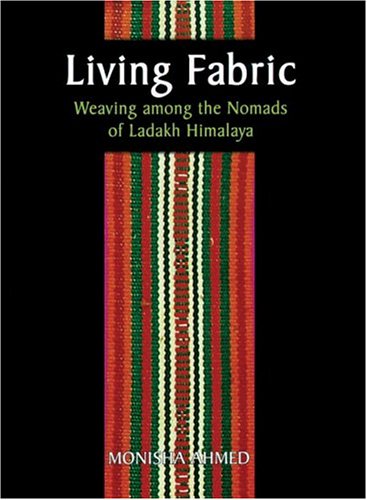
Title
Living Fabric: Weaving Among The Nomads Of Ladakh Himalaya,Used
Sold by Ergodebooks, an authorized reseller.
Returns accepted within 30 days | support@ergodebooks.com
Shipping Information
- Free Standard Shipping — United States only
- Processing Time: 3–5 business days
- Estimated Delivery: 6–10 business days after dispatch
- Double-boxed, fully insured & discreetly packaged
- Tracking number sent via email once dispatched
Returns & Refund
Returns accepted within 30 days of delivery.
Damaged or Defective Item
Free return shipping + replacement or full refund
Wrong Item Received
Free return shipping + replacement or full refund
Change of Mind
Return shipping at customer's expense · 25% restocking fee applies
Payment Option

This is the first study of the tradition of weaving among the nomadic pastoralists of Rupshu, in eastern Ladakh. Weaving touches all aspects of life in Rupshu, where both women and men weave, each on a different type of loom. Local narrative states that the craft of weaving was bestowed upon Rupshu by the gods, and thus all feats related to it have a close connection to the sublime.This book documents and analyses the ways in which fibers, weaving, and textiles are symbolized, constructed, and experienced in Rupshu where themes such as gender, kinship, hierarchical and spatial relations find ready expression through the design and making of cloth. Through her work the author traces the relationship between livestock, weaving, social and symbolic structures in order to understand the multitude of contexts within which wooloriented activities exist.Richly illustrated, this book will appeal to those with an interest in textiles, nomads, gender studies, and the Himalaya.
⚠️ WARNING (California Proposition 65):
This product may contain chemicals known to the State of California to cause cancer, birth defects, or other reproductive harm.
For more information, please visit www.P65Warnings.ca.gov.
- Q: What is the size of the book 'Living Fabric: Weaving Among The Nomads Of Ladakh Himalaya'? A: The book measures eight and a half inches in length, one inch in width, and ten point eight inches in height. This size makes it easy to handle and read.
- Q: How many pages does this book have? A: This book contains one hundred ninety-two pages. It offers a comprehensive exploration of weaving traditions among nomadic pastoralists.
- Q: What type of binding does this book have? A: The book features a hardcover binding. This durable format helps protect the pages and ensures longevity.
- Q: Who is the author of 'Living Fabric'? A: The author of the book is Monisha Ahmed. She provides valuable insights into the weaving practices of the Rupshu region.
- Q: What themes are explored in this book? A: The book explores themes such as gender, kinship, and hierarchical relations through the lens of weaving. It illustrates how these themes manifest in textile creation.
- Q: Is this book suitable for anyone interested in textiles? A: Yes, the book is ideal for those interested in textiles, nomads, gender studies, and the Himalaya. Its rich illustrations and insights cater to a variety of readers.
- Q: How can I best appreciate the content of this book? A: To fully appreciate the content, readers should engage with the illustrations and narratives detailing the weaving practices. This will enhance their understanding of the cultural context.
- Q: Is this book appropriate for academic use? A: Yes, this book is suitable for academic use. It provides in-depth analyses that can be referenced in gender studies and anthropology courses.
- Q: How do I care for my hardcover book? A: To care for your hardcover book, store it upright in a cool, dry place away from direct sunlight. This will help maintain its condition over time.
- Q: Can this book be used as a gift? A: Yes, this book makes an excellent gift for anyone interested in culture or textiles. Its unique subject matter will appeal to a diverse audience.
- Q: What if my book arrives damaged? A: If your book arrives damaged, you should contact the seller for return instructions. Many sellers offer a satisfaction guarantee or replacement policy.
- Q: Is there an ISBN for this book? A: Yes, the book has an ISBN which can be used to locate it in libraries or bookstores. This makes it easier for readers to find the exact edition.
- Q: What makes this book unique? A: This book is unique because it is the first comprehensive study of the weaving traditions among the nomadic pastoralists of Rupshu. It combines cultural insights with rich visual documentation.
- Q: Are there any illustrations in this book? A: Yes, the book is richly illustrated. The visuals complement the text and provide a deeper understanding of the weaving practices discussed.
- Q: Is this book part of a series? A: No, 'Living Fabric: Weaving Among The Nomads Of Ladakh Himalaya' is a standalone book. It offers a focused exploration of a specific cultural practice.