
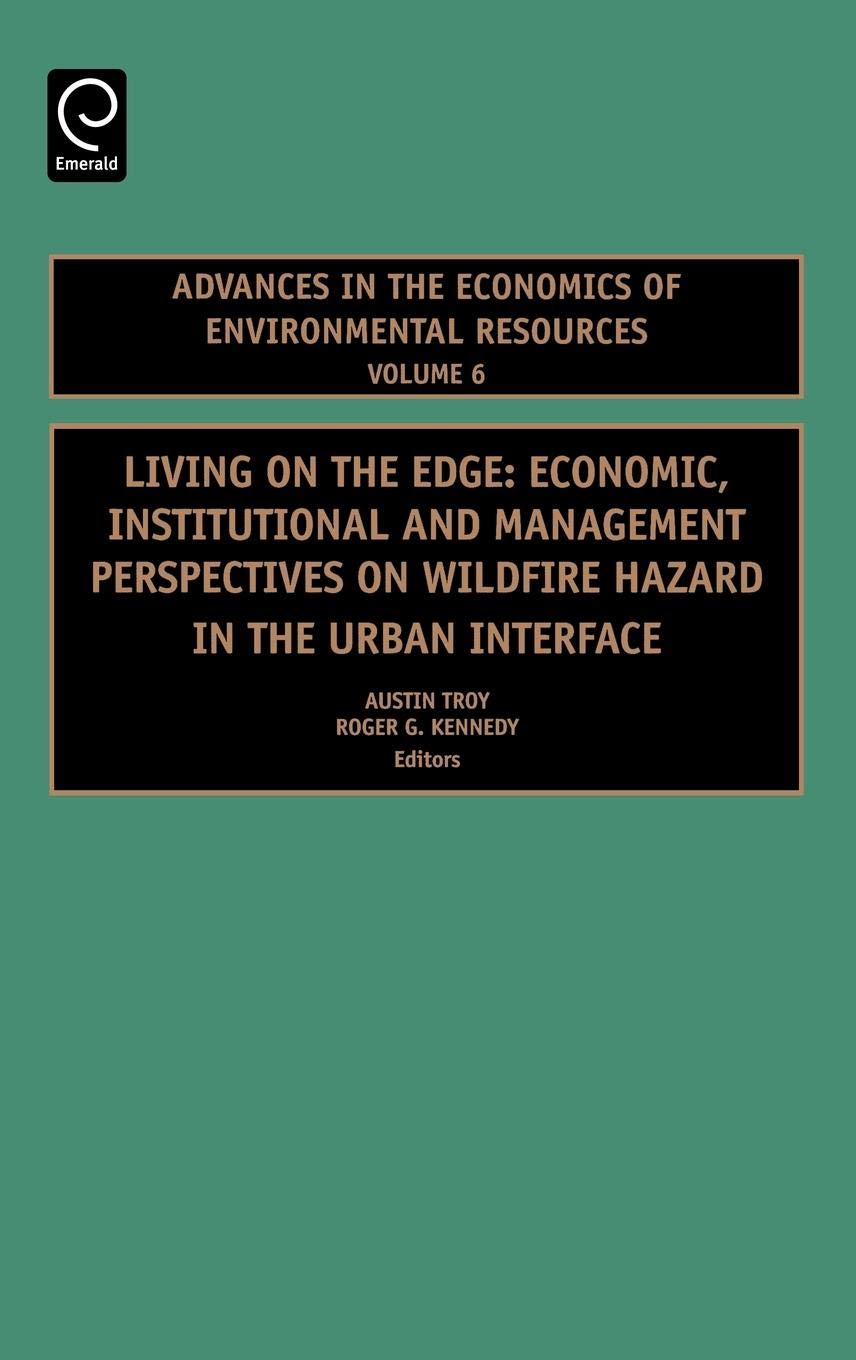
Title
Living On The Edge: Economic, Institutional And Management Perspectives On Wildfire Hazard In The Urban Interface (Advances In T
Sold by Ergodebooks, an authorized reseller.
Returns accepted within 30 days | support@ergodebooks.com
Shipping Information
- Free Standard Shipping — United States only
- Processing Time: 3–5 business days
- Estimated Delivery: 6–10 business days after dispatch
- Double-boxed, fully insured & discreetly packaged
- Tracking number sent via email once dispatched
Returns & Refund
Returns accepted within 30 days of delivery.
Damaged or Defective Item
Free return shipping + replacement or full refund
Wrong Item Received
Free return shipping + replacement or full refund
Change of Mind
Return shipping at customer's expense · 25% restocking fee applies
Payment Option

Wildfires are a fact of life throughout many arid and semiarid regions, such as the American West. With growing population pressures in these regions, human communities are increasingly developing in socalled urbanwildland interface zones, where severe fire driven ecosystems coexist uneasily with humans and their property. This edited volume addresses this problem and its potential solutions from an interdisciplinary perceptive, with contributions from authors in public policy, sociology, economics, ecology, computer modeling, planning, and ecology. The first section of the book addresses institutional and policy aspects, including chapters on national fire policy in the United States, local fire planning and policy, smart growth approaches to planning in fire zones, and institutional roadblocks to fuels management. The second section deals with economic aspects, including chapters on the role of information and disclosure of hazards in real estate markets, methods of underwriting fire insurance, and the consequences of statemandated fire insurers of last resort. The third section deals with community level involvement in fire management, addressing a wide range of issues including models of community engagement, criteria for success, and approaches for institutionalizing this process, both in the US and abroad. The final section deals with management and ecology and includes chapters on the predicted effects of climate change on wildfire activity, new computer modeling tools for mitigating fire risk, and complex institutional mechanisms behind largefire suppression in the US. It addresses institutional and policy aspects, economic aspects, community level involvement in fire management, and the management and ecology of wildfires.
⚠️ WARNING (California Proposition 65):
This product may contain chemicals known to the State of California to cause cancer, birth defects, or other reproductive harm.
For more information, please visit www.P65Warnings.ca.gov.