
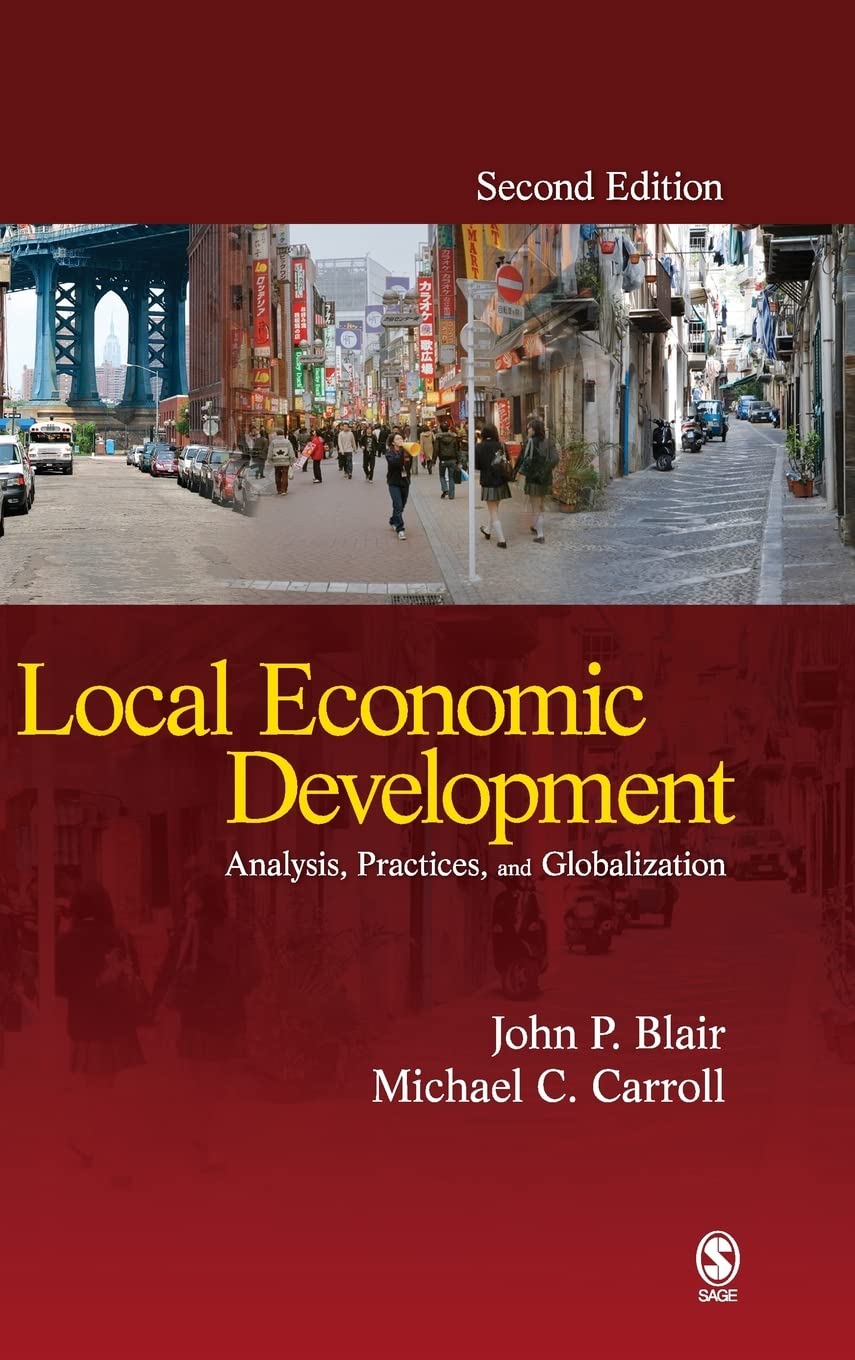
Title
Local Economic Development: Analysis, Practices, And Globalization
Sold by Ergodebooks, an authorized reseller.
Returns accepted within 30 days | support@ergodebooks.com
Shipping Information
- Free Standard Shipping — United States only
- Processing Time: 3–5 business days
- Estimated Delivery: 6–10 business days after dispatch
- Double-boxed, fully insured & discreetly packaged
- Tracking number sent via email once dispatched
Returns & Refund
Returns accepted within 30 days of delivery.
Damaged or Defective Item
Free return shipping + replacement or full refund
Wrong Item Received
Free return shipping + replacement or full refund
Change of Mind
Return shipping at customer's expense · 25% restocking fee applies
Payment Option

Local Economies Are The Building Blocks For National Ones. An Updated And Expansive Core Text, The Second Edition Of Local Economic Development: Analysis, Practices, And Globalization Provides A Comprehensive Introduction To The Economics Of Local Economic Development. Delving Into Cuttingedge Topics Such As Cluster Analysis, Creative Class Orientation, Competitive Advantage, Social Capital, Business Expansion And Retention, And Learning Regions, This Clearly Written Interdisciplinary Text Connects Theories With Reallife Examples And Offers The Reader Pragmatic Tools For Future Application, Including A Valuable Howto Understanding Regarding Important Qualitative Tools And Their Interpretation.Importantly, This Text Is Uniquely Accessible To Students Who Lack A Background In The Field Of Economics.New To This Editionoffers A Global Emphasis: Local Economic Development Is Clearly Linked To National Development Throughout, Making The Text Useful For Adding An International Component To Traditional National Economic Development Courses. Features An Institutionalist Focus: The Text Describes The Ways Political And The Social Environments Interact With And Influence The Local Development Process, Giving Instructors Opportunities To Localize Course Material. It Also Addresses Equity Issues And The Importance Of Interregional Linkages, Demonstrating The Importance Of An Interdisciplinary Approach. Demonstrates Comparative Versus Competitive Advantages: The Author Illustrates The Changing Perceptions Of The Sources Of Local Advantages, Given The Dynamic Global And Technological Environments. Provides Valuable Information On Careers In The Field: Students Will Learn About Jobs Where Knowledge Of Local Economic Development Is A Primary Or Useful Requirement, From Opportunities As Development Officials In Local Agencies To Banking To Community Development.Intended Audiencethis Is An Ideal Core Text For Undergraduate And Graduate Students Of Economics, Political Science, Geography, Public Administration, And Urban And Regional Planning. It Is Also A Valuable Resource For Economic Development Professionals, Ngos, County Commissioner Offices And Others Involved In The Economic Aspects Of Local Economic Development.
⚠️ WARNING (California Proposition 65):
This product may contain chemicals known to the State of California to cause cancer, birth defects, or other reproductive harm.
For more information, please visit www.P65Warnings.ca.gov.
- Q: How many pages does the book have? A: The book has three hundred twenty-eight pages. This length provides a comprehensive exploration of local economic development topics.
- Q: What is the binding type of this book? A: This book is hardcover. The durable binding ensures it withstands frequent use and handling.
- Q: Who is the author of this book? A: The author is John P. Blair. He provides valuable insights into local economic development practices.
- Q: What is the size of the book? A: The book measures six and a half inches in length, nine point seven six inches in height, and three fourths of an inch in width. This size makes it easy to handle and read.
- Q: What subjects does this book cover? A: This book covers local economic development, globalization, and related economic theories. It serves as an interdisciplinary resource for various academic fields.
- Q: Is this book suitable for beginners? A: Yes, this book is accessible to students without a background in economics. It introduces concepts clearly, making it suitable for beginners.
- Q: How can I apply the knowledge from this book? A: You can apply the knowledge by utilizing the pragmatic tools and real-life examples provided. The book offers a 'how-to' understanding of local economic development.
- Q: Is this book appropriate for graduate-level students? A: Yes, it is an ideal core text for both undergraduate and graduate students. It provides in-depth analysis suitable for advanced studies.
- Q: Can this book help in career development? A: Yes, the book provides valuable information about careers in local economic development. It highlights job opportunities where this knowledge is essential.
- Q: What makes this edition different from the previous one? A: This edition offers a global emphasis and an institutionalist focus, enhancing its relevance to contemporary local development issues.
- Q: How do I keep this book in good condition? A: Store the book in a cool, dry place away from direct sunlight. Avoid bending or folding the pages to maintain its condition.
- Q: Is this book safe for all age groups? A: Yes, the book is appropriate for college students and professionals. However, it may not be suitable for younger audiences due to its complex topics.
- Q: What if I receive a damaged copy? A: If you receive a damaged copy, contact the seller for a return or exchange. Most retailers have policies to address such issues.
- Q: Can I use this book for a research project? A: Yes, this book is a valuable resource for research projects related to local economic development and globalization topics.
- Q: Does this book include real-life examples? A: Yes, it connects theories with real-life examples, making the concepts more relatable and applicable.
- Q: Are there any additional resources included? A: While the book itself is comprehensive, it does not specifically mention additional resources. Refer to the bibliography for further reading.