
Title
Location, Scheduling, Design and Integer Programming (International Series in Operations Research & Management Science, 3),Used
Sold by Ergodebooks, an authorized reseller.
Returns accepted within 30 days | support@ergodebooks.com
Shipping Information
- Free Standard Shipping — United States only
- Processing Time: 3–5 business days
- Estimated Delivery: 6–10 business days after dispatch
- Double-boxed, fully insured & discreetly packaged
- Tracking number sent via email once dispatched
Returns & Refund
Returns accepted within 30 days of delivery.
Damaged or Defective Item
Free return shipping + replacement or full refund
Wrong Item Received
Free return shipping + replacement or full refund
Change of Mind
Return shipping at customer's expense · 25% restocking fee applies
Payment Option

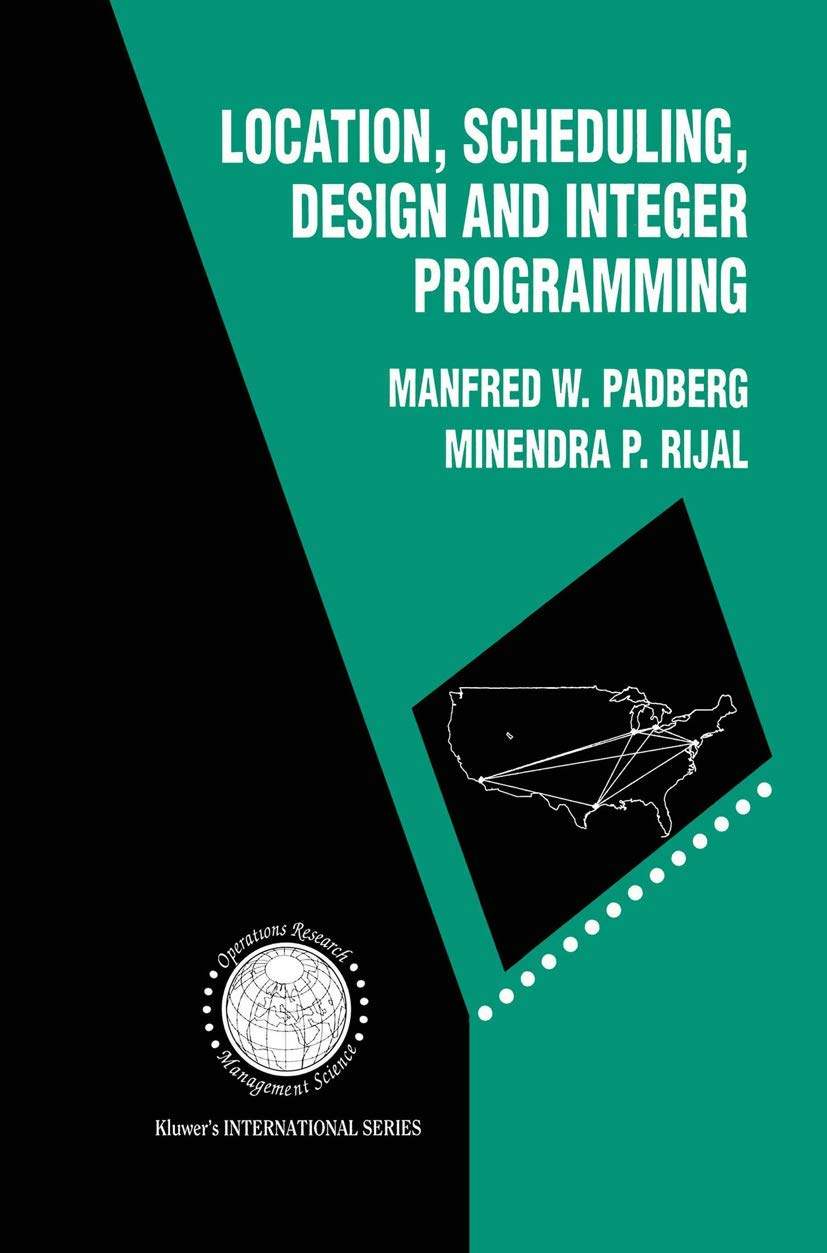
Location, scheduling and design problems are assignment type problems with quadratic cost functions and occur in many contexts stretching from spatial economics via plant and office layout planning to VLSI design and similar prob lems in hightechnology production settings. The presence of nonlinear inter action terms in the objective function makes these, otherwise simple, problems NP hard. In the first two chapters of this monograph we provide a survey of models of this type and give a common framework for them as Boolean quadratic problems with special ordered sets (BQPSs). Special ordered sets associated with these BQPSs are of equal cardinality and either are disjoint as in clique partitioning problems, graph partitioning problems, classroom scheduling problems, operationsscheduling problems, multiprocessor assign ment problems and VLSI circuit layout design problems or have intersections with well defined joins as in asymmetric and symmetric KoopmansBeckmann problems and quadratic assignment problems. Applications of these problems abound in diverse disciplines, such as anthropology, archeology, architecture, chemistry, computer science, economics, electronics, ergonomics, marketing, operations management, political science, statistical physics, zoology, etc. We then give a survey of the traditional solution approaches to BQPSs. It is an unfortunate fact that even after years of investigation into these problems, the state of algorithmic development is nowhere close to solving largescale real life problems exactly. In the main part of this book we follow the polyhedral approach to combinatorial problem solving because of the dramatic algorith mic successes of researchers who have pursued this approach.
⚠️ WARNING (California Proposition 65):
This product may contain chemicals known to the State of California to cause cancer, birth defects, or other reproductive harm.
For more information, please visit www.P65Warnings.ca.gov.