If you have any questions, you are always welcome to contact us. We'll get back to you as soon as possible, withing 24 hours on weekdays.
Customer service
All questions about your order, return and delivery must be sent to our customer service team by e-mail at yourstore@yourdomain.com
Sale & Press
If you are interested in selling our products, need more information about our brand or wish to make a collaboration, please contact us at press@yourdomain.com
Help
If you have any questions, you are always welcome to contact us. We'll get back to you as soon as possible, withing 24 hours on weekdays.
Customer service
All questions about your order, return and delivery must be sent to our customer service team by e-mail at yourstore@yourdomain.com
Sale & Press
If you are interested in selling our products, need more information about our brand or wish to make a collaboration, please contact us at press@yourdomain.com
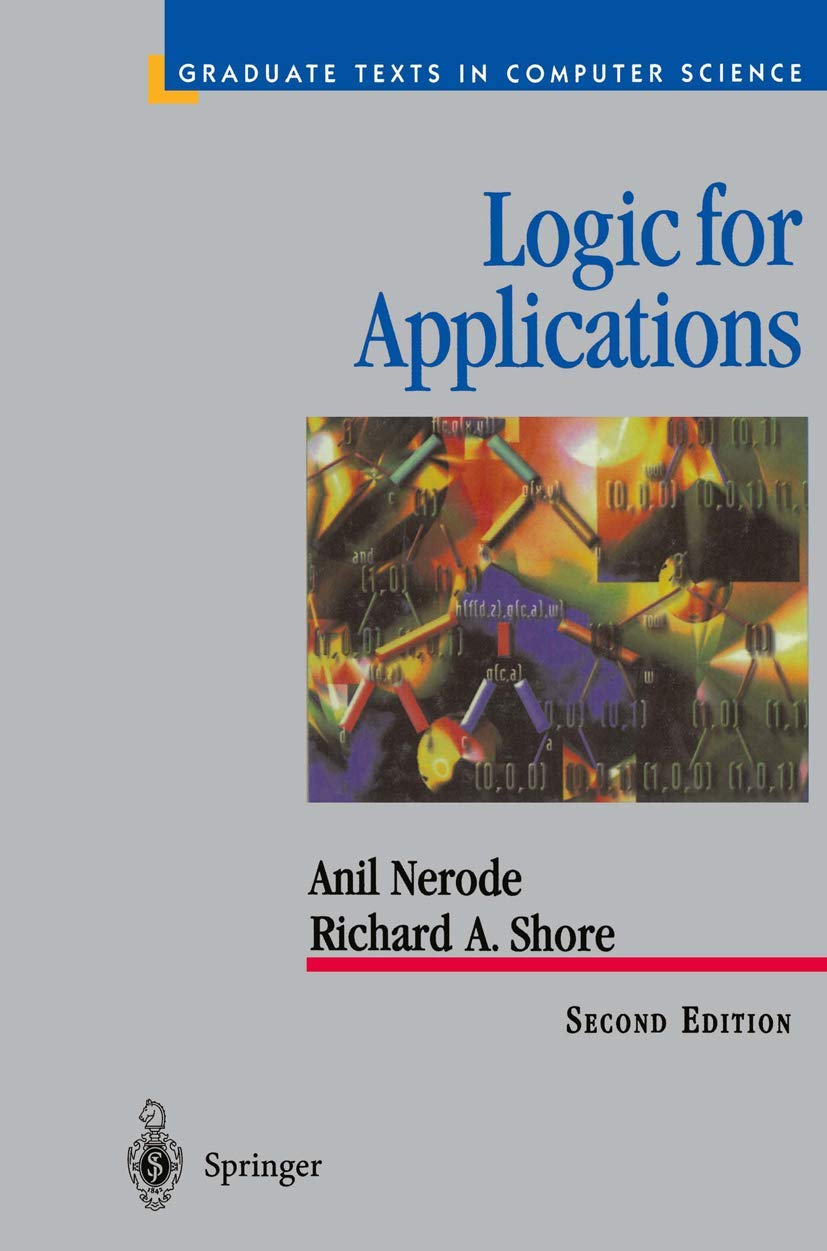
In writing this book, our goal was to produce a text suitable for a first course in mathematical logic more attuned than the traditional textbooks to the re cent dramatic growth in the applications oflogic to computer science. Thus, our choice oftopics has been heavily influenced by such applications. Of course, we cover the basic traditional topics: syntax, semantics, soundnes5, completeness and compactness as well as a few more advanced results such as the theorems of SkolemLowenheim and Herbrand. Much ofour book, however, deals with other less traditional topics. Resolution theorem proving plays a major role in our treatment of logic especially in its application to Logic Programming and PRO LOG. We deal extensively with the mathematical foundations ofall three ofthese subjects. In addition, we include two chapters on nonclassical logics modal and intuitionistic that are becoming increasingly important in computer sci ence. We develop the basic material on the syntax and semantics (via Kripke frames) for each of these logics. In both cases, our approach to formal proofs, soundness and completeness uses modifications of the same tableau method in troduced for classical logic. We indicate how it can easily be adapted to various other special types of modal logics. A number of more advanced topics (includ ing nonmonotonic logic) are also briefly introduced both in the nonclassical logic chapters and in the material on Logic Programming and PROLOG.
⚠️ WARNING (California Proposition 65):
This product may contain chemicals known to the State of California to cause cancer,
birth defects, or other reproductive harm.
For MAP (Minimum Advertised Price) violations and Intellectual Property (IP) or Trademark concerns, please contact:
support@ergodebooks.com
⚠️ California Proposition 65 Warning: Some products sold on this website may expose you to chemicals known to the State of California to cause cancer, birth defects, or other reproductive harm. For more information, visit www.P65Warnings.ca.gov.