If you have any questions, you are always welcome to contact us. We'll get back to you as soon as possible, withing 24 hours on weekdays.
Customer service
All questions about your order, return and delivery must be sent to our customer service team by e-mail at yourstore@yourdomain.com
Sale & Press
If you are interested in selling our products, need more information about our brand or wish to make a collaboration, please contact us at press@yourdomain.com
Help
If you have any questions, you are always welcome to contact us. We'll get back to you as soon as possible, withing 24 hours on weekdays.
Customer service
All questions about your order, return and delivery must be sent to our customer service team by e-mail at yourstore@yourdomain.com
Sale & Press
If you are interested in selling our products, need more information about our brand or wish to make a collaboration, please contact us at press@yourdomain.com
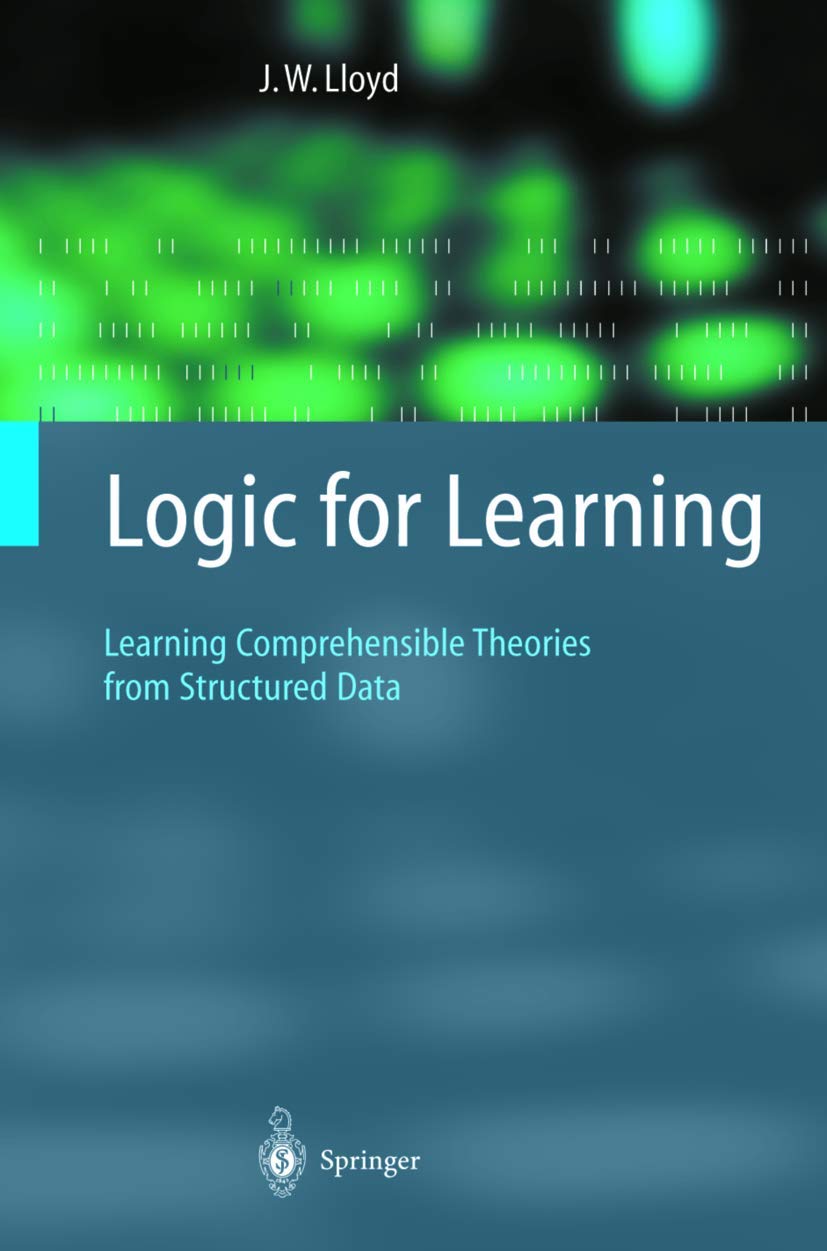
This book is concerned with the rich and fruitful interplay between the fields of computational logic and machine learning. The intended audience is senior undergraduates, graduate students, and researchers in either of those fields. For those in computational logic, no previous knowledge of machine learning is assumed and, for those in machine learning, no previous knowledge of computational logic is assumed. The logic used throughout the book is a higherorder one. Higherorder logic is already heavily used in some parts of computer science, for example, theoretical computer science, functional programming, and hardware verifica tion, mainly because of its great expressive power. Similar motivations apply here as well: higherorder functions can have other functions as arguments and this capability can be exploited to provide abstractions for knowledge representation, methods for constructing predicates, and a foundation for logicbased computation. The book should be of interest to researchers in machine learning, espe cially those who study learning methods for structured data. Machine learn ing applications are becoming increasingly concerned with applications for which the individuals that are the subject of learning have complex struc ture. Typical applications include text learning for the World Wide Web and bioinformatics. Traditional methods for such applications usually involve the extraction of features to reduce the problem to one of attributevalue learning.
⚠️ WARNING (California Proposition 65):
This product may contain chemicals known to the State of California to cause cancer,
birth defects, or other reproductive harm.
For MAP (Minimum Advertised Price) violations and Intellectual Property (IP) or Trademark concerns, please contact:
support@ergodebooks.com
⚠️ California Proposition 65 Warning: Some products sold on this website may expose you to chemicals known to the State of California to cause cancer, birth defects, or other reproductive harm. For more information, visit www.P65Warnings.ca.gov.