If you have any questions, you are always welcome to contact us. We'll get back to you as soon as possible, withing 24 hours on weekdays.
Customer service
All questions about your order, return and delivery must be sent to our customer service team by e-mail at yourstore@yourdomain.com
Sale & Press
If you are interested in selling our products, need more information about our brand or wish to make a collaboration, please contact us at press@yourdomain.com
Help
If you have any questions, you are always welcome to contact us. We'll get back to you as soon as possible, withing 24 hours on weekdays.
Customer service
All questions about your order, return and delivery must be sent to our customer service team by e-mail at yourstore@yourdomain.com
Sale & Press
If you are interested in selling our products, need more information about our brand or wish to make a collaboration, please contact us at press@yourdomain.com
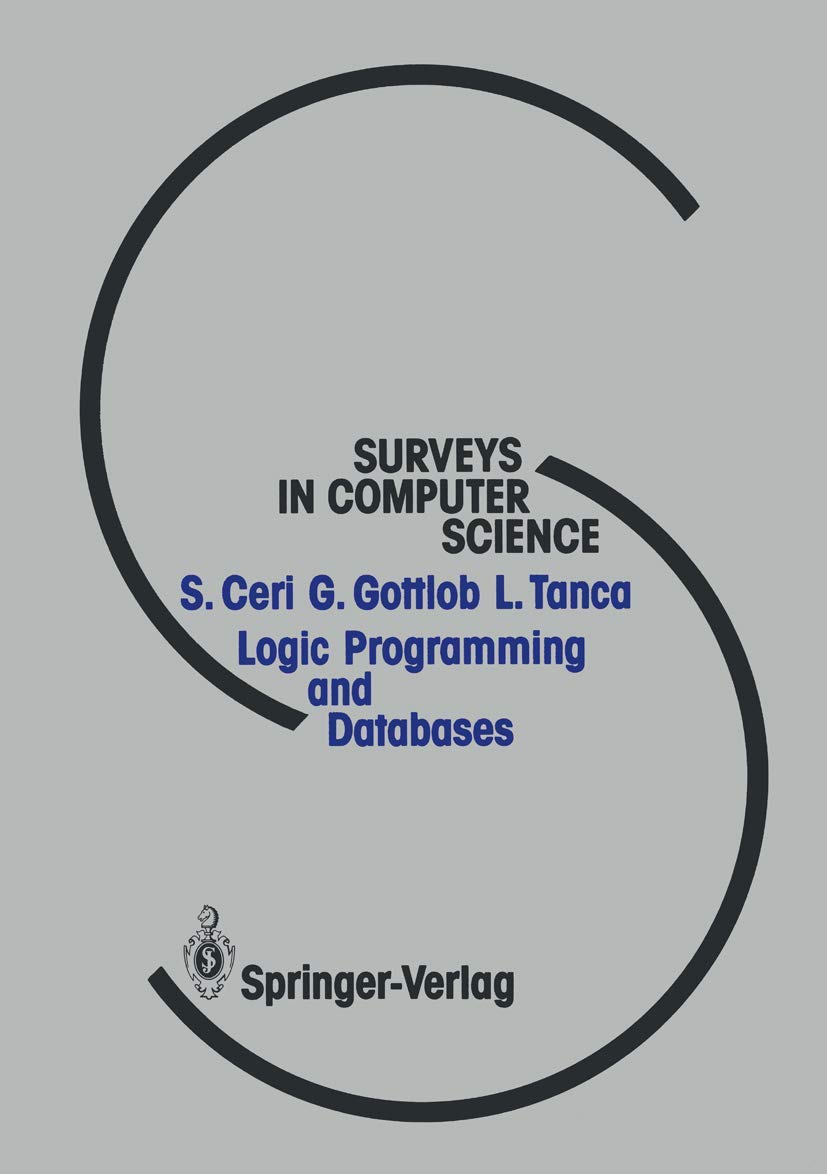
The topic of logic programming and databases. has gained in creasing interest in recent years. Several events have marked the rapid evolution of this field: the selection, by the Japanese Fifth Generation Project, of Prolog and of the relational data model as the basis for the development of new machine archi tectures; the focusing of research in database theory on logic queries and on recursive query processing; and the pragmatic, applicationoriented development of expert database systems and of knowledgebase systems. As a result, an enormous amount of work has been produced in the recent literature, coupled with the spontaneous growth of several advanced projects in this area. The goal of this book is to present a systematic overview of a rapidly evolving discipline, which is presently not described with the same approach in other books. We intend to introduce stu dents and researchers to this new discipline; thus we use a plain, tutorial style, and complement the description of algorithms with examples and exercises. We attempt to achieve a balance be tween theoretical foundations and technological issues; thus we present a careful introduction to the new language Datalog, but we also focus on the efficient interfacing of logic programming formalisms (such as Prolog and Datalog) with large databases.
⚠️ WARNING (California Proposition 65):
This product may contain chemicals known to the State of California to cause cancer,
birth defects, or other reproductive harm.
For MAP (Minimum Advertised Price) violations and Intellectual Property (IP) or Trademark concerns, please contact:
support@ergodebooks.com
⚠️ California Proposition 65 Warning: Some products sold on this website may expose you to chemicals known to the State of California to cause cancer, birth defects, or other reproductive harm. For more information, visit www.P65Warnings.ca.gov.