If you have any questions, you are always welcome to contact us. We'll get back to you as soon as possible, withing 24 hours on weekdays.
Customer service
All questions about your order, return and delivery must be sent to our customer service team by e-mail at yourstore@yourdomain.com
Sale & Press
If you are interested in selling our products, need more information about our brand or wish to make a collaboration, please contact us at press@yourdomain.com
Help
If you have any questions, you are always welcome to contact us. We'll get back to you as soon as possible, withing 24 hours on weekdays.
Customer service
All questions about your order, return and delivery must be sent to our customer service team by e-mail at yourstore@yourdomain.com
Sale & Press
If you are interested in selling our products, need more information about our brand or wish to make a collaboration, please contact us at press@yourdomain.com
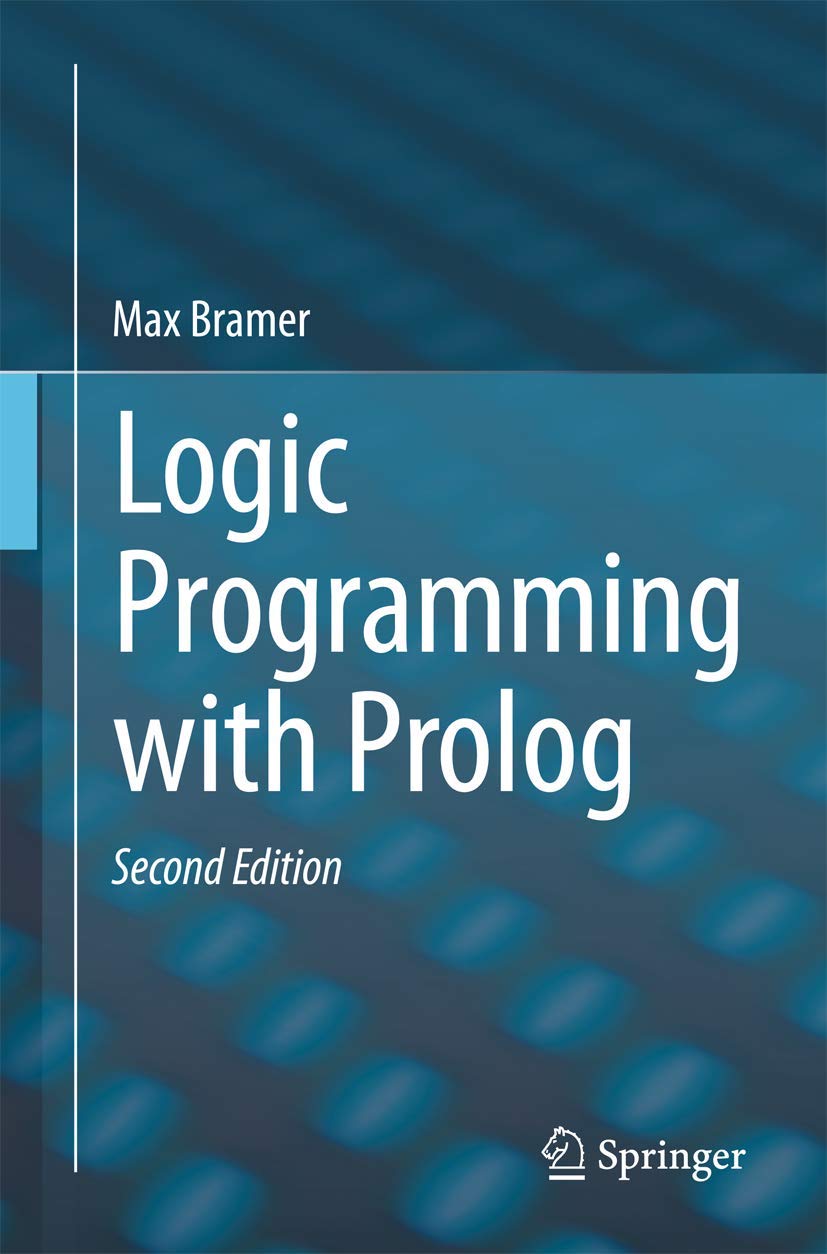
Logic Programming is the name given to a distinctive style of programming, very different from that of conventional programming languages such as C++ and Java. By far the most widely used Logic Programming language is Prolog. Prolog is a good choice for developing complex applications, especially in the field of Artificial Intelligence.Logic Programming with Prolog does not assume that the reader is an experienced programmer or has a background in Mathematics, Logic or Artificial Intelligence. It starts from scratch and aims to arrive at the point where quite powerful programs can be written in the language. It is intended both as a textbook for an introductory course and as a selfstudy book. On completion readers will know enough to use Prolog in their own research or practical projects.Each chapter has selfassessment exercises so that readers may check their own progress. A glossary of the technical terms used completes the book.This second edition has been revised to be fully compatible with SWIProlog, a popular multiplatform public domain implementation of the language. Additional chapters have been added covering the use of Prolog to analyse English sentences and to illustrate how Prolog can be used to implement applications of an 'Artificial Intelligence' kind.Max Bramer is Emeritus Professor of Information Technology at the University of Portsmouth, England. He has taught Prolog to undergraduate computer science students and used Prolog in his own work for many years.
⚠️ WARNING (California Proposition 65):
This product may contain chemicals known to the State of California to cause cancer,
birth defects, or other reproductive harm.
For MAP (Minimum Advertised Price) violations and Intellectual Property (IP) or Trademark concerns, please contact:
support@ergodebooks.com
⚠️ California Proposition 65 Warning: Some products sold on this website may expose you to chemicals known to the State of California to cause cancer, birth defects, or other reproductive harm. For more information, visit www.P65Warnings.ca.gov.