
Title
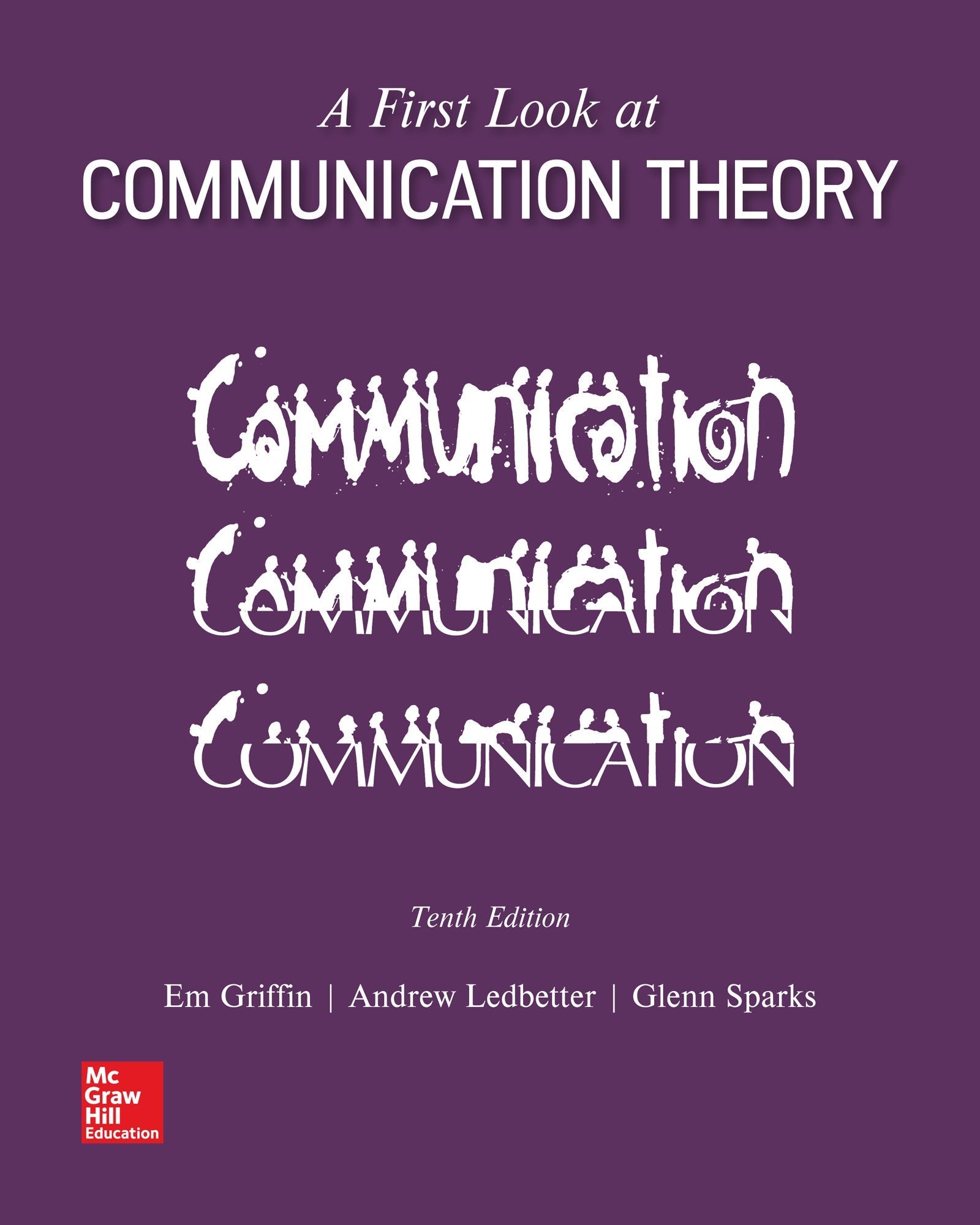
Looseleaf For A First Look At Communication Theory
Sold by Ergodebooks, an authorized reseller.
Returns accepted within 30 days | support@ergodebooks.com
Shipping Information
- Free Standard Shipping — United States only
- Processing Time: 3–5 business days
- Estimated Delivery: 6–10 business days after dispatch
- Double-boxed, fully insured & discreetly packaged
- Tracking number sent via email once dispatched
Returns & Refund
Returns accepted within 30 days of delivery.
Damaged or Defective Item
Free return shipping + replacement or full refund
Wrong Item Received
Free return shipping + replacement or full refund
Change of Mind
Return shipping at customer's expense · 25% restocking fee applies
Payment Option

The Tenth Edition Of A First Look At Communication Theory Justifies Again The Program'S Enduring Popularity. Em Griffin, Now Joined By Colleagues Andrew Ledbetter And Glenn Sparks, Encourages Students Who Are Encountering The Field For The First Time To Tackle Theories Without Fear. The Text'S Conversational Style And Relevant Examples Keep Complex Theories Within The Grasp Of Firsttime Theory Students. The Authors Introduce 32 Diverse Theories That Are A Mix Of Foundational And Recent Scholarship And, With The Benefit Of Numerous Examples And Connections To Pop Culture, Help Students Apply Them To Their Own Lives. The Discrete Presentation Of The Theories Ensures A Wellrounded Understanding Of Each While Promoting Integrative Thinking And Facilitating The Ability Of Instructors To Skip Or Rearrange Their Presentation. The Broad Selection Of Theoriesfrom The Classics To The Cutting Edgeensures That Students Have A Solid Foundation With Which To Begin Understanding The Relationships Between Theories.New To This Edition?Responding To Instructors' Desire To Offer Students More Than One Social Media Theory, A New Chapter Highlights Caroline Hawthornthwaite'S Media Multiplexity Theory.?A New Chapter Features Marc Orbe'S Cocultural Theory, Which Is Based On Extensive Phenomenological Research Among The Lgbtq Community, People With Physical Disabilities, And African American Men. ?The Discussion Of Relational Dialectics Theory Has Been Fully Updated To Center On Baxter'S Second Version Of The Theory, Which Draws Heavily On The Thinking Of Mikhail Bahktin.?Updated Examples Will Appeal To Current Students, Including The Illustration Of Social Judgment Theory With The Issue Of Gun Control Rather Than Airline Safety. ?A Revised Critique Of Social Information Processing Theory Cites Mit Professor Sherry Turkle'S Challenge To Walther'S Basic Claim That Anything We Do Facetoface Can Be Done Just As Well Or Better Online.?Cultural Studies Now Includes Larry Frey'S Appeal For Communicative Activism For Social Justice. This Is The Only Ethical Reflection In The Book Highlighting An Ethicist Currently Active In The Field Of Communication.?Based On Updated Research, The Presentation Of Facenegotiation Theory Has Been Simplified.?Endofchapter Critique Sections Are Sharpened.
⚠️ WARNING (California Proposition 65):
This product may contain chemicals known to the State of California to cause cancer, birth defects, or other reproductive harm.
For more information, please visit www.P65Warnings.ca.gov.
- Q: What is the page count of this book? A: The book contains five hundred sixty pages. This extensive content provides a thorough exploration of communication theories.
- Q: What is the binding type of this book? A: This book is bound in loose leaf format. This allows for flexibility in arranging or removing pages as needed.
- Q: What are the dimensions of this book? A: The dimensions of the book are eight inches in length and ten inches in height. This size is typical for academic texts, making it easy to handle.
- Q: How should I read this book? A: You can read this book at your own pace. It's designed for students new to communication theory, making complex concepts more accessible.
- Q: Is this book suitable for beginners? A: Yes, this book is ideal for beginners. It encourages first-time students to engage with communication theories without feeling overwhelmed.
- Q: What audience is this book intended for? A: This book is aimed at students studying communication theory. It's appropriate for both undergraduate and graduate levels.
- Q: How do I keep this book in good condition? A: To maintain the book, store it in a dry place and avoid bending the pages. Cleaning should be done with a dry cloth to prevent damage.
- Q: Can I write in this book? A: Yes, you can write in this book. The loose leaf format allows for note-taking and highlighting key concepts.
- Q: Is this book safe for all readers? A: Yes, this book is suitable for general readership. It addresses various communication theories without inappropriate content.
- Q: What if my book arrives damaged? A: If your book arrives damaged, you should contact the seller for a return or exchange. Most sellers have policies in place for damaged items.
- Q: Is there a warranty for this book? A: No, books typically do not come with a warranty. However, you can check the seller’s return policy for any guarantees.
- Q: How do I return this book if needed? A: To return the book, follow the seller's return instructions. Usually, this involves packaging it securely and providing a return label.
- Q: What is unique about the theories presented? A: The book introduces thirty-two diverse theories, blending foundational and contemporary scholarship. This variety helps students connect theories to real-life situations.
- Q: Are there updated examples in this edition? A: Yes, this edition includes updated examples relevant to today’s students. Topics like social judgment theory are illustrated using contemporary issues.
- Q: Does this book cover social media theories? A: Yes, it includes a new chapter on media multiplexity theory among other social media theories. This addresses the evolving landscape of communication.
- Q: Is there a focus on ethical communication? A: Yes, there is a focus on ethical communication, particularly through cultural studies. This highlights the importance of communicative activism for social justice.