
Title
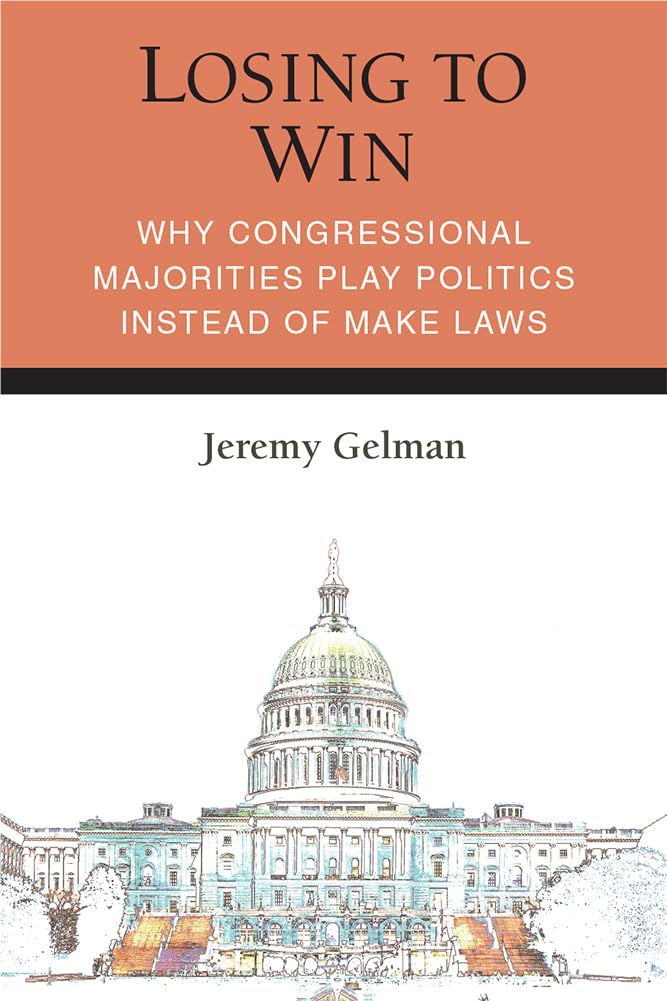
Losing to Win: Why Congressional Majorities Play Politics Instead of Make Laws (Legislative Politics And Policy Making),Used
Sold by Ergodebooks, an authorized reseller.
Returns accepted within 30 days | support@ergodebooks.com
Shipping Information
- Free Standard Shipping — United States only
- Processing Time: 3–5 business days
- Estimated Delivery: 6–10 business days after dispatch
- Double-boxed, fully insured & discreetly packaged
- Tracking number sent via email once dispatched
Returns & Refund
Returns accepted within 30 days of delivery.
Damaged or Defective Item
Free return shipping + replacement or full refund
Wrong Item Received
Free return shipping + replacement or full refund
Change of Mind
Return shipping at customer's expense · 25% restocking fee applies
Payment Option

Most everyone, voters, political scientists, even lawmakers, think Congress is dysfunctional. Instead of solving problems, Democrats and Republicans spend their time playing politics. These days Capitol Hill seems more a place to bicker, not to pass laws. The reality is more complicated. Yes, sometimes Congress is broken. But sometimes it is productive. What explains this variation? Why do Democrats and Republicans choose to legislate or score political points? And why do some issues become so politicized they devolve into partisan warfare, while others remain safe for compromise?Losing to Win answers these questions through a novel theory of agendasetting. Unlike other research that studies bills that become law, Jeremy Gelman begins from the opposite perspective. He studies why majority parties knowingly take up deadonarrival (DOA) bills, the ideas everyone knows are going to lose. In doing so, he argues that congressional parties decisions to play politics instead of compromising, and the topics on which they choose to bicker, are strategic and predictable. Gelman finds that legislative dysfunction arises from a mutually beneficial relationship between a majority party in Congress, which is trying to win unified government, and its allied interest groups, which are trying to enact their policies. He also challenges the conventional wisdom that DOA legislation is political theater. By tracking bills over time, Gelman shows that some former deadonarrival ideas eventually become law. In this way, ideas viewed as too extreme or partisan today can produce longlasting future policy changes.Through his analysis, Gelman provides an original explanation for why both parties pursue the partisan bickering that voters find so frustrating. He moves beyond conventional arguments that our discordant politics are merely the result of political polarization. Instead, he closely examines the specific circumstances that give rise to legislative dysfunction. The result is a fresh, straightforward perspective on the question we have all asked at some point, Why cant Democrats and Republicans stop fighting and just get something done?
⚠️ WARNING (California Proposition 65):
This product may contain chemicals known to the State of California to cause cancer, birth defects, or other reproductive harm.
For more information, please visit www.P65Warnings.ca.gov.