
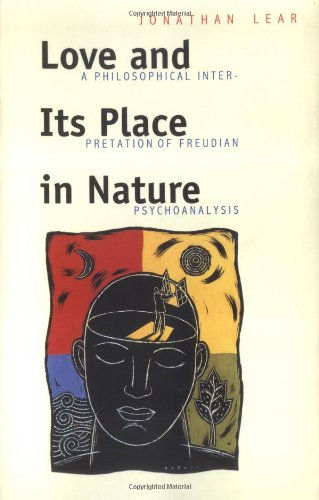
Title
Love and Its Place in Nature: A Philosophical Interpretation of Freudian Psychoanalysis,Used
Sold by Ergodebooks, an authorized reseller.
Returns accepted within 30 days | support@ergodebooks.com
Shipping Information
- Free Standard Shipping — United States only
- Processing Time: 3–5 business days
- Estimated Delivery: 6–10 business days after dispatch
- Double-boxed, fully insured & discreetly packaged
- Tracking number sent via email once dispatched
Returns & Refund
Returns accepted within 30 days of delivery.
Damaged or Defective Item
Free return shipping + replacement or full refund
Wrong Item Received
Free return shipping + replacement or full refund
Change of Mind
Return shipping at customer's expense · 25% restocking fee applies
Payment Option

Jonathan Lear has shown us both Freuds texts and his subject matter from a new angle of vision, one that renders much recent controversy about psychoanalytic theory irrelevant. For any student of those texts this book is indispensable.'Alasdair MacIntyre'Lear makes one understand how psychoanalysis works not only on the therapists couch but also as a condition of being alive. . . . Love and Its Place in Nature not only offers a form of spiritual nutriment for the self, it also defines that self with a clear profundity that few readers will have encountered before.'Christopher LehmannHaupt, New York Times'A brief and engaging philosophical perspective on Freudian psychoanalysis. The book is simply written, but important themes are profoundly investigated. . . . An important philosophic reading of Freud.'Don Browning, Christian CenturyIn this brilliant book, Jonathan Lear argues that Freud posits love as a basic force in nature, one that makes individuationthe condition for psychological health and developmentpossible. Love is active not just in the development of the individual but also in individual analysis and indeed in the development of psychoanalysis itself, says Lear. Expanding on philosophical conceptions of love, nature, and mind, Lear shows that love can cure because it is the force that makes us human.
⚠️ WARNING (California Proposition 65):
This product may contain chemicals known to the State of California to cause cancer, birth defects, or other reproductive harm.
For more information, please visit www.P65Warnings.ca.gov.
- Q: What is the main theme of 'Love and Its Place in Nature'? A: The main theme of the book revolves around Freud's concept of love as a fundamental force in nature that facilitates individuation and psychological health.
- Q: Who is the author of this book? A: The author of 'Love and Its Place in Nature' is Jonathan Lear.
- Q: When was 'Love and Its Place in Nature' published? A: The book was published on February 8, 1999.
- Q: What is the binding type of this book? A: The book is available in paperback binding.
- Q: How many pages does this book have? A: This edition contains 256 pages.
- Q: Is this book suitable for students of psychoanalysis? A: Yes, it is considered indispensable for students of Freud's texts and psychoanalytic theory.
- Q: What makes this book unique compared to other psychoanalytic texts? A: The book offers a philosophical interpretation of Freudian psychoanalysis, providing new insights and perspectives on the subject.
- Q: Does the book discuss the role of love in psychological development? A: Yes, it discusses how love is crucial for individuation and the development of both individuals and psychoanalysis.
- Q: What type of reader would benefit from this book? A: Readers interested in philosophy, psychology, and psychoanalysis will find valuable insights in this book.
- Q: Is there a specific edition of this book? A: Yes, it is a new edition of Jonathan Lear's work on Freudian psychoanalysis.