
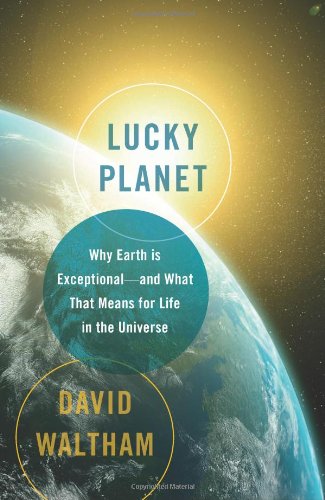
Title
Lucky Planet: Why Earth is Exceptionaland What That Means for Life in the Universe,Used
Sold by Ergodebooks, an authorized reseller.
Returns accepted within 30 days | support@ergodebooks.com
Shipping Information
- Free Standard Shipping — United States only
- Processing Time: 3–5 business days
- Estimated Delivery: 6–10 business days after dispatch
- Double-boxed, fully insured & discreetly packaged
- Tracking number sent via email once dispatched
Returns & Refund
Returns accepted within 30 days of delivery.
Damaged or Defective Item
Free return shipping + replacement or full refund
Wrong Item Received
Free return shipping + replacement or full refund
Change of Mind
Return shipping at customer's expense · 25% restocking fee applies
Payment Option

Humankind has long fantasized about life elsewhere in the universe. And as we discover countless exoplanets orbiting other starsamong them, rocky superEarths and gaseous Hot Jupiterswe become ever more hopeful that we may come across extraterrestrial life. Yet even as we become aware of the vast numbers of planets outside our solar system, it has also become clear that Earth is exceptional. The question is: why?In Lucky Planet, astrobiologist David Waltham argues that Earths climate stability is one of the primary factors that makes it able to support life, and that nothing short of luck made such conditions possible. The fourbillionyear stretch of good weather that our planet has experienced is statistically so unlikely, he shows, that chances are slim that we will ever encounter intelligent extraterrestrial others.Describing the three factors that typically control a planets average temperaturethe heat received from its star, how much heat the planet absorbs, and the concentration of greenhouse gases in the atmosphereWaltham paints a complex picture of how special Earths climate really is. He untangles the mystery of why, although these factors have shifted by such massive measures over the history of life on Earth, surface temperatures have never fluctuated so much as to make conditions hostile to life. Citing factors such as the size of our Moon and the effect of an everwarming Sun, Waltham challenges the prevailing scientific consensus that other Earthlike planets have natural stabilizing mechanisms that allow life to flourish.A lively exploration of the stars above and the ground beneath our feet, Lucky Planet seamlessly weaves the story of Earth and the worlds orbiting other stars to give us a new perspective of the surprising role chance plays in our place in the universe.
⚠️ WARNING (California Proposition 65):
This product may contain chemicals known to the State of California to cause cancer, birth defects, or other reproductive harm.
For more information, please visit www.P65Warnings.ca.gov.
- Q: What is the main topic of 'Lucky Planet'? A: 'Lucky Planet' explores the uniqueness of Earth in relation to potential extraterrestrial life, focusing on how Earth's climate stability contributes to its ability to support life.
- Q: Who is the author of 'Lucky Planet'? A: The author of 'Lucky Planet' is David Waltham, an astrobiologist.
- Q: When was 'Lucky Planet' published? A: 'Lucky Planet' was published on April 8, 2014.
- Q: What is the page count of 'Lucky Planet'? A: 'Lucky Planet' contains 208 pages.
- Q: What type of binding does 'Lucky Planet' have? A: 'Lucky Planet' is available in hardcover binding.
- Q: Is 'Lucky Planet' suitable for someone interested in astronomy? A: Yes, 'Lucky Planet' falls under the category of astronomy and is suitable for readers interested in understanding Earth's unique position in the universe.
- Q: What key factors does David Waltham discuss in 'Lucky Planet'? A: David Waltham discusses three key factors that control a planet's average temperature: the heat received from its star, how much heat the planet absorbs, and the concentration of greenhouse gases in the atmosphere.
- Q: Does 'Lucky Planet' argue that other Earth-like planets can support life? A: 'Lucky Planet' challenges the prevailing consensus that other Earth-like planets have stabilizing mechanisms to support life, emphasizing Earth's unique conditions.
- Q: What themes are explored in 'Lucky Planet'? A: 'Lucky Planet' explores themes of climate stability, the role of chance in the universe, and the comparative analysis of Earth with other planets.
- Q: Is 'Lucky Planet' a scientific or fictional book? A: 'Lucky Planet' is a scientific book that presents astrobiological concepts and theories rather than a work of fiction.