
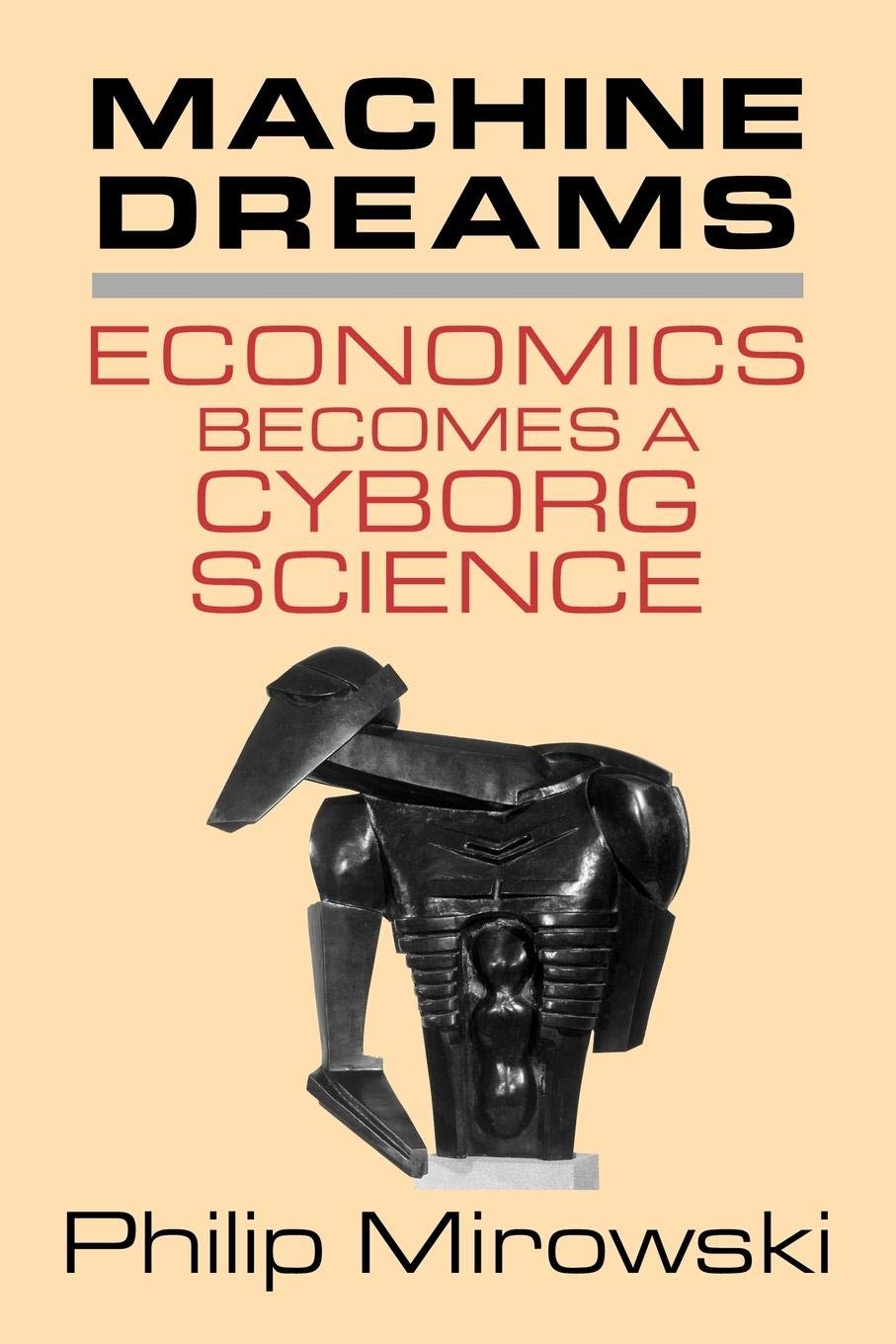
Title
Machine Dreams
Sold by Ergodebooks, an authorized reseller.
Returns accepted within 30 days | support@ergodebooks.com
Shipping Information
- Free Standard Shipping — United States only
- Processing Time: 3–5 business days
- Estimated Delivery: 6–10 business days after dispatch
- Double-boxed, fully insured & discreetly packaged
- Tracking number sent via email once dispatched
Returns & Refund
Returns accepted within 30 days of delivery.
Damaged or Defective Item
Free return shipping + replacement or full refund
Wrong Item Received
Free return shipping + replacement or full refund
Change of Mind
Return shipping at customer's expense · 25% restocking fee applies
Payment Option

This Is The First Crossover Book In The History Of Science Written By An Historian Of Economics, Combining A Number Of Disciplinary And Stylistic Orientations. In It Philip Mirowshki Shows How What Is Conventionally Thought To Be History Of Technology Can Be Integrated With The History Of Economic Ideas. His Analysis Combines Cold War History With The History Of The Postwar Economics Profession In America And Later Elsewhere, Revealing That The Pax Americana Had Much To Do With The Content Of Such Abstruse And Formal Doctrines Such As Linear Programming And Game Theory. He Links The Literature On Cyborg Science Found In Science Studies To Economics, An Element Missing In The Literature To Date. Mirowski Further Calls Into Question The Idea That Economics Has Been Immune To Postmodern Currents Found In The Larger Culture, Arguing That Neoclassical Economics Has Surreptitiously Participated In The Desconstruction Of The Integral Self. Finally, He Argues For A Different Style Of Economics, An Alliance Of Computational And Institutional Themes, And Challenges The Widespread Impression That There Is Nothing Else Besides American Neoclassical Economic Theory Left Standing After The Demise Of Marxism. Philip Mirowski Is Carl Koch Professor Of Economics And The History And Philosophy Of Science, University Of Notre Dame. He Teaches In Both The Economics And Science Studies Communities And Has Written Frequently For Academic Journals. He Is Also The Author Of More Heat Than Light (Cambridge, 1992) And Editor Of Natural Images In Economics (Cambridge, 1994) And Science Bought And Sold (University Of Chicago, 2001).
⚠️ WARNING (California Proposition 65):
This product may contain chemicals known to the State of California to cause cancer, birth defects, or other reproductive harm.
For more information, please visit www.P65Warnings.ca.gov.
- Q: How many pages does 'Machine Dreams' have? A: This book has six hundred seventy-two pages. It provides a comprehensive exploration of economic history and its intersections with technology.
- Q: What are the dimensions of 'Machine Dreams'? A: The dimensions are six inches in length, one point sixty-nine inches in width, and nine point zero two inches in height. These measurements make it a convenient size for reading.
- Q: What type of binding does 'Machine Dreams' have? A: This book is published in paperback binding. This makes it lightweight and easy to handle for extended reading sessions.
- Q: Who is the author of 'Machine Dreams'? A: The author is Philip Mirowski. He is a renowned historian of economics and a professor at the University of Notre Dame.
- Q: What genre does 'Machine Dreams' belong to? A: This book falls under the genre of Economic History. It combines various disciplines to analyze the interplay between technology and economic ideas.
- Q: Is 'Machine Dreams' suitable for all ages? A: Yes, it is suitable for adults and older teens interested in economic theory and history. The content is complex and may not be suitable for younger readers.
- Q: How should I read 'Machine Dreams' for best understanding? A: To fully grasp the concepts, it's helpful to read it in a quiet environment. Consider taking notes on key themes and arguments presented throughout the chapters.
- Q: Can I use 'Machine Dreams' for academic research? A: Yes, it is a valuable resource for academic research. The book offers insights into the history of technology and economic thought, making it suitable for scholarly work.
- Q: How should I care for 'Machine Dreams'? A: To keep it in good condition, store it in a dry place away from direct sunlight. Handle it gently to avoid creasing the pages or damaging the cover.
- Q: Is there a specific way to clean 'Machine Dreams'? A: Yes, you can gently wipe the cover with a soft, dry cloth. Avoid using liquids or cleaning products that could damage the material.
- Q: What should I do if my copy of 'Machine Dreams' arrives damaged? A: If it arrives damaged, contact the seller immediately for return or exchange options. Most sellers have a policy for handling damaged items.
- Q: What are the recommended storage conditions for 'Machine Dreams'? A: Store it upright on a shelf in a cool, dry place. Avoid stacking heavy items on top to prevent bending or crushing.
- Q: How does 'Machine Dreams' compare to other economic history books? A: It offers a unique perspective by integrating technology history with economic ideas, which is less common in other texts. This makes it a distinctive addition to the genre.
- Q: Is 'Machine Dreams' a good choice for someone new to economic history? A: Yes, it's accessible for beginners but also rich in content for seasoned readers. It provides foundational insights as well as advanced discussions.
- Q: Can 'Machine Dreams' help with understanding modern economics? A: Yes, it provides historical context that can enhance understanding of contemporary economic theories and practices. The insights into postmodern influences are particularly relevant.