
Title
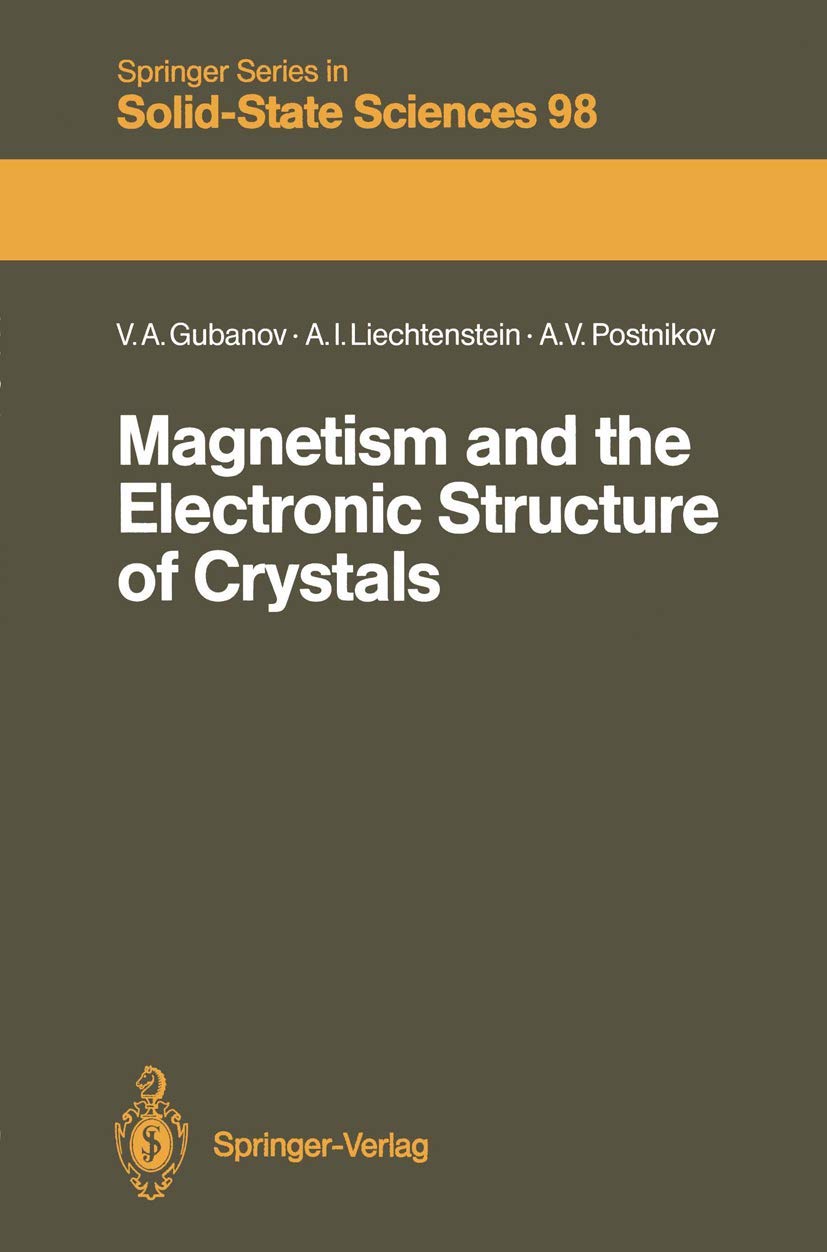
Magnetism and the Electronic Structure of Crystals (Springer Series in SolidState Sciences, 98),Used
Sold by Ergodebooks, an authorized reseller.
Returns accepted within 30 days | support@ergodebooks.com
Shipping Information
- Free Standard Shipping — United States only
- Processing Time: 3–5 business days
- Estimated Delivery: 6–10 business days after dispatch
- Double-boxed, fully insured & discreetly packaged
- Tracking number sent via email once dispatched
Returns & Refund
Returns accepted within 30 days of delivery.
Damaged or Defective Item
Free return shipping + replacement or full refund
Wrong Item Received
Free return shipping + replacement or full refund
Change of Mind
Return shipping at customer's expense · 25% restocking fee applies
Payment Option

The quantum theory of magnetism is a welldeveloped part of contemporary solidstate physics. The basic concepts of this theory can be used to describe such important effects as ferromagnetic ordering oflocalized magnetic moments in crystals and ferromagnetism of metals produced by essentially delocalized electrons, as well as various types of mutual orientation of atomic magnetic moments in solids possessing different crystal lattices and compositions. In recent years,the spinfluctuational approach has been developed, which can overcome some contradictions between "localized" and "itinerant" models in the quantum mechanics of magnetic crystals. These are only some of the principal achievements of quantum magnetic theory. Almost all of the known magnetic properties of solids can be qualitat ively explained on the basis of its concepts. Further developments should open up the possibility of reliable quantitative description of magnetic properties of solids. Unfortunately, such calculations based on model concepts appear to be very complicated and, quite often, not definite enough. The rather small number of parameters of qualitative models are usually not able to take into account the very different types of magnetic interactions that appear in crystals. Further development of magnetic theory requires quantitative information on electronic wave function in the crystal considered. This can be proved by electronic band structure and cluster calculations. In many cases the latter can be a starting point for quantitative calculations of parameters used in magnetic theory.
⚠️ WARNING (California Proposition 65):
This product may contain chemicals known to the State of California to cause cancer, birth defects, or other reproductive harm.
For more information, please visit www.P65Warnings.ca.gov.