
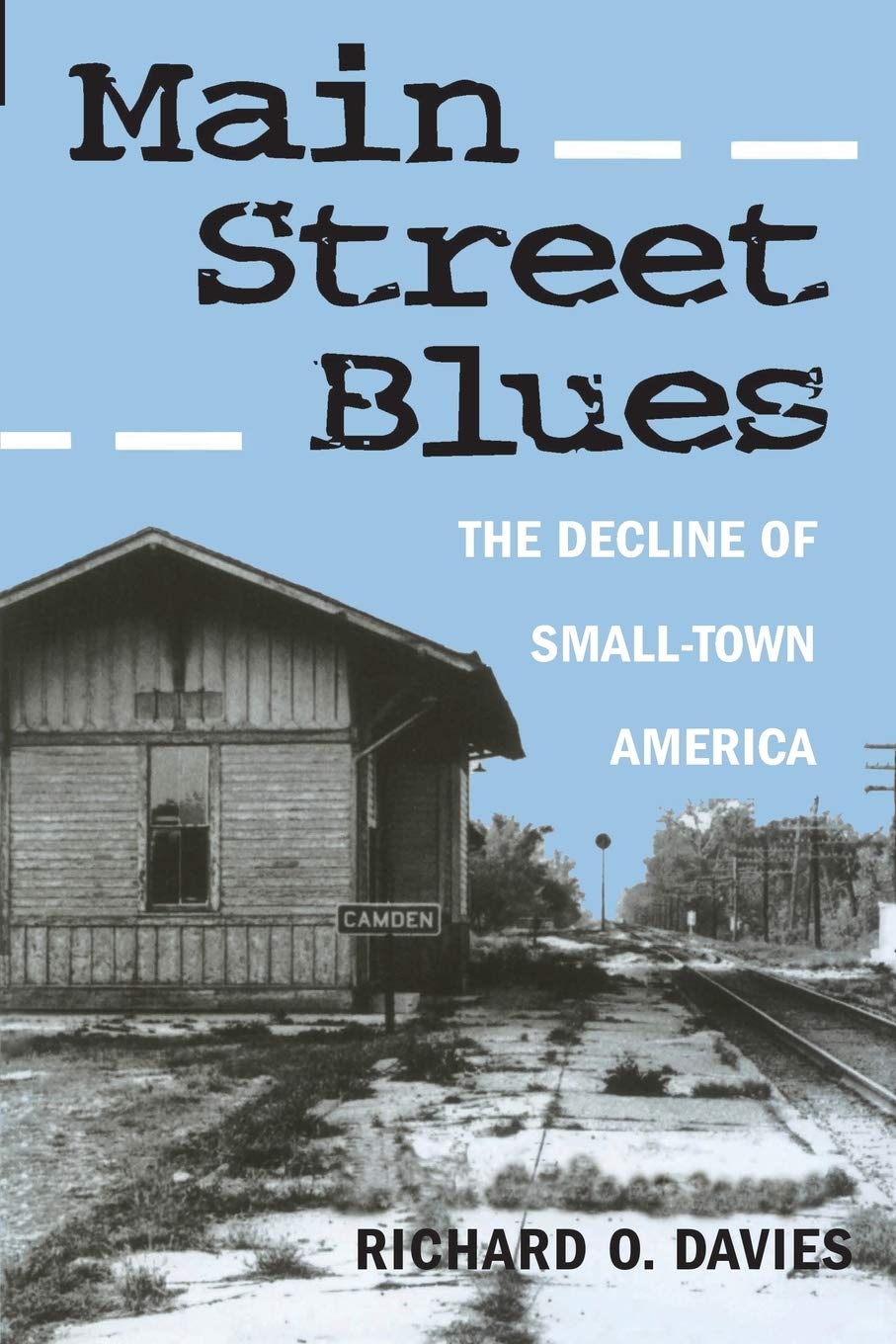
Title
MAIN STREET BLUES: THE DECLINE OF SMALLTOWN AMERICA (URBAN LIFE & URBAN LANDSCAPE),Used
Sold by Ergodebooks, an authorized reseller.
Returns accepted within 30 days | support@ergodebooks.com
Shipping Information
- Free Standard Shipping — United States only
- Processing Time: 3–5 business days
- Estimated Delivery: 6–10 business days after dispatch
- Double-boxed, fully insured & discreetly packaged
- Tracking number sent via email once dispatched
Returns & Refund
Returns accepted within 30 days of delivery.
Damaged or Defective Item
Free return shipping + replacement or full refund
Wrong Item Received
Free return shipping + replacement or full refund
Change of Mind
Return shipping at customer's expense · 25% restocking fee applies
Payment Option

Richard O. Davies takes the reader through two hundred years of American history as reflected in the small Ohio farming village of Camden. Davies describes the development of the relatively selfsufficient community that emerged from the Ohio land rush of the early nineteenth century, a community that reached its apex during the 1920s and then entered into a period of slow decline caused by forces beyond its control. He details the roles of land speculation, the railroad era, the impact of the automobile, the emergence of a tightly knit community, and finally the postWorld War II loss of business and population to the nearby cities of Dayton, Hamilton, and Cincinnati.
⚠️ WARNING (California Proposition 65):
This product may contain chemicals known to the State of California to cause cancer, birth defects, or other reproductive harm.
For more information, please visit www.P65Warnings.ca.gov.
- Q: How many pages does the book have? A: The book contains two hundred fifty-six pages. This length allows for an in-depth exploration of the themes related to the decline of small-town America.
- Q: What is the binding type of this book? A: The binding type is paperback. This makes the book lightweight and easy to handle for reading.
- Q: What are the dimensions of the book? A: The dimensions are six inches in length, zero point seven inches in width, and nine point zero two inches in height. These measurements make it a convenient size for reading and storage.
- Q: Who is the author of the book? A: The author is Richard O. Davies. He brings a historical perspective to the topic of small-town decline in America.
- Q: What genre does this book belong to? A: The book is categorized under State & Local history. It provides insights into American life through the lens of a small Ohio village.
- Q: What is the main topic of the book? A: The book discusses the decline of small-town America, specifically through the history of Camden, Ohio. It covers significant historical events and changes over two hundred years.
- Q: Is this book suitable for young readers? A: Yes, the book is appropriate for young adult readers and above. It provides historical context that may interest high school students studying American history.
- Q: How can I use this book for research? A: You can utilize this book as a resource for understanding the socio-economic changes in small towns. It offers detailed historical narratives that can support various academic projects.
- Q: What age group is this book best suited for? A: The book is best suited for readers aged twelve and up. Its themes and language are appropriate for teenagers and adults.
- Q: How should I care for this paperback book? A: To care for this paperback book, keep it in a dry place away from direct sunlight. This will help preserve its condition over time.
- Q: Can I store the book on a bookshelf? A: Yes, you can store the book on a bookshelf. Its dimensions allow for easy placement among other standard-sized books.
- Q: What if my book arrives damaged? A: If your book arrives damaged, you should contact the seller for a return or exchange. Most retailers have policies in place for such situations.
- Q: What is the return policy for this book? A: The return policy typically allows returns within thirty days of purchase. Make sure to check the specific retailer's policy for details.
- Q: Does the book have any special features? A: The book is a used copy but is in good condition. It provides a historical narrative without any additional features like illustrations or maps.
- Q: Is this book a reliable source for learning about small-town history? A: Yes, this book is a reliable source as it is written by a knowledgeable author who examines historical events in detail.
- Q: What themes are explored in this book? A: The book explores themes such as community development, economic decline, and the impact of transportation changes on small towns. It provides a comprehensive look at these historical issues.