If you have any questions, you are always welcome to contact us. We'll get back to you as soon as possible, withing 24 hours on weekdays.
Customer service
All questions about your order, return and delivery must be sent to our customer service team by e-mail at yourstore@yourdomain.com
Sale & Press
If you are interested in selling our products, need more information about our brand or wish to make a collaboration, please contact us at press@yourdomain.com
Help
If you have any questions, you are always welcome to contact us. We'll get back to you as soon as possible, withing 24 hours on weekdays.
Customer service
All questions about your order, return and delivery must be sent to our customer service team by e-mail at yourstore@yourdomain.com
Sale & Press
If you are interested in selling our products, need more information about our brand or wish to make a collaboration, please contact us at press@yourdomain.com
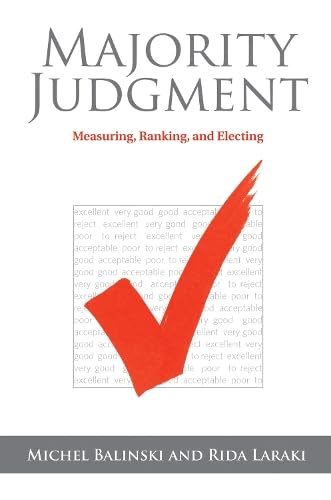
An account of a new theory and method of voting, judging and ranking, majority judgment, shown to be superior to all other known methods.In Majority Judgment, Michel Balinski and Rida Laraki argue that the traditional theory of social choice offers no acceptable solution to the problems of how to elect, to judge, or to rank. They find that the traditional modeltransforming the preference lists of individuals into a preference list of societyis fundamentally flawed in both theory and practice. Balinski and Laraki propose a more realistic model. It leads to an entirely new theory and methodmajority judgmentproven superior to all known methods. It is at once meaningful, resists strategic manipulation, elicits honesty, and is not subject to the classical paradoxes encountered in practice, notably Condorcet's and Arrow's. They offer theoretical, practical, and experimental evidencefrom national elections to figure skating competitionsto support their arguments. Drawing on insights from wine, sports, music, and other competitions, Balinski and Laraki argue that the question should not be how to transform many individual rankings into a single collective ranking, but rather, after defining a common language of grades to measure merit, how to transform the many individual evaluations of each competitor into a single collective evaluation of all competitors. The crux of the matter is a new model in which the traditional paradigmto compareis replaced by a new paradigmto evaluate.
⚠️ WARNING (California Proposition 65):
This product may contain chemicals known to the State of California to cause cancer,
birth defects, or other reproductive harm.
For MAP (Minimum Advertised Price) violations and Intellectual Property (IP) or Trademark concerns, please contact:
support@ergodebooks.com
⚠️ California Proposition 65 Warning: Some products sold on this website may expose you to chemicals known to the State of California to cause cancer, birth defects, or other reproductive harm. For more information, visit www.P65Warnings.ca.gov.