
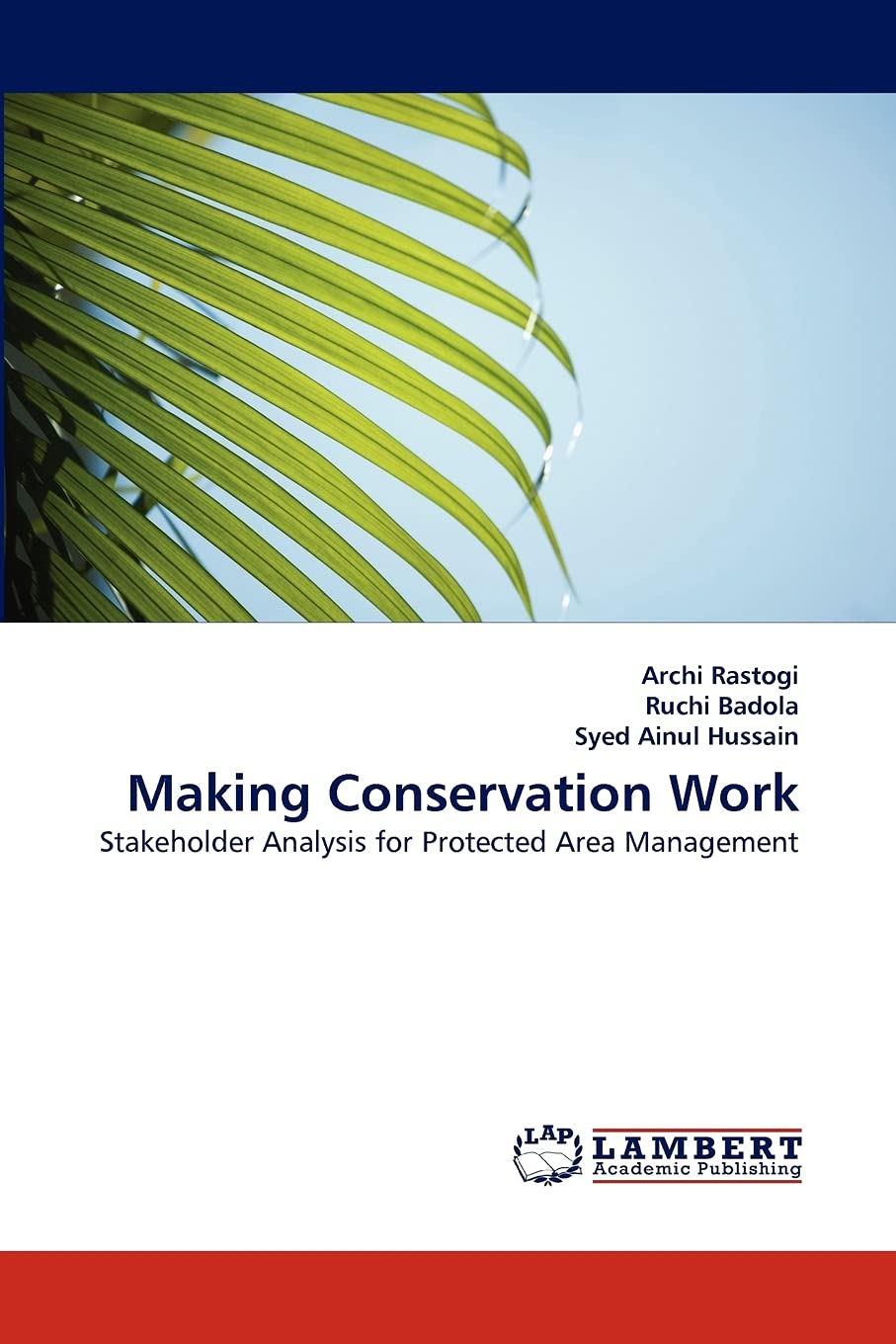
Title
Making Conservation Work: Stakeholder Analysis for Protected Area Management,Used
Sold by Ergodebooks, an authorized reseller.
Returns accepted within 30 days | support@ergodebooks.com
Shipping Information
- Free Standard Shipping — United States only
- Processing Time: 3–5 business days
- Estimated Delivery: 6–10 business days after dispatch
- Double-boxed, fully insured & discreetly packaged
- Tracking number sent via email once dispatched
Returns & Refund
Returns accepted within 30 days of delivery.
Damaged or Defective Item
Free return shipping + replacement or full refund
Wrong Item Received
Free return shipping + replacement or full refund
Change of Mind
Return shipping at customer's expense · 25% restocking fee applies
Payment Option

The subject of this book was conceived when India's ?tiger crisis' was brewing in 2005. The country had just discovered that the tiger had become locally extinct from a premier Protected Area. The large public and media coverage led to formation of a Tiger Task Force, which pointed out that India's tiger conservation schemes had been lacking in collecting support from local communities. If a conservation scheme antagonizes local people, there is very little chance for success. With this background, we set out to test the utility of a new methodology. Conservation needed methods that could be employed on ground without having to wait for large scale policy change. And our method provides us that opportunity. Through this publication, we hope to bring the scientific community a little closer to answering pertinent questions about balancing stakeholder aspirations, natural justice, and prudence of environmental management. We hope that this work will contribute to societal discourse on incorporating local expectations in management of sensitive ecosystems, and would be useful to Protected Area managers, academicians and NGOs and all those working on natural resources management.
⚠️ WARNING (California Proposition 65):
This product may contain chemicals known to the State of California to cause cancer, birth defects, or other reproductive harm.
For more information, please visit www.P65Warnings.ca.gov.