
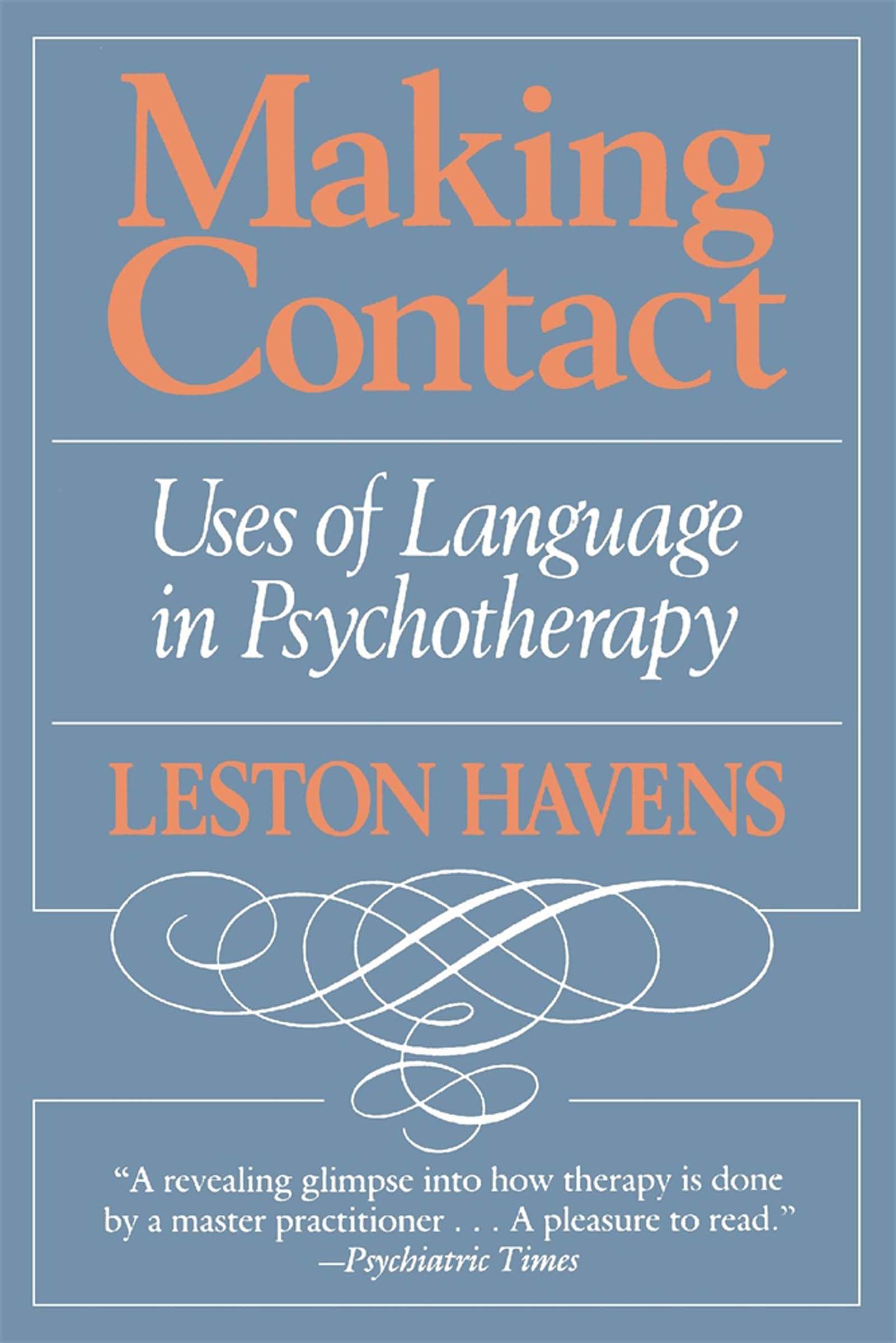
Title
Making Contact: Uses Of Language In Psychotherapy,New
Sold by Ergodebooks, an authorized reseller.
Returns accepted within 30 days | support@ergodebooks.com
Shipping Information
- Free Standard Shipping — United States only
- Processing Time: 3–5 business days
- Estimated Delivery: 6–10 business days after dispatch
- Double-boxed, fully insured & discreetly packaged
- Tracking number sent via email once dispatched
Returns & Refund
Returns accepted within 30 days of delivery.
Damaged or Defective Item
Free return shipping + replacement or full refund
Wrong Item Received
Free return shipping + replacement or full refund
Change of Mind
Return shipping at customer's expense · 25% restocking fee applies
Payment Option

Since 1955, Moving From Early Work In Psychopharmacology To Studies Of Clinical Method And The Psychiatric Schools, Leston Havens Has Been Working Toward A General Theory Of Therapy. It Often Seems That Twentiethcentury Psychiatry, Sectridden, Is A Tower Of Babel, As Havens Once Characterized It. This Book Is The Distillation Of Long Years Of Thought And Practice, A Bold Yet Modest Attempt To Delineate An Integrated Psychotherapy.The Boldness Of This Effort Lies In Its Authors Willingness To Recognize The Best That Each School Has To Offer, To Describe It Cogently, And To Integrate It Into A Full Response To Todays New Kind Of Patient. Descriptive Or Medical Psychiatry, Psychoanalysis, Interpersonal Or Behavioristic Psychiatry, Empathic Or Existential Therapyviewed In Metaphors, Respectively, Of Perceiving, Thinking, Managing, Feelingall Have Useful Contributions To Make To Contemporary Methods Of Treatment. But How? Havenss Modest Answer Is Through Appropriate Language, And He Demonstrates Exactly What He Means: When To Ask Questions, When To Direct Or Draw Back, When To Sympathize.Practitioners Now Must Deal With Less Dramatic, But More Stubborn, Problems Of Character And Situation; Lack Of Purpose, Isolation, Submissiveness, Invasiveness, Deep Yet Vague Dissatisfaction. Some Kind Of Human Presence Must Be Discovered In The Patient, And Havens Gives Concrete, Absorbing Examples Of Ways Of Speaking To Absence, Of Making Contact. The Emphasis Is On Verbal Technique, But The Underlying Broad, Humane Intent Is Everywhere Evident. It Is No Less Than To Transform Passivity, By Means Of Disciplined Therapeutic Concern, Into A State Of Being Human.
⚠️ WARNING (California Proposition 65):
This product may contain chemicals known to the State of California to cause cancer, birth defects, or other reproductive harm.
For more information, please visit www.P65Warnings.ca.gov.
- Q: How many pages does the book have? A: This book has two hundred sixteen pages. It's a comprehensive read on psychotherapy and language use.
- Q: What is the binding type of the book? A: The book is published in paperback binding. This makes it lightweight and easy to handle.
- Q: What are the dimensions of the book? A: The book measures six inches in length, zero point five five inches in width, and nine point zero two inches in height. These dimensions make it portable and easy to store.
- Q: Who is the author of this book? A: The author is Leston Havens, a notable figure in psychotherapy. His extensive experience enriches the content of the book.
- Q: What category does this book belong to? A: This book is categorized under Psychoanalysis. It provides insights into language use in therapeutic settings.
- Q: How does this book apply to modern psychotherapy? A: This book discusses integrating various schools of thought in therapy. It emphasizes the importance of language in addressing patient needs.
- Q: Is this book suitable for beginners in psychotherapy? A: Yes, the book is suitable for beginners. It provides foundational concepts alongside practical examples of therapy techniques.
- Q: Can this book be useful for advanced practitioners? A: Yes, advanced practitioners can find valuable insights. It offers a unique perspective on integrating different therapeutic approaches.
- Q: What therapeutic schools are discussed in the book? A: The book discusses various therapeutic schools, including psychoanalysis, behaviorism, and existential therapy. Each is analyzed for its contributions.
- Q: How should I care for this book? A: To care for the book, keep it in a dry place and avoid direct sunlight. This will help preserve its condition over time.
- Q: Is the book covered under any warranty? A: Books typically do not have a warranty. However, check return policies for any issues upon receipt.
- Q: What should I do if the book is damaged upon arrival? A: If the book arrives damaged, you should contact the seller for a return or exchange. Most retailers have policies in place for such situations.
- Q: How can I enhance my understanding of the book's content? A: Reading supplementary materials on psychotherapy can enhance understanding. Engaging in discussions with peers can also provide deeper insights.
- Q: Does this book include examples of therapy sessions? A: Yes, the book includes concrete examples of therapy sessions. These examples illustrate practical applications of the discussed techniques.
- Q: Is this book appropriate for academic study? A: Yes, the book is appropriate for academic study in psychology or counseling courses. It offers a scholarly perspective on language in therapy.
- Q: What is the main theme of the book? A: The main theme is the use of language in psychotherapy. It explores how effective communication can facilitate therapeutic processes.