
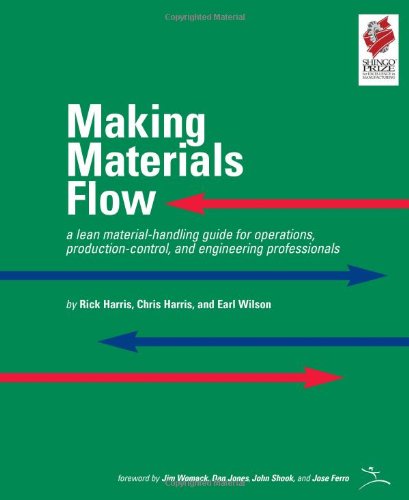
Title
Making Materials Flow: A Lean MaterialHandling Guide for Operations, ProductionControl, and Engineering Professionals,Used
Sold by Ergodebooks, an authorized reseller.
Returns accepted within 30 days | support@ergodebooks.com
Shipping Information
- Free Standard Shipping — United States only
- Processing Time: 3–5 business days
- Estimated Delivery: 6–10 business days after dispatch
- Double-boxed, fully insured & discreetly packaged
- Tracking number sent via email once dispatched
Returns & Refund
Returns accepted within 30 days of delivery.
Damaged or Defective Item
Free return shipping + replacement or full refund
Wrong Item Received
Free return shipping + replacement or full refund
Change of Mind
Return shipping at customer's expense · 25% restocking fee applies
Payment Option

Making Materials Flow describes in plain language another step in implementing a complete lean business system.LEI's first workbook, Learning to See, focused on where to start at the value stream for each product family within your facilities.Seeing the Whole then expanded the value stream map beyond facility walls, all the way from raw materials to customer.After mapping has identified waste and potential applications of flow and pull, you can use the techniques in Creating Continuous Flow to implement truly continuous flow in cellularized operations.Making Materials Flow takes the next step by explaining how to supply purchased parts to the value stream in order to support continuous flow.'Companies are making progress in creating areas of continuous flow as more managers learn about valuestream mapping and continuousflow cells,' said coauthor Rick Harris, who also coauthored the Creating Continuous Flow workbook. 'But as I walk through facilities and examine earnest efforts to create continuous flow, I see how hard it is to sustain steady output. The problem often is the lack of a lean materialhandling system for purchased parts to support continuousflow cells, smallbatch processing, and traditional assembly lines.'Making Materials Flow explains in plain language how to create such a system by applying the relevant concepts and methods in a stepbystep progression. The workbook reveals the exercises, formulas, standards, and forms that a consultant would use to implement the system in your environment. And, like LEI's other workbooks, Making Materials Flow answers the key question managers often have about lean tools and concepts, 'What do I do on Monday morning to implement this?' The four key steps detailed in the workbook include:1. Developing the Plan For Every Part (PFEP). This basic database fosters accurate and controlled inventory reduction and is the foundation for the continuous improvement of a facility's materialhandling system.2. Building the purchasedparts market. Learn the formulas and methods to size and operate a market that eliminates the waste of hoarding, searching for parts, and storing inventory throughout a facility.3. Designing delivery routes. You get the principles and calculations that turn a sprawling, messy plant into an organized community where operators get the parts they need, when needed, and in the quantity needed, delivered right to their fingertips. Proper delivery routes not only improve inventory and flow but also safety and housekeeping.4. Implementing pull signals to integrate the new materialhandling system with the information management system. Learn the steps to creating a system that keeps inventory under control by allowing operators to pull just what they need while focusing on producing value for customers. You'll also learn how to calculate the number of pull signals needed and how often to deliver material.Finally, you'll learn how to sustain and continuously improving the system by implementing periodic audits of the materialhandling system across the chain of management, from route operator to plant manager. You'll learn the fivestep process for introducing audits of the market, routes, and pull signals by a crossfunctional team from production control, operations, and industrial engineering.Harris and coauthors Chris Harris and Earl Wilson lead you through 10 simple but pragmatic questions that show how a manufacturing facility implements a robust but flexible lean materialhandling system for purchased parts:The Plan For Every Part (PFEP)1. What information should you include in the PFEP?2. How will you maintain the integrity of the PFEP?Developing a PurchasedParts Market3. Where do you locate your purchasedparts market?4. What is the correct size for your purchasedparts market, and what is the correct amount of each part to hold in the market?5. How do you operate your purchasedparts market?Designing the Delivery Route and the Information Management System6. How do you convey parts from the purchasedparts market to the production areas?7. How do your production areas signal the purchasedparts market what to deliver and when?8. How do you fill the delivery route?Sustaining and Improving9. How can you sustain the performance of your lean materialhandling system?10. How can you identify and remove additional waste?An appendix explores how to adapt the key principles of lean materialhandling to more complex environments, such as incorporating workinprocess (WIP) markets into the system for purchased parts, adding delivery routes from production cells to a finishedgoods market, and applying the system to lowvolume, highmix processes.Making Materials Flow will benefit lean leaders, managers, and executives in production control, operations, and engineering who have at least a basic knowledge of lean concepts such as valuestream mapping, cell design, and standard work. The 93page workbook contains
⚠️ WARNING (California Proposition 65):
This product may contain chemicals known to the State of California to cause cancer, birth defects, or other reproductive harm.
For more information, please visit www.P65Warnings.ca.gov.