
Title
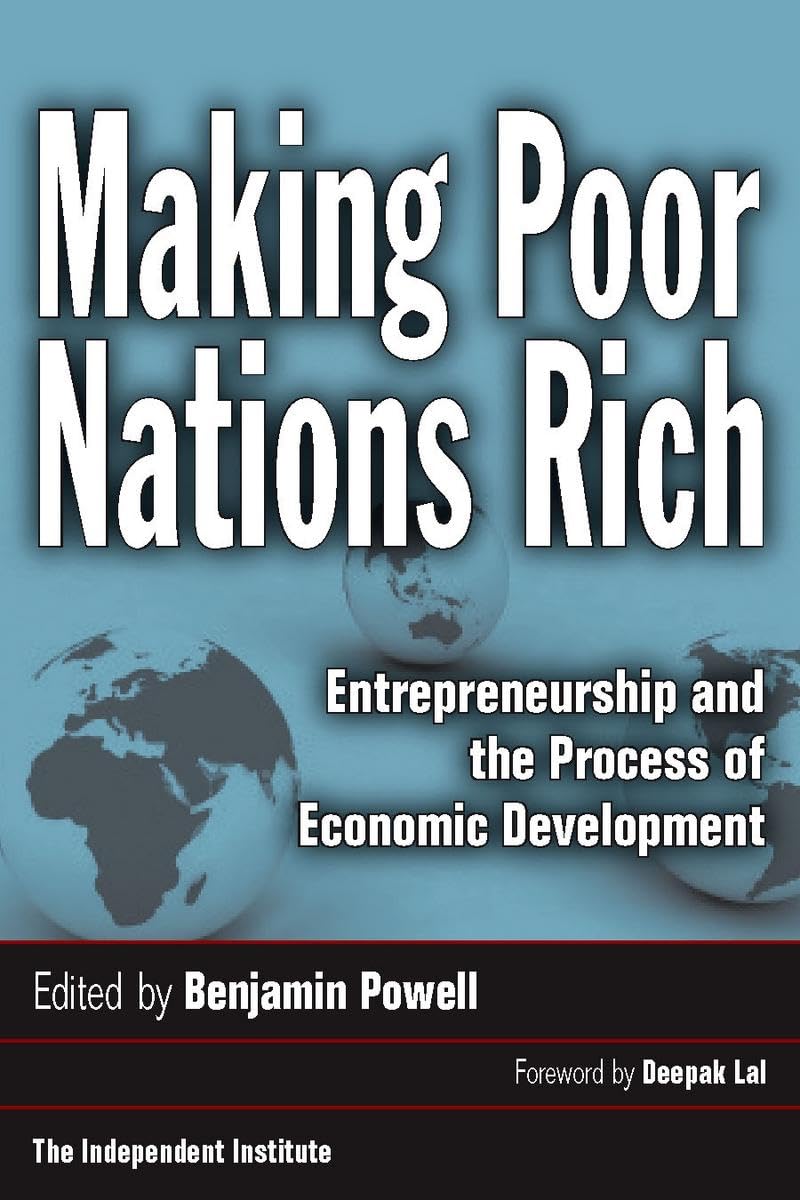
Making Poor Nations Rich: Entrepreneurship And The Process Of Economic Development (Independent Institute Series),Used
Sold by Ergodebooks, an authorized reseller.
Returns accepted within 30 days | support@ergodebooks.com
Shipping Information
- Free Standard Shipping — United States only
- Processing Time: 3–5 business days
- Estimated Delivery: 6–10 business days after dispatch
- Double-boxed, fully insured & discreetly packaged
- Tracking number sent via email once dispatched
Returns & Refund
Returns accepted within 30 days of delivery.
Damaged or Defective Item
Free return shipping + replacement or full refund
Wrong Item Received
Free return shipping + replacement or full refund
Change of Mind
Return shipping at customer's expense · 25% restocking fee applies
Payment Option

Product DescriptionWhy do some nations become rich while others remain poor? Traditional mainstream economic growth theory has done little to answer this questionduring most of the twentieth century the theory focused on models that assumed growth was a simple function of labor, capital, and technology. Through a collection of case studies from Asia and Africa to Latin America and Europe, Making Poor Nations Rich argues for examining the critical role entrepreneurs and the institutional environment of private property rights and economic freedom play in economic development. Making Poor Nations Rich begins by explaining how entrepreneurs create economic growth and why some institutional environments encourage more productive entrepreneurship than others. The volume then addresses countries and regions that have failed to develop because of barriers to entrepreneurship. Finally, the authors turn to countries that have developed by reforming their institutional environment to protect private property rights and grant greater levels of economic freedom. The overall lesson from this volume is clear: promarket reforms are essential to promoting the productive entrepreneurship that leads to economic growth. In countries where this institutional environment is lacking, sustained economic development will remain illusive.Review'The book concludes with encouraging success stories from nations in Asia (China, India), Europe (Ireland), and even Africa (Botswana), whose economic achievement illustrates Powell's belief that encouraging smallbusiness entrepreneurs is the best way to achieve and maintain general affluence... The writing here is vivid and intelligent. Futurists will be particularly interested in the essays by James A. Dorn on China's key achievements and remaining economic needs, as well as the assessment of India's prospects for attaining world prominence in trade and culture by Parth J. Shah and Renuka Sane.' The Futurist'Making Poor Nations Rich is a serious attempt to further develop the theory of entrepreneurship. Fourteen chapters of the book cover the most important issues of our time: wealth and poverty of nations, the role of entrepreneurship in economic and human development, economic performance of transitional economies with the stories of both winners and losers.' Yuri Maltsev Carthage College'This book is a bold quarterback sneak directly into a line of argument in economic development studies that has long been ignored, trivialized or considered impossible to measure. It emphasizes the critical role of entrepreneurship vigorously undertaken in a friendly institutional setting, moving from theoretical analyses to individual and national case studies in countries and regions worldwide.' William Ratliff, Hoover Institution Stanford University'While previous literature on entrepreneurship focused on how to construct new government programs to promote entrepreneurship, this book turns that theory on its head. This book shows how policies that limit government's scope of action are necessary to promote entrepreneurship. It is a refreshing change, and much more in line with the new and upcoming theories in this area than any previous works on state entrepreneurship policy.' Russell S. Sobel West Virginia UniversityAbout the AuthorBenjamin Powell is Director of the Center on Entrepreneurial Innovation at the Independent Institute and Assistant Professor of Economics at San Jose State University.
⚠️ WARNING (California Proposition 65):
This product may contain chemicals known to the State of California to cause cancer, birth defects, or other reproductive harm.
For more information, please visit www.P65Warnings.ca.gov.