
Title
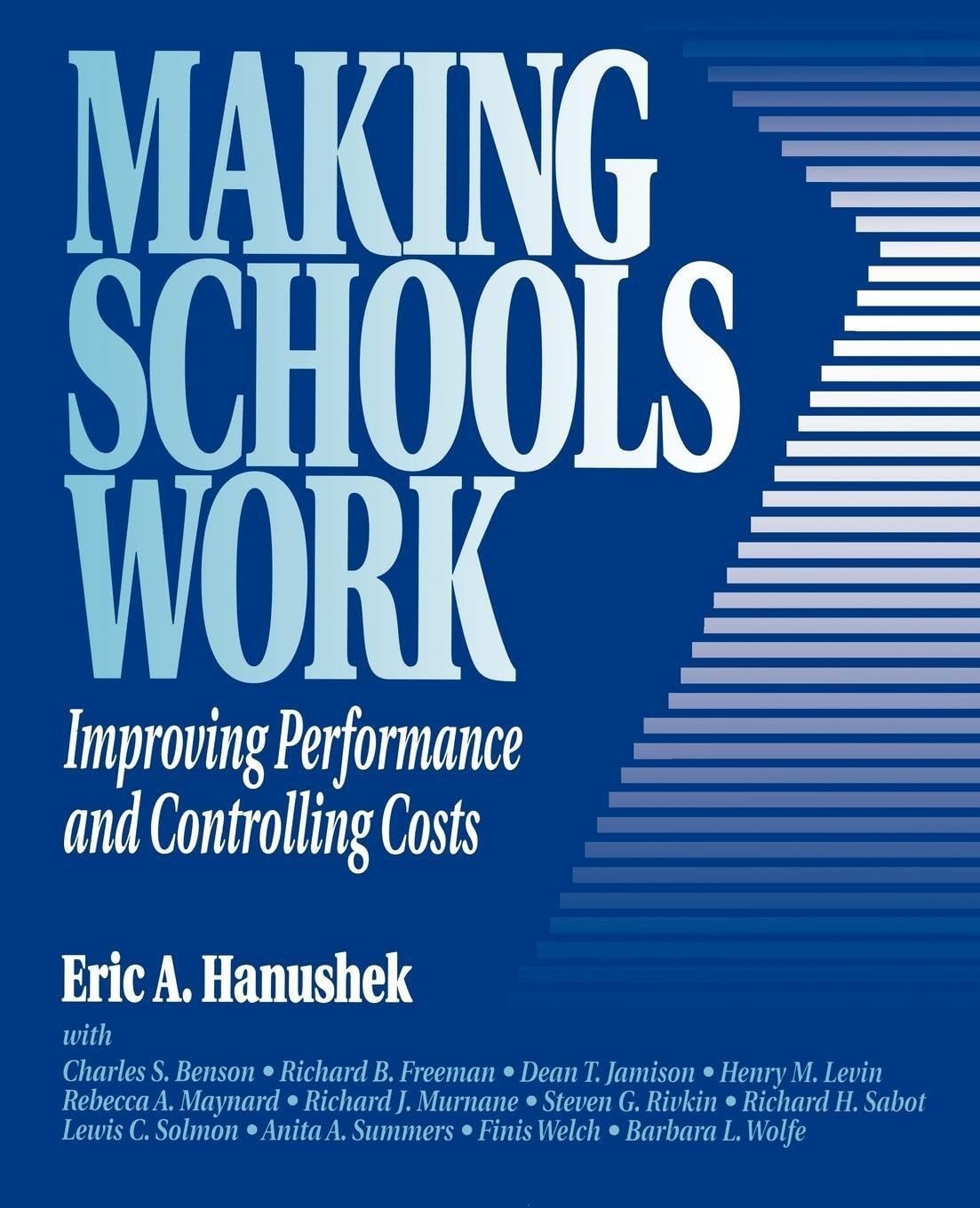
Making Schools Work: Improving Performance And Controlling Costs,Used
Sold by Ergodebooks, an authorized reseller.
Returns accepted within 30 days | support@ergodebooks.com
Shipping Information
- Free Standard Shipping — United States only
- Processing Time: 3–5 business days
- Estimated Delivery: 6–10 business days after dispatch
- Double-boxed, fully insured & discreetly packaged
- Tracking number sent via email once dispatched
Returns & Refund
Returns accepted within 30 days of delivery.
Damaged or Defective Item
Free return shipping + replacement or full refund
Wrong Item Received
Free return shipping + replacement or full refund
Change of Mind
Return shipping at customer's expense · 25% restocking fee applies
Payment Option

Educational reform is a big business in the United States. Parents, educators, and policymakers generally agree that something must be done to improve schools, but the consensus ends there. The myriad of reform documents and policy discussions that have appeared over the past decade have not helped to pinpoint exactly what should be done.The case for investment in education is an economic one: schooling improves the productivity and earnings of individuals and promotes stronger economic growth and better functioning of society. Recent trends in schooling have, however, lessened the value of society's investments as costs have risen dramatically while student performance has stayed flat or even fallen. The task is to improve performance while controlling costs.This book is the culmination of extensive discussions among a panel of economists led by Eric Hanushek. They conclude that economic considerations have been entirely absent from the development of educational policies and that economic reality is sorely needed in discussions of new policies. The book outlines an improvement plan that emphasizes changing incentives in schools and gathering information about effective approaches. Available research and analysis demonstrates that current central decisionmaking has worked poorly. Concentrating on inputs such as pupilteacher ratios or teacher graduate degrees appears quite inferior to systems that directly reward performance. Nonetheless, since experience with such alternatives is very limited, a program of extensive evaluation appears to be in order.Attempts to institute radical change on the basis of currently available information involve substantial risks of failure. Many people today find proposals such as charter schools, expanded use of merit pay, or educational vouchers to be appealing. Yet there is little evidence of their effectiveness, and widespread adoption of these proposals is sure to run into substantial problems of implementation. Instead of choosing the ''right'' approach, this book advocates a more systematic approach of experimentation, evaluation, and change.In addition to Hanushek, the contributors are Charles S. Benson, University of California, Berkeley; Richard B. Freeman, Harvard University; Dean T. Jamison, UCLA: Henry M. Levin, Stanford University; Rebecca A. Maynard, University of Pennsylvania; Richard J. Murnane, Harvard University; Steven G. Rivkin, Amherst College; Richard H. Sabot, Williams College; Lewis C. Solmon, Milken Institute for Job and Capital Formation; Anita A. Summers, University of Pennsylvania; Finis Welch, Texas A&M University; and Barbara L. Wolfe, University of Wisconsin.'
⚠️ WARNING (California Proposition 65):
This product may contain chemicals known to the State of California to cause cancer, birth defects, or other reproductive harm.
For more information, please visit www.P65Warnings.ca.gov.