
Title
Making the Implicit Explicit,Used
Sold by Ergodebooks, an authorized reseller.
Returns accepted within 30 days | support@ergodebooks.com
Shipping Information
- Free Standard Shipping — United States only
- Processing Time: 3–5 business days
- Estimated Delivery: 6–10 business days after dispatch
- Double-boxed, fully insured & discreetly packaged
- Tracking number sent via email once dispatched
Returns & Refund
Returns accepted within 30 days of delivery.
Damaged or Defective Item
Free return shipping + replacement or full refund
Wrong Item Received
Free return shipping + replacement or full refund
Change of Mind
Return shipping at customer's expense · 25% restocking fee applies
Payment Option

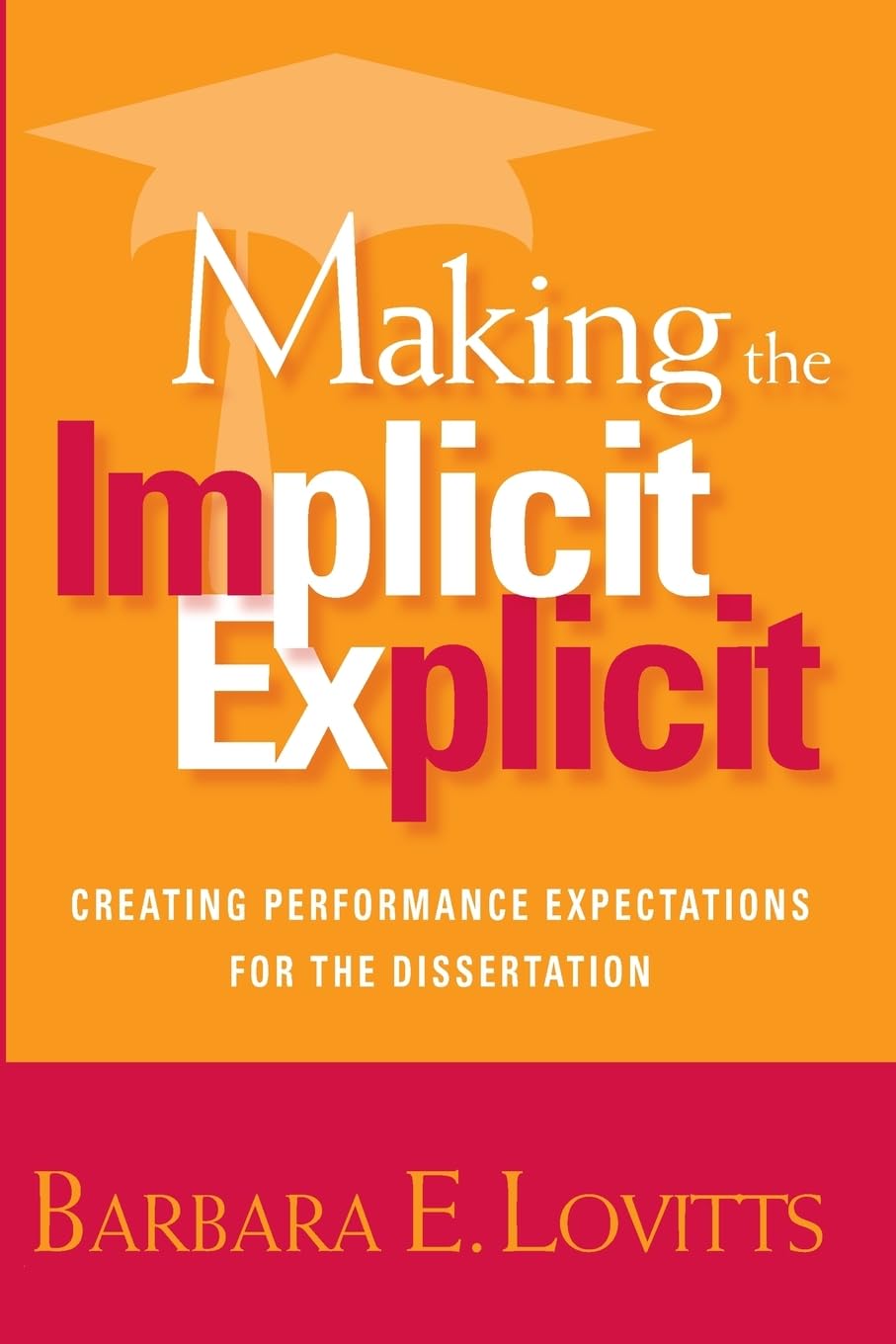
Despite their and other stakeholders consistent demand for excellence, doctoral programs have rarely, if ever, been assessed in terms of the quality of the dissertations departments produce. Yet dissertations provide the most powerful, objective measure of the success of a departments doctoral program. Indeed, assessment, when done properly, can help departments achieve excellence by providing insight into a programs strengths and weaknesses.This book and the groundbreaking study on which it is based is about making explicit to doctoral students the tacit rules for the assessment of the final of all final educational productsthe dissertation. The purpose of defining performance expectations is to make them more transparent to graduate students while they are in the researching and writing phases, and thus to help them achieve to higher levels of accomplishment. Lovitts proposes the use of rubrics to clarify performance expectationsnot to rate dissertations or individual components of dissertations to provide a summary score, but to facilitate formative assessment to support, not substitute for, the advising process. She provides the results of a study in which over 270 faculty from ten major disciplinesspanning the sciences, social sciences, and humanitieswere asked to make explicit their implicit standards or criteria for evaluating dissertations. The book concludes with a summary of the practical and research implications for different stakeholders: faculty, departments, universities, disciplinary associations, accrediting organizations, and doctoral students themselves.The methods described can easily be adapted for the formative assessment of capstone courses, senior and masters theses, comprehensive exams, papers, and journal articles.
⚠️ WARNING (California Proposition 65):
This product may contain chemicals known to the State of California to cause cancer, birth defects, or other reproductive harm.
For more information, please visit www.P65Warnings.ca.gov.