
Title
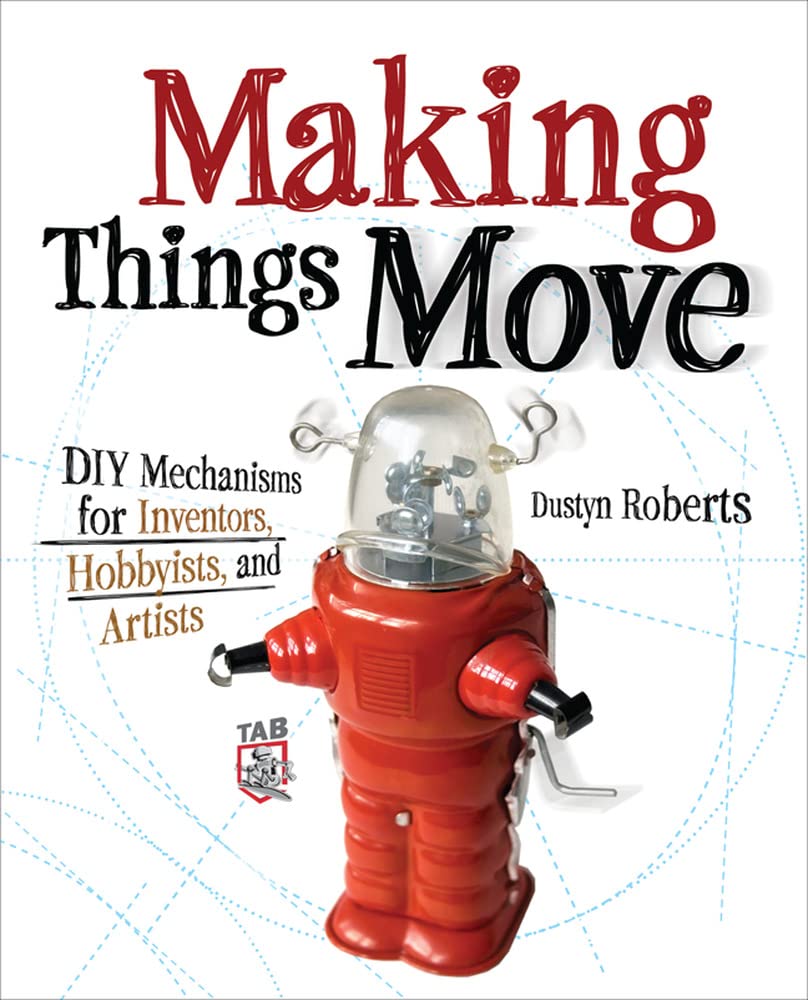
Making Things Move DIY Mechanisms for Inventors, Hobbyists, and Artists,Used
Sold by Ergodebooks, an authorized reseller.
Returns accepted within 30 days | support@ergodebooks.com
Shipping Information
- Free Standard Shipping — United States only
- Processing Time: 3–5 business days
- Estimated Delivery: 6–10 business days after dispatch
- Double-boxed, fully insured & discreetly packaged
- Tracking number sent via email once dispatched
Returns & Refund
Returns accepted within 30 days of delivery.
Damaged or Defective Item
Free return shipping + replacement or full refund
Wrong Item Received
Free return shipping + replacement or full refund
Change of Mind
Return shipping at customer's expense · 25% restocking fee applies
Payment Option

A unique guide to practical mechanical design principles and their applicationsIn Making Things Move, you'll learn how to build moving mechanisms through nontechnical explanations, examples, and doityourself projectsfrom art installations to toys to laborsaving devices. The projects include a drawing machine, a mini wind turbine, a mousetrap powered car, and more, but the applications of the examples are limited only by your imagination. A breadth of topics is covered ranging from how to attach couplers and shafts to a motor, to converting between rotary and linear motion.Each chapter features photographs, drawings, and screenshots of the components and systems involved. Emphasis is placed on using offtheshelf components whenever possible, and most projects also use readily available metals, plastics, wood, and cardboard, as well as accessible fabrication techniques such as laser cutting. Small projects in each chapter are designed to engage you in applying the material in the chapter at hand. Later in the book, more involved projects incorporate material from several chapters.Making Things Move:Focuses on practical applications and results, not abstract engineering theories Contains more than a dozen topicfocused projects and three largescale projects incorporating lessons from the whole book Features shopping lists and guides to offtheshelf components for the projects Incorporates discussions of new fabrication techniques such as laser cutting and 3D printing, and how you can gain access Includes online component for continuing education with the book's companion website and blog (makingthingsmove.com) Handson coverage of moving mechanismsIntroduction to Mechanisms and Machines; Materials and Where to Find Them; Screwed or Glued? On Fastening and Joining Parts; Forces, Friction and Torque (Oh My); Mechanical and Electrical Power, Work, and Energy; Eeny, Meeny, Miny, Motor? Creating and Controlling Motion; The Guts: Bearings, Bushings. Couplers, and Gears; Rotary vs. Linear Motion; Automatons and Mechanical Toys; Making Things and Getting Them Made; Projects
⚠️ WARNING (California Proposition 65):
This product may contain chemicals known to the State of California to cause cancer, birth defects, or other reproductive harm.
For more information, please visit www.P65Warnings.ca.gov.
- Q: What is the main focus of the book 'Making Things Move'? A: The book focuses on practical mechanical design principles and their applications for inventors, hobbyists, and artists, emphasizing hands-on projects and real-world results.
- Q: What types of projects are included in this book? A: The book includes various projects such as a drawing machine, a mini wind turbine, a mousetrap powered car, and other moving mechanisms that can be applied to art installations, toys, and labor-saving devices.
- Q: Is prior technical knowledge required to understand the book? A: No, the book provides non-technical explanations, making it accessible for readers without a background in engineering.
- Q: How many pages does 'Making Things Move' have? A: The book has a total of 368 pages.
- Q: What materials are recommended for the projects in the book? A: The projects utilize readily available materials such as metals, plastics, wood, and cardboard, along with off-the-shelf components.
- Q: What topics does the book cover? A: The book covers a range of topics including mechanisms and machines, fastening techniques, forces and torque, controlling motion, and creating automatons.
- Q: Is there any online resource associated with this book? A: Yes, the book includes a companion website and blog where readers can find additional resources and continuing education.
- Q: What is the publication date of 'Making Things Move'? A: The book was published on December 8, 2010.
- Q: Who is the author of the book? A: The book is authored by Dustyn Roberts.
- Q: What binding style does the book have? A: The book is available in paperback binding.