
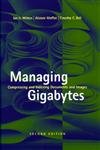
Title
Managing Gigabytes: Compressing and Indexing Documents and Images (The Morgan Kaufmann Series in Multimedia Information and Syst,Used
Sold by Ergodebooks, an authorized reseller.
Returns accepted within 30 days | support@ergodebooks.com
Shipping Information
- Free Standard Shipping — United States only
- Processing Time: 3–5 business days
- Estimated Delivery: 6–10 business days after dispatch
- Double-boxed, fully insured & discreetly packaged
- Tracking number sent via email once dispatched
Returns & Refund
Returns accepted within 30 days of delivery.
Damaged or Defective Item
Free return shipping + replacement or full refund
Wrong Item Received
Free return shipping + replacement or full refund
Change of Mind
Return shipping at customer's expense · 25% restocking fee applies
Payment Option

In this fully updated second edition of the highly acclaimed Managing Gigabytes, authors Witten, Moffat, and Bell continue to provide unparalleled coverage of stateoftheart techniques for compressing and indexing data. Whatever your field, if you work with large quantities of information, this book is essential readingan authoritative theoretical resource and a practical guide to meeting the toughest storage and access challenges. It covers the latest developments in compression and indexing and their application on the Web and in digital libraries. It also details dozens of powerful techniques supported by mg, the authors' own system for compressing, storing, and retrieving text, images, and textual images. mg's source code is freely available on the Web. Uptodate coverage of new text compression algorithms such as block sorting, approximate arithmetic coding, and fat Huffman coding New sections on contentbased index compression and distributed querying, with 2 new data structures for fast indexing New coverage of image coding, including descriptions of de facto standards in use on the Web (GIF and PNG), information on CALIC, the new proposed JPEG Lossless standard, and JBIG2 New information on the Internet and WWW, digital libraries, web search engines, and agentbased retrieval Accompanied by a public domain system called MG which is a fully workedout operational example of the advanced techniques developed and explained in the book New appendix on an existing digital library system that uses the MG software
⚠️ WARNING (California Proposition 65):
This product may contain chemicals known to the State of California to cause cancer, birth defects, or other reproductive harm.
For more information, please visit www.P65Warnings.ca.gov.
- Q: What is the main focus of 'Managing Gigabytes'? A: The book primarily focuses on state-of-the-art techniques for compressing and indexing data, making it essential for anyone working with large quantities of information.
- Q: Who are the authors of this book? A: The authors of 'Managing Gigabytes' are Ian H. Witten, Alistair Moffat, and Timothy C. Bell.
- Q: What is the publication date of the second edition? A: The second edition was published on May 17, 1999.
- Q: How many pages does the book contain? A: The book contains a total of 560 pages.
- Q: What type of binding does this book have? A: This book is available in hardcover binding.
- Q: Are there any new topics covered in the second edition? A: Yes, the second edition includes new sections on content-based index compression, distributed querying, and updates on image coding standards.
- Q: Is there any software included with the book? A: Yes, the book is accompanied by a public domain system called MG, which serves as a practical example of the advanced techniques discussed.
- Q: What condition is the book in? A: The book is listed as 'New' condition.
- Q: Does the book cover modern algorithms? A: Yes, it covers the latest developments in text compression algorithms such as block sorting and approximate arithmetic coding.
- Q: Is this book suitable for beginners in data compression? A: While it provides authoritative theoretical resources, it is best suited for individuals who have some background in the field of data compression and indexing.